
OOBThaiAmulets
Por Sala Tan
Por Sala Tan
Couldn't load pickup availability
Summary
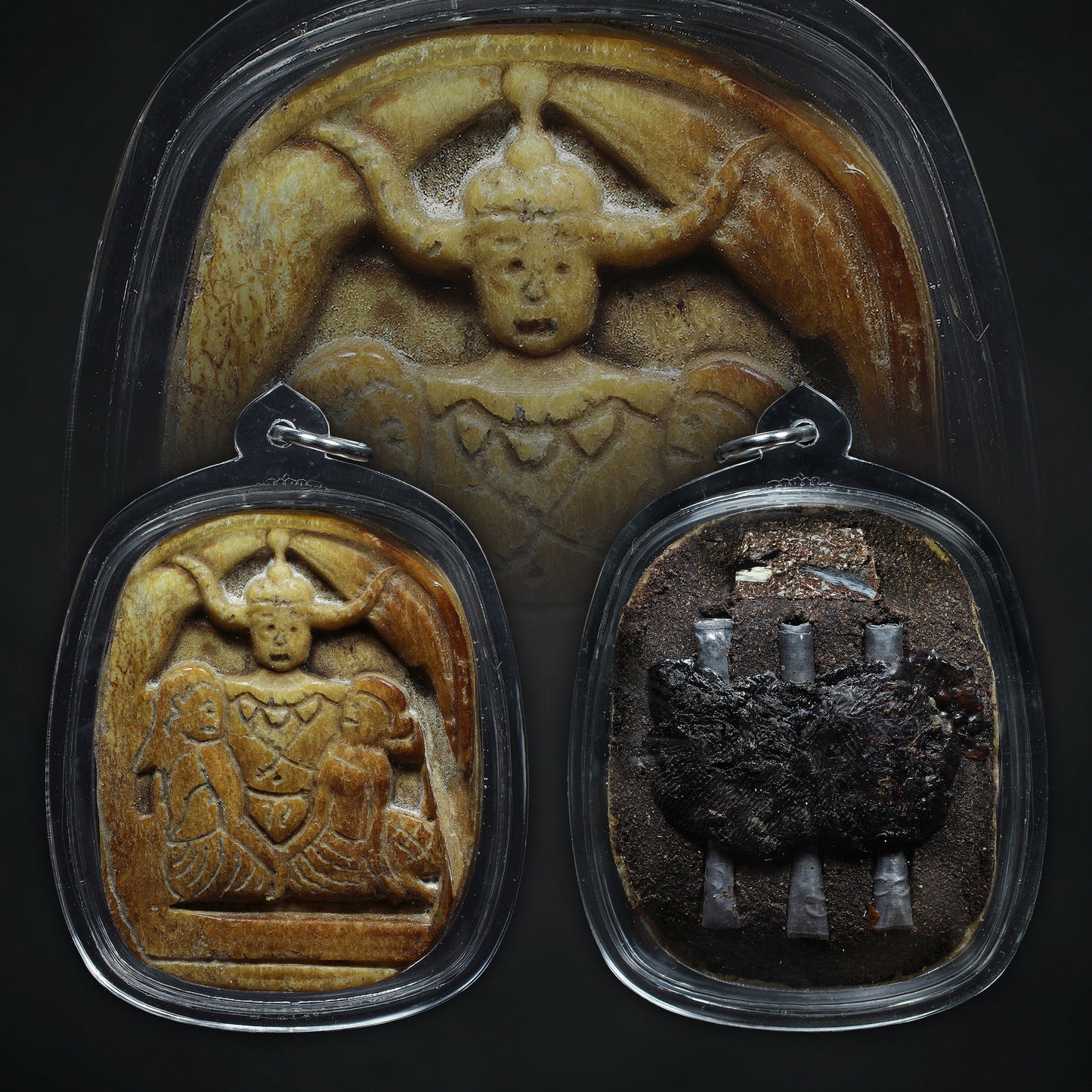
This Payakaokam amulet is a rare ritual relic connected to a Lersi who practiced Paya Kao Kam wiccha, a highly uncommon branch associated with the Indra-incarnate current. Consecrated and carved by Por Sala Tan from the Lersi’s own relic material, the piece is oriented toward wish fulfillment, supported by strong secondary fields of wealth and metta–seneh. Among Payakaokam works, this example is weighted decisively toward wish granting due to direct lineage transmission rather than symbolic invocation.
Historical Background
Por Sala Tan frequently undertook long periods of cave seclusion, a discipline comparable to intensive training for spiritual practitioners. These caves were also meeting points for advanced wiccha holders, including Lersi from various traditions.
Most Lersi specialize in more commonly encountered paths such as fire-based or medicinal lineages. In this case, the Lersi practiced Paya Kao Kam wiccha, a rare discipline linked to the Indra current rather than standard forest or elemental lines.
At the moment this Lersi attained final liberation, Por Sala Tan was present. He observed a clear energetic release in which the Lersi’s cultivated essence merged with the Payakaokam current and exited the realm. In accordance with Buddhist understanding, the physical body was regarded only as a vessel; the remaining relic matter still retained structured energy suitable for ritual use.
Origins of the Material
Following liberation rites conducted with assisting disciples, selected relic material from the Lersi was harvested. A hip relic was chosen for carving due to its stability and containment qualities. Additional fragments, including a paneang chip from the Lersi, were reserved for internal insertion.
Ritual Process
Por Sala Tan personally carved the Payakaokam image, depicting the central deity flanked by two attendant angels. The form was selected to preserve doctrinal accuracy rather than aesthetic embellishment.
The reverse was filled with:
-
Cave soil collected from the seclusion site
-
A paneang fragment from the Lersi, acting as a direct lineage anchor
The ritual focus emphasized continuity of function rather than amplification, allowing the inherited essence to operate without distortion.
Blessings and Effects
Paya Kao Kam is traditionally associated with three domains:
-
Wealth
-
Metta and seneh
-
Wish granting
In this specific piece, wish fulfillment is dominant due to the Lersi’s transmitted essence. During the Lersi’s lifetime, individuals who sought blessings—particularly for business outcomes or lottery-related wishes—reported consistent results after engaging with him through ritual means.
The attraction and wealth aspects remain present but operate in support of the primary function rather than independently.
Modern Application
This amulet is suited for individuals seeking structured progress rather than sudden, unsupported outcomes. In traditional understanding, wish granting operates through alignment and action rather than passive expectation. The amulet supports intention, decision-making, and opportunity—but requires personal effort to complete the causal chain.
Physical Details
-
Size: approximately 2.5–3 inches
-
Material: carved relic bone with ritual fillings
-
Configuration: Payakaokam with two angels, rear-sealed
Recommended Pairing
Pairs effectively with baramee-generating amulets such as Somdej or Phra Kring.
No additional attraction-based items are required, as metta and seneh output is already structurally complete within this piece.
-
Free Shipping for Singapore| $15 Worldwide | $100 USA All products