
OOBThaiAmulets
Por Sala Tan
Por Sala Tan
Couldn't load pickup availability
PST06
Phaya Khao Kham
Por Sala Tan
Barang Artifact
1 Inch
Sacred Craftsmanship
Each carving was prepared individually by hand from naturally irregular sacred material. Variations in the relic, carving, herb mixture, takruts and Sai Sin therefore give every completed artifact its own distinctive character.
Personal Experiences Shared by Luksits
Phaya Khao Kham artifacts of this type have produced numerous accounts from Por Sala Tan's luksits, with opposite-sex attraction and increased social attention being among the most frequently mentioned experiences.
Some owners describe strangers becoming noticeably more willing to approach them, conversations beginning more naturally and introductions happening without the wearer having to make the first move.
This has been particularly remarked upon by people who frequent nightlife environments or work within the night entertainment industry, where meeting new people and establishing rapport are part of everyday life.
Several users felt that they received considerably more attention from the opposite sex after carrying the artifact. Others described the effect less dramatically, saying that people simply appeared warmer, more curious about them and more willing to remain in conversation.
Beyond attraction, some luksits also associate Phaya Khao Kham with improved confidence. They felt more comfortable approaching others, speaking openly and presenting themselves without the hesitation they previously experienced.
Within traditional practice, these experiences are regarded as expressions of saneh and metta, rather than a means of overriding another person's free choice.
Summary
Phaya Khao Kham belongs to the colourful folk traditions of Northern Thailand and the wider Lanna–Tai Yai cultural world.
Often described in contemporary amulet culture as a kind of “Khun Phaen of Lanna,” Phaya Khao Kham represents exceptional charisma, prosperity, masculine confidence, attraction and social influence.
Por Sala Tan's interpretation places particular emphasis on this saneh and attraction character.
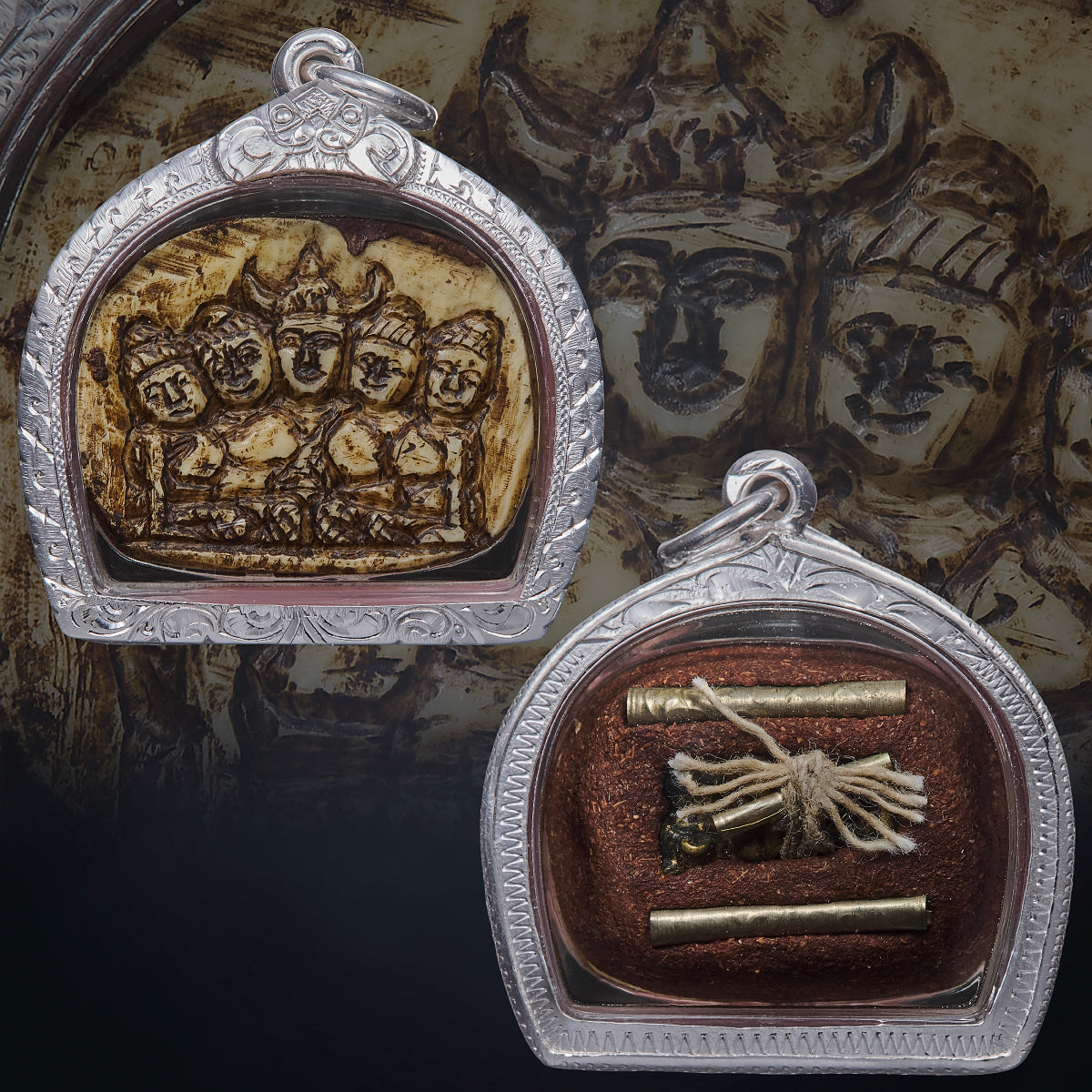
The central figure is carved from old hip relic and accompanied by four women. Its reverse combines Wahn Dok Thong, rare Wahn Gai Daeng, cemetery soil, Yin Tong takruts and Sai Sin — creating an artifact centred upon attraction, popularity, interpersonal opportunity and personal presence.
Historical Background
Phaya Khao Kham is primarily encountered through Northern Thai folk narratives and modern Lanna sacred-object traditions rather than through a single standard Buddhist scripture.
One commonly repeated legend tells of a ruler who had no heir and prayed earnestly for a child. His wish was eventually answered with the birth of an extraordinary prince.
The child was distinguished by golden horns, from which the name and imagery of Khao Kham — the “golden horn” — became associated with him.
As the prince matured, stories describe him as handsome, prosperous and exceptionally charismatic. People were naturally drawn towards him, while the golden horn became a sign of unusual fortune, status and personal magnetism.
Some modern practitioners consequently describe Phaya Khao Kham as the Northern counterpart of Khun Phaen, particularly when discussing wicha concerned with metta, saneh, attraction and popularity.
There are also practitioners who connect Phaya Khao Kham with aspects of Indra, reinforcing interpretations concerned with status, authority, prosperity and celestial favour. Such associations are best understood as part of living regional devotional traditions rather than a single universally accepted account of his origin.
Origins of the Materials
The foundation of this particular artifact is an old piece of hip relic that had remained with Por Sala Tan for a considerable period.
He did not immediately turn it into an artifact. According to the history accompanying the piece, Por Sala Tan kept the material until he found an image that he considered appropriate for its character.
He eventually selected Phaya Khao Kham surrounded by four women, allowing the physical composition itself to express the figure's traditional association with attraction and admiration.
The reverse contains several materials selected specifically for this purpose.
Wahn Dok Thong belongs to the broad family of traditional Thai herbal materials associated in folk wicha with attraction, metta and interpersonal charm.
More unusual is Wahn Gai Daeng, described by Por Sala Tan as a difficult-to-obtain red saneh herb. It was combined with cemetery soil to form part of the ritual base.
The presence of Yin Tong takruts further reinforces the male-and-female attraction symbolism of the artifact.
Ritual
After deciding upon Phaya Khao Kham as the appropriate form, Por Sala Tan carved the hip relic by hand, producing the central male figure surrounded closely by four female companions.
The completed carving was then ritually prepared according to his wicha.
At the reverse, Wahn Dok Thong and Wahn Gai Daeng were combined with cemetery soil and other prepared materials to create the sacred base.
Yin Tong takruts were embedded into this mixture. Sai Sin was also incorporated, visibly bound around the smaller ritual components at the centre of the reverse.
Phaya Khao Kham's essence was subsequently invited and established within the completed carving, bringing together the image, relic and saneh-oriented materials as a single working artifact.
Blessings and Effects
The principal character of this Phaya Khao Kham is Maha Saneh — strong personal attraction and magnetism.
Its traditional applications extend into several related areas:
- Saneh — attraction and personal magnetism.
- Metta Maha Niyom — goodwill, popularity and favourable reception.
- Opposite-sex attraction — encouraging opportunities to meet and connect with potential partners.
- Speech and social confidence — supporting conversation, introductions and interpersonal communication.
- Business and trade — attracting attention, customers and stronger interpersonal rapport.
- Baramee — strengthening presence, confidence and the impression one gives to others.
- Opportunity and fortune — being noticed when useful social or commercial opportunities arise.
The four female figures surrounding Phaya Khao Kham make the attraction symbolism especially explicit in this particular carving.
The intention is nevertheless better understood as drawing attention and favourable interaction, rather than forcing affection or controlling another person's decisions.
Modern Application
Phaya Khao Kham naturally suits people whose livelihood depends heavily upon personality, visibility and interaction with others.
Those involved in sales, entertainment, hospitality, nightlife, customer-facing businesses, networking or occupations requiring frequent introductions may find its traditional symbolism particularly relevant.
It may also appeal to someone who has ability but struggles to make himself visible. In that context, Phaya Khao Kham becomes a reminder to speak confidently, present oneself properly and allow others the opportunity to recognise one's qualities.
For relationships, the artifact is traditionally carried to encourage attraction and opportunities for connection. Its most constructive application remains straightforward: be noticed, be approachable and allow genuine mutual attraction to develop naturally.
Physical Details
This is a substantial hand-carved artifact formed from an old piece of hip relic. The front presents Phaya Khao Kham seated centrally beneath his characteristic horned crown, surrounded closely by four female figures, creating an unusually elaborate group composition within a single piece of material.
The aged cream and brown surface retains the natural character of the relic, with darker material remaining within the recessed carving and around the figures. These variations give considerable definition to the faces, clothing and central Phaya Khao Kham image.
The reverse is completely different in appearance. A reddish-brown ritual base prepared from Wahn Dok Thong, Wahn Gai Daeng, cemetery soil and associated sacred materials covers much of the surface. Two larger metallic takruts are positioned horizontally above and below the centre, while additional Yin Tong takrut elements and Sai Sin are bound together within the central recess.
The entire artifact is protected inside a custom silver casing, with both the detailed carving and its ritual-filled reverse remaining visible.
Recommended Pairing
For stronger metta and business application, Phaya Khao Kham may be paired with Salika-based artifacts, particularly where persuasive communication and customer interaction are important.
A Khun Phaen provides another natural pairing when the intended emphasis is confidence, popularity and interpersonal attraction.
For someone seeking to balance the strong saneh character with greater judgement and discipline, a Lersi artifact can provide a complementary symbolism of wisdom, restraint and clear decision-making.
Personal Notes
What stands out to me about this piece is how completely its physical imagery and sacred materials follow the same theme.
Por Sala Tan had kept the old hip relic for some time rather than immediately carving it. When he eventually chose Phaya Khao Kham, he created not merely the central figure but an entire composition of Phaya Khao Kham surrounded by four women.
The reverse continues that intention through the use of Wahn Dok Thong, the particularly rare Wahn Gai Daeng, cemetery soil, Yin Tong takruts and Sai Sin.
It is therefore one of those Por Sala Tan artifacts where the carving, material selection and ritual construction can be read together. From the four female figures on the front to the specialised saneh herbs concealed at the back, the entire piece was constructed around the traditional character of Phaya Khao Kham — attraction, charisma, popularity and the ability to draw people towards oneself.
-
Free Shipping for Singapore| $15 Worldwide | $60 USA For Items Below $350