
OOBThaiAmulets
Por Sala Tan
Por Sala Tan
Couldn't load pickup availability
PST05
Yant Setthi
Por Sala Tan
Barang Artifact
1.5 inches
Sacred Craftsmanship
Each piece was individually prepared and hand-yanted. Natural differences in the Paneang, inscriptions, oil absorption, cemetery soil and embedded components give every example its own character.
Personal Experiences Shared by Luksits
Among luksits, pieces made from these Ngan-related materials became particularly remembered for Choke Lap — unexpected or windfall fortune.
Some devotees reported receiving money from directions they had not anticipated. This could take the form of an unexpected commission, a forgotten payment being returned, additional work appearing suddenly or an old customer returning with a substantial order.
Others associated their Phra Ngan practice more directly with windfall luck. There were users who reported small lottery or chance-based winnings after carrying the piece and praying for fortune. More commonly, however, the improvement appeared through ordinary life in unexpectedly favourable ways rather than through a single dramatic win.
Business users described another pattern. During periods when trade had become quiet, customers or enquiries sometimes appeared unexpectedly. An old contact might introduce a new client, a stalled negotiation might suddenly move forward, or someone who had previously hesitated could return ready to complete the transaction.
One type of experience particularly suited to Yant Setthi concerns opportunity rather than money appearing directly. A wearer may pray for improvement in finances and, shortly afterwards, be introduced to a person who offers additional work or opens a new business connection. The resulting income still requires effort, but the opening itself arrives unexpectedly.
Within the tradition, these experiences are interpreted as the combined qualities of Yant Setthi for wealth, Phra Ngan for Choke Lap and opportunity, and the supporting attraction qualities of Yin Tong and Nam Man Prai.
Summary
Yant Setthi is traditionally understood as a yantra concerned with wealth, prosperity and the circumstances through which financial stability can develop.
The word Setthi refers to a wealthy or prosperous person. Within sacred yantra practice, the idea extends beyond simply possessing money. It encompasses successful livelihood, productive trade, accumulating resources and having sufficient opportunities for wealth to continue growing.
Por Sala Tan's version is particularly layered.
The front carries the hand-inscribed Yant Setthi.
The Paneang itself had previously been soaked in Nam Man Prai and came from a practitioner deeply involved with Ngan wicha.
The reverse combines nine graveyard soils, Phra Ngan, Yin Tong and takruts.
Its traditional direction is therefore unmistakably worldly: wealth, business, Choke Lap, favourable opportunities and financial advancement.
Historical Background
Wealth yantras occupy an established place within Thai and Khmer-derived sacred diagram traditions.
Their purpose is not limited to sudden riches. Historically, prosperity was inseparable from productive land, successful commerce, abundant resources and favourable relationships with other people.
Yant Setthi consequently represents the condition of becoming prosperous rather than merely receiving money once.
For merchants, this can mean attracting customers and maintaining healthy trade. For employees, it may be interpreted through promotion, increased responsibility or improved income. For entrepreneurs and investors, it concerns recognising and securing favourable opportunities.
The Phra Ngan element gives Por Sala Tan's interpretation a more specialised character. Ngan is traditionally associated with worldly assistance, Choke Lap and opportunities that may arise unexpectedly.
Together, Yant Setthi and Phra Ngan create a complementary relationship: one establishes prosperity as the destination, while the other is traditionally associated with unexpected openings through which fortune may arrive.
Origins of the Materials
The Paneang was originally held by a practitioner whose principal speciality was Ngan wicha.
He was said to have travelled extensively and learned from numerous forest hermits and traditional practitioners throughout Thailand. The material therefore already had a history within Ngan practice before reaching Por Sala Tan.
Significantly, the Paneang had also been soaked in Nam Man Prai as part of its earlier ritual preparation.
After receiving the material, Por Sala Tan added components from his own practice.
The most substantial addition was cemetery soil collected from nine separate graveyards situated along the northern border. These different soils were brought together and prepared as the foundation for the reverse.
The number nine carries an auspicious association in Thai culture with progress and moving forward, making it particularly appropriate for a piece whose principal direction is financial advancement.
Ritual
Por Sala Tan first worked directly upon the Paneang by hand-inscribing Yant Setthi across its front.
The yantra established the principal intention of the artefact: wealth, prosperity, successful livelihood and Choke Lap.
He then prepared the reverse using the combined soil from nine northern-border graveyards. A small Phra Ngan was installed prominently upon this foundation, accompanied by Yin Tong and takruts.
The earlier Nam Man Prai preparation was retained as part of the Paneang itself rather than treated as a separate addition.
Through consecration, Por Sala Tan brought these otherwise different materials into a single ritual structure: Setthi for wealth, Ngan for fortune and opportunity, Yin Tong for attraction, Nam Man Prai for the Barang and Saneh dimension, and takruts for the supporting wicha.
Blessings and Effects
The central quality of Yant Setthi is wealth attraction and financial progress.
For merchants and business owners, this is traditionally interpreted through stronger customer flow, successful transactions, repeat business and opportunities to increase turnover.
For working professionals, the same principle may appear through additional responsibility, promotion, commissions, salary improvement or meeting people capable of opening new opportunities.
Choke Lap is another important aspect. Phra Ngan has long been sought by devotees for unexpected fortune, including small winnings, surprise income and favourable circumstances that could not easily have been planned beforehand.
The Yin Tong and Nam Man Prai aspects introduce attraction and interpersonal response. This is particularly relevant to commerce because wealth rarely operates independently of people. Customers must be attracted, negotiations require rapport, and opportunities often arrive through relationships.
The piece therefore represents several routes towards prosperity rather than a single idea of instant wealth.
Modern Application
Yant Setthi is particularly relevant to business owners, merchants, salespeople, property agents, investors and commission-based professionals.
Someone operating a shop may focus upon customers and continued turnover. A salesperson may seek stronger enquiries and successful closures. An employee may pray for advancement or increased income, while a business owner may focus upon profitable opportunities and useful connections.
Its Choke Lap aspect also makes it suitable for those who appreciate the traditional Phra Ngan association with unexpected fortune.
The deeper principle, however, is not simply waiting for money to arrive.
Yant Setthi represents creating the conditions of a Setthi — someone whose livelihood, opportunities and resources continue to develop and accumulate.
Physical Details
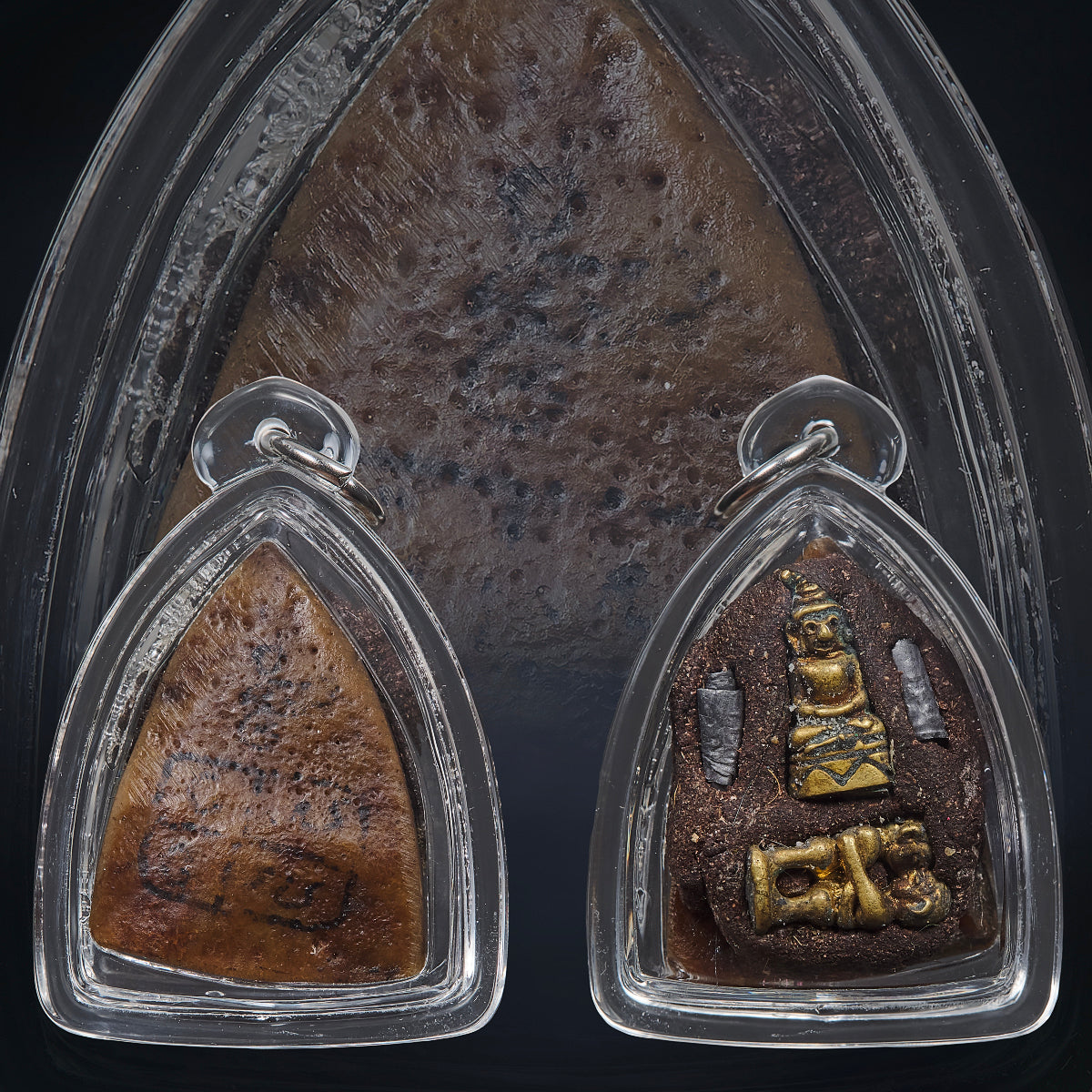
The artefact retains the natural triangular form of the old Paneang, with its warm brown colouring, porous texture, darkened areas and visible signs of age and preparation. The material had previously been soaked in Nam Man Prai before entering Por Sala Tan's possession.
Across the front, Por Sala Tan personally applied the Yant Setthi, its sacred markings worked directly onto the Paneang. The inscriptions have aged into the material rather than sitting prominently above its surface, giving the front a restrained appearance compared with the more elaborate reverse.
The reverse is filled with Por Sala Tan's prepared dark reddish-brown foundation containing cemetery soil from nine graveyards along the northern border.
A small metallic Phra Ngan occupies the upper centre. Takruts are embedded beside it, while a Yin Tong rests prominently across the lower portion. The arrangement brings the fortune and attraction components together over the nine-graveyard foundation.
The two sides consequently reveal the structure of the wicha clearly: Yant Setthi establishes wealth on the front, while Phra Ngan, Yin Tong, takruts and cemetery earth reinforce fortune and worldly opportunity from the reverse.
Recommended Pairing
For those using Yant Setthi principally for business, Nang Kwak is a natural companion where customer attraction and trade are important.
Phra Sivali complements the piece through his traditional association with abundance, livelihood and support, while Phra Somdej can provide a more stable Buddhist foundation of Baramee alongside the stronger Barang character of the Yant Setthi.
Personal Notes
The character of this piece lies in how Por Sala Tan redirected an already prepared material towards wealth.
The Paneang had its own history before reaching him. It came from a practitioner devoted principally to Ngan wicha, someone who had sought knowledge from forest hermits and traditional practitioners across Thailand. It had also been soaked in Nam Man Prai.
Por Sala Tan preserved that foundation but gave it a clearer destination.
He wrote Yant Setthi upon the Paneang.
He added earth from nine northern-border graveyards.
He installed Phra Ngan for Choke Lap and worldly assistance, Yin Tong for attraction, and takruts to reinforce the wicha.
This makes the piece more than a simple wealth yantra. It represents several traditional pathways through which prosperity may develop: being noticed, meeting the right people, encountering unexpected opportunities, improving trade and occasionally receiving fortune from a direction that could not have been anticipated.
The intention of Yant Setthi is therefore not merely to receive money once, but to move progressively towards the condition implied by its name — Setthi: prosperity that can be established, strengthened and sustained.
-
Free Shipping for Singapore| $15 Worldwide | $60 USA For Items Below $350