
OOBThaiAmulets
Por Sala Tan
Por Sala Tan
Couldn't load pickup availability
Phra Ngan
Por Sala Tan
1.5 inches
Barang Artifact
Sacred Craftsmanship
Each piece was individually carved and assembled from naturally irregular sacred materials. Variations in Paneang, carving, cemetery soil and embedded ritual components give every example its own character.
Personal Experiences Shared by Luksits
Among devotees, Phra Ngan has long been particularly associated with Choke Lap — unexpected or windfall fortune.
Luksits carrying Por Sala Tan's Ngan works have spoken of small but unexpected financial openings appearing at useful moments. These were not always dramatic lottery wins. Some described receiving forgotten payments, unexpected commissions, additional work or money arriving from sources they had not been relying upon.
Others specifically associated their Phra Ngan with windfall luck. Some devotees reported unexpected winnings or fortunate opportunities after praying to the Ngan, particularly when they made a simple request and promised to make merit or offerings afterwards.
Business users have described another pattern: periods of quiet trade suddenly improving through unexpected customers or introductions. A person might arrive through recommendation, an old customer return without being contacted, or an opportunity appear through someone the wearer had only recently met.
Some users also speak of becoming unusually alert to opportunities. Rather than money simply appearing, they felt they were more likely to notice a useful opening, make the right approach or be in the right place when an opportunity presented itself.
Within Ngan tradition, these experiences are often interpreted as Choke Lap and spiritual assistance working together.
Summary
This Phra Ngan is an unusual collaboration of materials and wicha from two practitioners.
Its foundation is old Paneang connected with a practitioner who specialised extensively in Ngan wicha and had studied with forest hermits and masters throughout Thailand. The Paneang was carved into Phra Ngan before being passed to Por Sala Tan.
Por Sala Tan subsequently added his own ritual foundation: soil from nine graveyards situated around the northern border, together with Phra Ngan, Yin Tong and a takrut on the reverse.
The principal traditional emphasis is Choke Lap — unexpected fortune and opportunities arriving outside one's normal income or planning. Alongside this are the familiar Ngan qualities of attraction, opportunity, interpersonal influence and assistance in worldly affairs.
Historical Background
Phra Ngan occupies a distinctive position within Thai occult practice.
Unlike mainstream Buddhist imagery, Ngan belongs more closely to the world of traditional wicha and Barang practice. Different lineages interpret the figure differently, and consequently the materials, rites and intended qualities of Ngan pieces can vary considerably between masters.
A recurring theme, however, is worldly assistance.
Phra Ngan is commonly approached for matters involving luck, attraction, opportunity, trade and situations where favourable circumstances need to be drawn towards the practitioner.
This explains why Ngan pieces became particularly interesting to merchants, gamblers, commission-based workers and people whose livelihood depends partly upon timing and opportunity.
The inclusion of Yin Tong further reinforces the attraction and interpersonal aspect, while the cemetery materials connect the artefact with the spirit-oriented side of Por Sala Tan's practice.
Origins of the Materials
The central Paneang came from a practitioner whose principal speciality was Ngan wicha.
Rather than studying from a single source, he was said to have travelled extensively and learned from numerous forest hermits and practitioners throughout Thailand. The Paneang remained among his materials and was eventually selected to be carved into the Phra Ngan form.
After the carving was completed, it was passed to Por Sala Tan.
Por Sala Tan did not leave the piece in its existing state. He incorporated materials from his own practice, most importantly cemetery soil gathered from nine separate graveyards along the northern border.
The use of nine locations was deliberate. Instead of allowing the artefact to depend upon the character of a single cemetery, material from multiple grounds was brought together into one ritual foundation.
The number nine itself carries an auspicious association in Thai culture, particularly with progress and moving forward, adding another symbolic dimension to the construction.
Ritual
Once the carved Paneang entered his possession, Por Sala Tan prepared the reverse according to his own Ngan and Barang methods.
Soil from the nine northern-border graveyards was combined and prepared as the principal backing material.
Upon this foundation he installed a small Phra Ngan image, a Yin Tong and a takrut. Together, these components create a concentrated arrangement of Ngan, attraction and written wicha over the cemetery-earth base.
The earlier practitioner's relationship with Ngan wicha was therefore not replaced. Por Sala Tan effectively built another ritual layer upon it, joining the history of the Paneang with materials from his own practice.
The finished artefact was then consecrated towards the worldly qualities traditionally associated with Phra Ngan: fortune, attraction, opportunity and assistance.
Blessings and Effects
Choke Lap, or unexpected fortune, is one of the strongest qualities associated with this particular piece.
This may traditionally include windfall money, unexpected commissions, fortunate transactions, small winnings or opportunities appearing without extensive planning beforehand.
Phra Ngan is also associated with opening opportunity. In practical terms, devotees may interpret this as meeting useful people, discovering an overlooked possibility, encountering customers at the right moment or receiving assistance from an unexpected direction.
The Yin Tong element supports Saneh and interpersonal attraction, particularly favourable attention and greater receptiveness from other people.
For commercial users, these qualities naturally overlap. Attraction brings people closer; opportunity creates the opening; Choke Lap represents the unexpected favourable result.
The nine-graveyard foundation gives the artefact its distinctly Barang character and connects these worldly intentions with Por Sala Tan's spirit-oriented practice.
Modern Application
The qualities of this Phra Ngan translate particularly well to people whose income is not completely fixed.
Salespeople, property agents, traders, business owners and commission-based professionals may relate strongly to its traditional association with unexpected opportunities and additional sources of income.
Collectors interested in Ngan wicha may value it for another reason: its lineage did not begin solely with Por Sala Tan. The Paneang had already passed through the hands of a practitioner deeply involved with Ngan practice before Por Sala Tan added his own materials.
For everyday keeping, the emphasis can remain simple — fortune, opportunity and favourable encounters, rather than constantly making large or unrealistic requests.
Physical Details
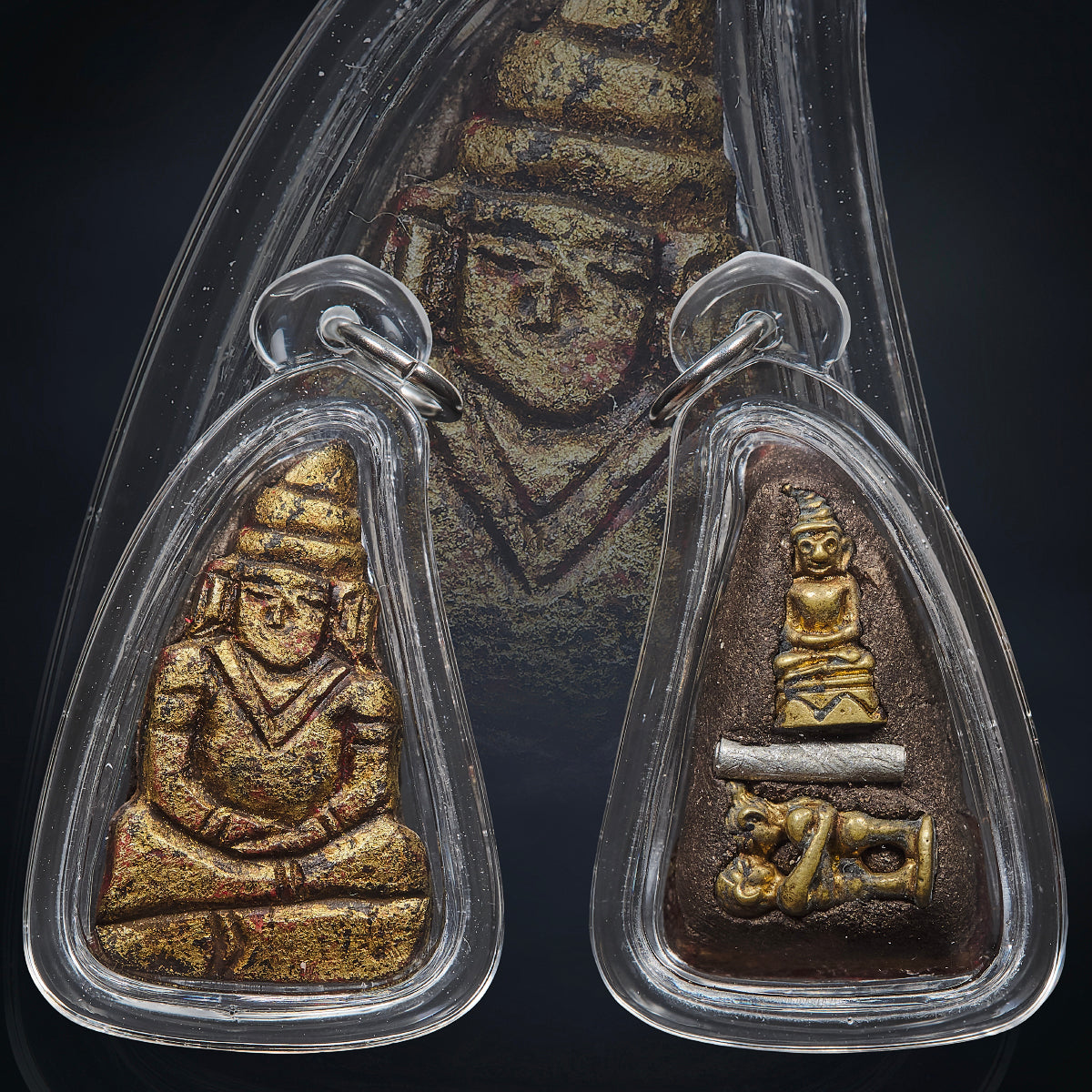
The front is carved from a pale piece of aged Paneang into the traditional seated Phra Ngan form. The figure sits cross-legged with the hands positioned across the body, wearing the characteristic pointed headdress. Remnants of gold and ritual colouring remain across portions of the carving, while the natural grain, ageing and irregularities of the Paneang are still visible beneath.
The reverse reveals Por Sala Tan's additions. A dark prepared foundation containing soil from nine graveyards along the northern border fills the back of the piece. A small metallic Phra Ngan sits prominently towards the upper section, beneath which a horizontal takrut separates the upper and lower components.
At the bottom is a small Yin Tong, its paired figures immediately reinforcing the attraction aspect of the composition.
The construction therefore allows the history of the piece to be read physically from both sides: the carved Paneang represents the earlier Ngan practitioner's contribution, while the cemetery-earth foundation, embedded sacred images and takrut represent Por Sala Tan's subsequent work.
The complete artefact is protected within a fitted clear casing.
Recommended Pairing
Because this Phra Ngan already carries strong Choke Lap and worldly-opportunity qualities, Phra Sivali makes a suitable pairing for those seeking steadier livelihood and abundance alongside unexpected fortune.
Nang Kwak complements it particularly well for merchants and business owners concerned with customers and trade. A Phra Somdej may instead be worn alongside it to provide a more traditional Buddhist foundation of Baramee and stability.
Personal Notes
What distinguishes this Phra Ngan is the continuity of its wicha.
The Paneang did not begin as an ordinary material later chosen simply because it was suitable for carving. It came from a practitioner whose principal study was Ngan wicha and whose knowledge had been gathered through contact with forest hermits and traditional practitioners throughout Thailand.
He had the Ngan carved.
Then the piece passed to Por Sala Tan.
Por Sala Tan did not attempt to erase that earlier history. Instead, he added another layer: nine graveyard soils from the northern border, his own ritual preparation, takrut, Phra Ngan and Yin Tong.
This gives the artefact a particularly interesting character for collectors of Por Sala Tan's Barang work. It represents one practitioner's Ngan lineage passing into the hands of another, with each contributing something different to the completed piece.
Its traditional purpose remains equally clear: Ngan for worldly assistance, Yin Tong for attraction, cemetery earth for the Barang foundation, and Choke Lap for the unexpected opportunities through which fortune sometimes arrives.
-
Free Shipping for Singapore| $15 Worldwide | $60 USA For Items Below $350