
OOBThaiAmulets
Por Sala Tan
Por Sala Tan
Couldn't load pickup availability
PST05
Tao Wessuwan
Por Sala Tan
7cm
Barang artifact
Sacred Craftsmanship
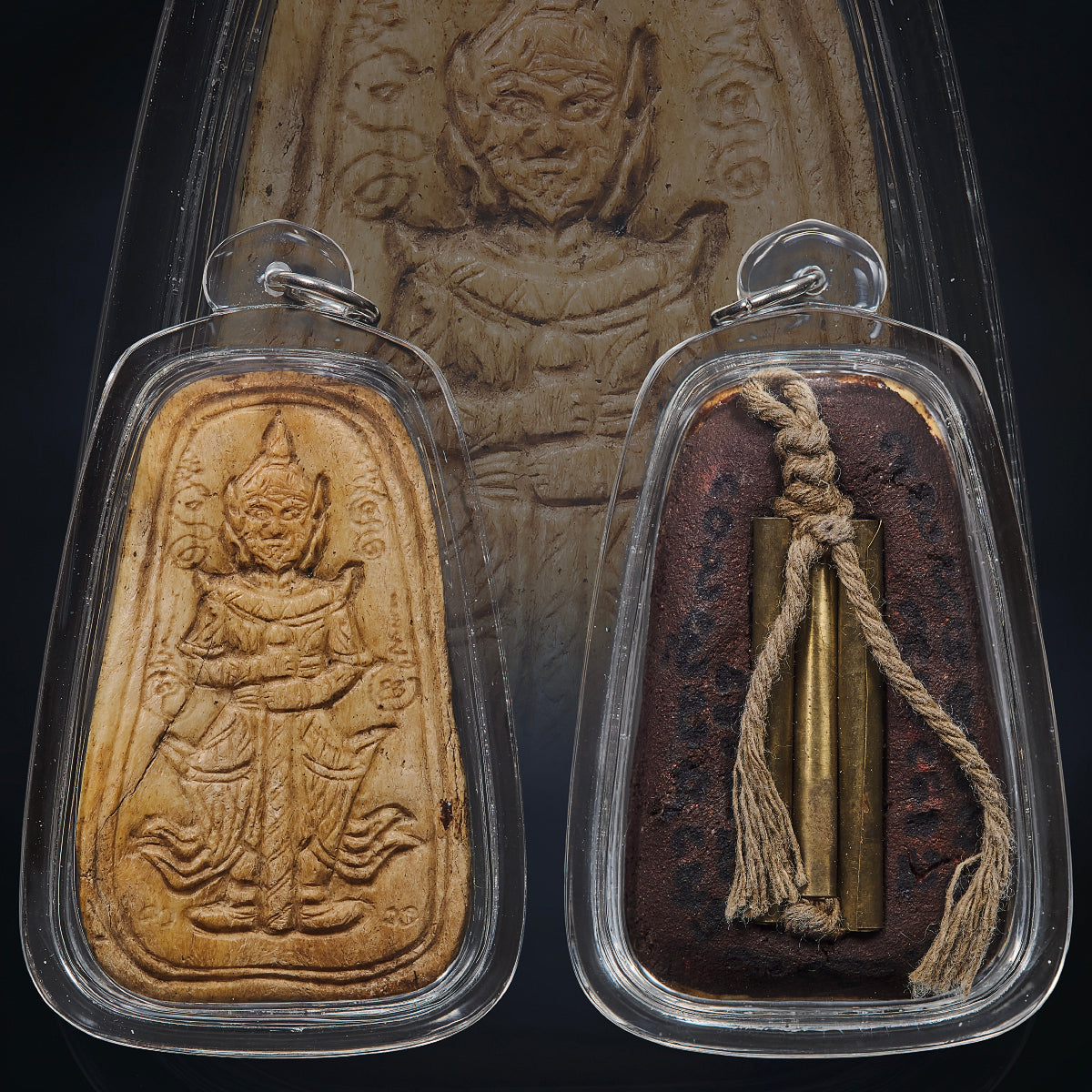
This Tao Wessuwan was individually carved by Por Sala Tan from an old relic associated with a person who had passed away suddenly in an accident.
The relic came to Por Sala Tan after local people sought his assistance with a persistent spiritual disturbance. According to the account preserved with the piece, the deceased's spirit had remained close to the area of the accident and was unable or unwilling to move on. Villagers repeatedly reported seeing a figure wandering near the village and believed it to be connected with the person who had died.
Por Sala Tan chose Tao Wessuwan for the carving because of his traditional position as a great guardian and authority over spirits. Rather than using the relic simply to create a forceful Prai object, the purpose was first to bring the unsettled presence under order, calm it and provide a path through which it could accumulate merit.
The reverse was subsequently prepared with wealth-fetching powder and soil collected from prosperous or good-harvest ground, together with handwritten takruts and Sai Sin. These materials transformed the completed piece from a work of spirit pacification into an artefact also directed towards protection, livelihood and prosperity.
Each example was individually carved and ritually prepared by hand. Variations in the original relic, carving, powders, soil, takruts and Sai Sin form part of the individual character of every piece.
Personal Experiences Shared by Luksits
One luksit began wearing Tao Wessuwan during a period when his business was struggling with irregular cash flow. Rather than receiving a sudden windfall, he noticed that old customers began returning and several outstanding payments were finally settled. Within a few months, the business became easier to manage. He regarded this as Tao Wessuwan helping to restore stability rather than simply bringing unexpected wealth.
Another wearer frequently travelled late at night for work. On several occasions he described experiencing a sudden feeling that he should change his route or delay his journey. Nothing dramatic occurred, but he later discovered accidents or disturbances along the routes he had originally intended to take. He came to regard these moments as timely warnings and continued carrying Tao Wessuwan principally for protection.
For users, the piece consequently became associated with a strong sense of guardianship, together with support in matters of livelihood, opportunity and protection.
Summary
This Por Sala Tan Tao Wessuwan brings together three distinct aspects of his wicha: spirit pacification, guardianship and prosperity.
Its origin lies with the relic of someone who died unexpectedly in an accident and whose presence was subsequently believed to remain around the place of death.
Tao Wessuwan was carved onto the relic as the governing figure. Within Thai tradition, Tao Wessuwan represents authority over yaksha, spirits and unseen forces, making his image particularly appropriate for bringing an unsettled spiritual presence under control.
The reverse was then prepared with wealth-fetching powder and soil from fertile, prosperous ground. This gives the finished piece a second direction concerned with growth, livelihood and material stability.
Most importantly, the spirit was not simply bound for service. Por Sala Tan's intention was to pacify the presence and allow assistance to become a means of accumulating good karma and merit.
Historical Background
Tao Wessuwan occupies an important position in Thai Buddhist and occult traditions as one of the Four Great Heavenly Kings and guardian of the northern direction.
Within popular Thai practice, he is particularly respected as a powerful authority over yaksha, spirits and potentially harmful unseen beings. His image is consequently used for protection, maintaining spiritual order and preventing disruptive forces from affecting a household or individual.
This authority explains Por Sala Tan's choice of image for the relic.
Where an ordinary spirit-oriented carving might focus upon the identity of the deceased, Tao Wessuwan establishes a higher governing authority over the presence associated with the material.
The symbolism is therefore not one of conflict between Tao Wessuwan and the spirit. It is one of order: a restless presence is brought beneath a recognised guardian authority and redirected away from disturbance.
Origins of the Materials
The principal relic was given to Por Sala Tan after the death of its former owner in an accident.
According to the history accompanying the material, villagers subsequently began reporting sightings of a wandering figure around the village and near the location where the accident occurred. The repeated accounts led local people to believe that the deceased remained attached to the area.
Por Sala Tan was eventually asked to intervene, and part of the associated relic material came into his possession.
The reverse materials were deliberately selected to give the completed artefact a more auspicious worldly direction. Wealth-fetching powders were incorporated to support livelihood and opportunity.
Por Sala Tan also used soil from prosperous ground — land recognised for fertility or consistently good harvests. Within sympathetic ritual traditions, productive earth represents multiplication, nourishment and continuing abundance. Soil from land capable of producing good harvests therefore becomes a physical symbol for the wish that the keeper's livelihood should likewise remain productive.
Takruts and Sai Sin completed the ritual composition.
Ritual
Por Sala Tan first worked with the spiritual presence associated with the relic, seeking to calm and regulate it.
He then carved the image of Tao Wessuwan directly onto the material. In this context, Tao Wessuwan functioned as both guardian and governing authority, establishing spiritual order around what had previously been regarded as an unsettled presence.
Through the appropriate rites, the spirit was pacified and given a different purpose. Rather than remaining around the village and causing fear, it could assist the keeper under the authority represented by Tao Wessuwan.
The reverse was then packed with the prepared wealth-fetching powder and prosperous-ground soil. Takruts were installed over this foundation and bound together with old Sai Sin, adding further layers of written wicha and ritual blessing.
An important part of the work was the concept of merit transfer. Assistance offered by the spirit could be answered through merit dedicated by the keeper, creating a traditional reciprocal relationship centred upon improvement rather than continued unrest.
Blessings and Effects
Protection is the principal foundation of this piece. Tao Wessuwan is traditionally invoked against harmful spiritual influences, hostile unseen forces and disturbances that create fear or instability.
His image also represents Amnaj and Baramee — authority, firmness and the ability to remain composed when confronting difficult people or situations.
The materials at the reverse introduce a strong prosperity aspect. Wealth-fetching powder is directed towards financial opportunity and livelihood, while fertile or good-harvest soil symbolises steady production, continuing income and resources that multiply rather than diminish.
The spirit-assisted element adds another traditional dimension. Once pacified, the presence is regarded as capable of assisting its keeper through protection, awareness and favourable circumstances.
In return, making merit and dedicating it towards the deceased forms part of the traditional relationship. The ideal is therefore not simply to receive assistance, but for both keeper and spirit to benefit through merit and constructive action.
Modern Application
For modern use, this Tao Wessuwan carries a particularly balanced combination of protection and livelihood.
Business owners may relate strongly to the prosperous-ground symbolism: just as fertile soil repeatedly produces a good harvest, a healthy business requires customers, opportunities and income to continue circulating.
Those working in uncertain or competitive environments may instead place greater emphasis upon Tao Wessuwan's qualities of authority and protection.
The piece also carries a reminder concerning the relationship between spiritual assistance and merit. A keeper following Por Sala Tan's tradition may make offerings, perform charitable acts or undertake other forms of merit and dedicate them to the deceased.
Its underlying principle is therefore not simply “help me”, but a reciprocal relationship in which assistance is answered with merit.
Physical Details
The artefact is carved from an old relic associated with the individual who died in the accident. The front carries a detailed standing image of Tao Wessuwan, portrayed in traditional guardian form with a commanding facial expression, elaborate clothing and a strong upright posture. Sacred characters are carved around the figure, while the natural colour, ageing and irregular texture of the original material remain clearly visible.
The reverse contains the ritual foundation of the piece. Beneath the dark reddish-brown prepared surface are wealth-fetching powders combined with soil collected from prosperous or fertile good-harvest ground.
Several metal takruts are mounted vertically across this foundation and held together with Sai Sin, the old sacred cord forming a visible connection with blessing and ritual practice. The naturally aged fibres of the Sai Sin contrast with the metal takruts and darker prepared material beneath.
The physical construction reflects the purpose of the artefact clearly. Tao Wessuwan occupies the front as guardian and governing authority; the reverse carries the materials of prosperity, ritual protection and spiritual support.
The complete piece is now protected within a fitted clear casing while retaining full visibility of both sides.
Recommended Pairing
This Tao Wessuwan is already a complete piece for protection, authority and prosperity.
For greater emphasis upon livelihood, Phra Sivali provides a natural pairing through his traditional association with abundance and support during one's travels and work. Phra Somdej can provide a calmer Buddhist foundation of Baramee, while Nang Kwak may complement the prosperous-ground materials for those principally concerned with customers and commerce.
Personal Notes
The most significant aspect of this piece is the transformation behind its creation.
It began with an unfortunate death. The person passed suddenly in an accident, and the presence associated with the deceased was subsequently believed to remain near the village, repeatedly frightening local people.
Por Sala Tan's response was not simply to capture that disturbance and turn it into a powerful artefact.
Instead, he carved Tao Wessuwan — an authority capable of governing spirits — directly upon the relic. The intention was to calm what had been restless, establish order and redirect the presence towards something constructive.
The reverse tells the second half of the story. Fertile soil represents growth. Wealth powder represents livelihood. Takruts provide the written wicha, while Sai Sin connects the work with blessing and merit.
The spirit that once wandered without direction was therefore given a different path: to remain calm, assist rather than disturb, and through that assistance receive merit dedicated by the keeper.
In this sense, the deeper purpose of the artefact is not the imprisonment of a restless spirit, but its transformation from disturbance into guardianship, and from guardianship towards merit.
-
Free Shipping for Singapore| $15 Worldwide | $60 USA For Items Below $350