
OOBThaiAmulets
Por Sala Tan
Por Sala Tan
Couldn't load pickup availability
PST05
Jinn Hua Chamut Lin Thong
Por Sala Tan
Barang Artifact
6cm height
Sacred Craftsmanship
Each artifact was individually carved, assembled and spiritually prepared by hand. Natural differences in the relic, gold foil, bindings, takrut placement and sacred materials make every piece distinct.
Personal Experiences Shared by Luksits
Among the artifacts Por Sala Tan created from the materials recovered during this cemetery cleansing, the Hua Chamut held a particularly unusual background because its Jinn was not originally associated with a human practitioner.
According to Por Sala Tan, while performing the necessary rites around the damaged graves, he became aware of a Hua Chamut — a civet-associated animal Jinn that remained in the abandoned village.
Through spiritual communication, Por Sala Tan understood that the Jinn was benevolent in character and had previously assisted the villagers.
It was said to communicate through the village shaman, helping people with matters concerning their work and everyday difficulties. Although its appearance was fierce, its intention towards the villagers was regarded as good.
The most distinctive feature was its long protruding tongue.
Por Sala Tan came to understand this as a Lin Thong, or Golden Tongue. The Jinn was associated with truthful speech and was said to use its words to advise and help rather than deceive.
When severe flooding eventually forced the villagers to abandon the settlement, the people moved to safer ground. The Hua Chamut Jinn, however, was believed to have remained behind.
It was during Por Sala Tan's later cemetery work that this connection was encountered again.
Summary
The Jinn Hua Chamut Lin Thong combines the symbolism of a fierce animal guardian with the traditional concept of Golden-Tongued speech.
Its origin is connected with an abandoned mountain village devastated by severe monsoon flooding. When damaged graves later required ritual attention, Por Sala Tan was invited to assist.
During the cleansing, he encountered what he understood to be a civet-associated Jinn that had formerly assisted the villagers through their local shaman.
After communication and the appropriate rites, Por Sala Tan collected spiritually significant materials from the location and subsequently created several different sacred artifacts from them.
The Hua Chamut was one of these creations.
Its traditional character combines protection, truthful and persuasive speech, Metta, wealth attraction, opportunity and spiritual assistance.
Historical Background
The village was situated in a mountainous region towards the Thai–Burma border.
During a period of severe monsoon weather, flooding overwhelmed the surrounding land, submerging homes, rice fields and large sections of the settlement. Conditions eventually became unsuitable for continued habitation, forcing the villagers to relocate to safer ground.
Although the living had moved away, the village graves remained.
Years of rainfall and erosion caused damage to parts of the burial area, creating concern among former residents about the condition of the graves and the spiritual consequences of leaving them disturbed.
Por Sala Tan was therefore asked to assist with the necessary cemetery ceremonies and cleansing rites.
During this work he communicated with the spirits associated with the area and, where appropriate, collected selected materials for future sacred work.
These materials subsequently became the foundation for several of his cemetery-related artifacts.
Origins of the Materials
The Hua Chamut was created from materials directly connected with this abandoned village and its damaged burial ground.
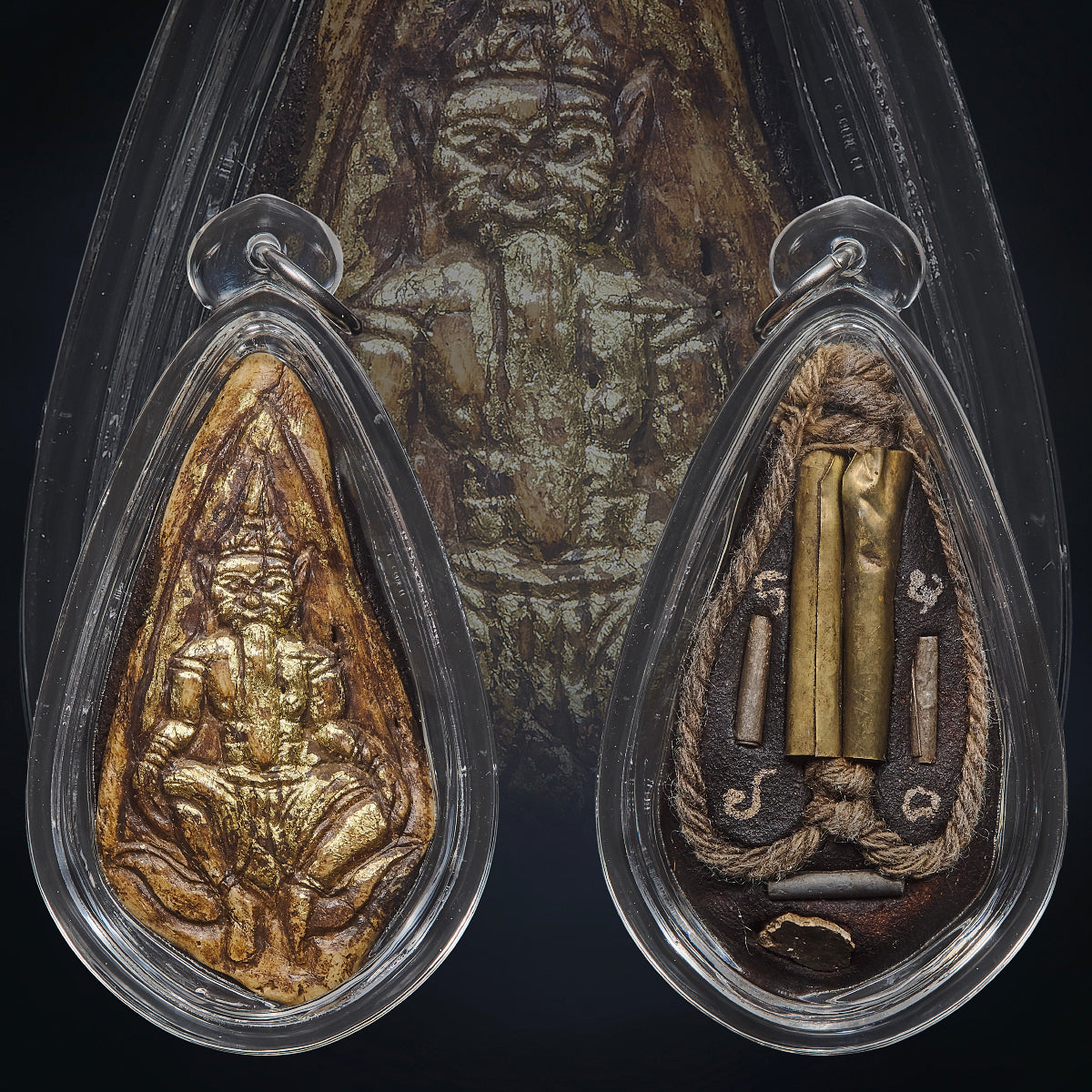
The front figure was carved from a sacred relic collected and ritually prepared by Por Sala Tan. Its fierce Hua Chamut face and extended tongue were then covered with gold foil, visually expressing its Lin Thong or Golden Tongue identity.
The reverse contains cemetery soil mixed with Nam Man Prai, together with relic fragments and multiple takruts.
Another particularly important component is the corpse rope incorporated into the construction.
Within certain Thai folk and Barang traditions, corpse rope — chueak sop — refers to cord, thread or binding material associated with funeral rites, a deceased person or a coffin. Such material is traditionally regarded as carrying a strong Prai or death-associated spiritual quality because of its connection with the boundary between life and death.
Its inclusion therefore forms an important part of the spiritual construction of this artifact.
Ritual
Before any material was removed, Por Sala Tan first performed the necessary rites for the disturbed burial area and communicated with the spiritual presences associated with it.
The purpose was not simply to enter an abandoned cemetery and collect unusual materials. The graves had been damaged by natural forces, and Por Sala Tan's original role was to settle and cleanse the area on behalf of the displaced villagers.
It was during these rites that he encountered the Hua Chamut Jinn.
After establishing its nature and history, the spiritually infused materials gathered from the location were prepared for sacred work.
For this artifact, Por Sala Tan combined the carved Hua Chamut relic with cemetery soil, Nam Man Prai, corpse rope, additional relic fragments and takruts.
The takruts were directed towards Metta, attraction of wealth, success and favourable movement of opportunities, while the Hua Chamut itself formed the central spiritual identity of the piece.
Blessings and Effects
The Jinn Hua Chamut Lin Thong is principally associated with speech, Metta, attraction, protection and assistance in worldly affairs.
Its Golden Tongue symbolism is especially relevant for people whose progress depends upon communication. Traditionally, this includes business owners, salespeople, negotiators and those who regularly need to persuade, explain or gain the confidence of others.
The Hua Chamut's history of communicating through the village shaman also strengthens its association with guidance and timely advice.
The corpse rope introduces another traditional layer. Rope symbolically ties, holds and connects. Within folk practice, this symbolism may be directed towards holding attention, encouraging customers to return, retaining opportunities or restraining hostile influences.
Together with the cemetery soil and Nam Man Prai, it gives the artifact a stronger Barang character associated traditionally with Metta Maha Niyom, Saneh, wealth calling and spiritual assistance.
Modern Application
The Hua Chamut Lin Thong is particularly suited to people working in environments where speech and personal relationships directly affect results.
Sales, negotiations, customer-facing businesses, commission work and situations requiring agreement or cooperation are natural applications of its Golden Tongue symbolism.
The wealth aspect is similarly connected with movement through people: attracting customers, receiving introductions, finding assistance and allowing opportunities to develop through communication.
Its protective character may also appeal to those dealing with complicated environments, hidden rivalry or individuals whose intentions are difficult to judge.
At the centre of the piece, however, remains the story of the Hua Chamut itself — a fierce-looking Jinn remembered not for deception, but for speaking truthfully and using its communication to assist others.
Physical Details
The Jinn Hua Chamut Lin Thong is a teardrop-shaped Barang artifact individually prepared by Por Sala Tan. The front consists of a Hua Chamut figure carved directly from sacred relic material, recognisable by its fierce expression and long extended tongue. Gold foil has been applied over the carving, representing its Golden Tongue identity.
The reverse exposes much of the working construction rather than concealing it. Cemetery soil mixed with Nam Man Prai forms the base, upon which several takruts are positioned for Metta, wealth attraction and success. Corpse rope surrounds and binds the arrangement, while additional relic material is incorporated towards the lower section.
Key points: hand-carved Hua Chamut relic, gold foil, cemetery soil, Nam Man Prai, corpse rope, relic fragments and multiple purpose-specific takruts.
The exposed bindings and individually positioned components are characteristic of Por Sala Tan's handmade Barang work rather than uniform factory construction.
Recommended Pairing
The Hua Chamut Lin Thong can be carried independently when the primary intention is communication, attraction, opportunity and protection.
For commercial purposes, it may be paired with a dedicated wealth-calling artifact, allowing the Hua Chamut to concentrate upon communication and human relationships while the accompanying piece strengthens financial movement.
It may also be paired with a protective Rahu or Tao Wessuwan when stronger emphasis upon clearing opposition and external obstacles is desired.
Because this artifact already combines several different materials and functions, additional pairing is not essential.
Personal Notes
What makes this piece particularly interesting within Por Sala Tan's cemetery work is the character attributed to the Jinn.
Its appearance is deliberately fierce. The extended tongue can initially make the Hua Chamut appear threatening, yet Por Sala Tan's account presents almost the opposite character.
The Jinn was remembered as an animal spirit that wanted to help people. It communicated with the villagers through their shaman and was associated with assisting them in their work.
Its Golden Tongue did not represent clever deception. It represented the belief that its words carried truth and were used to guide others.
Then the flood came.
The houses and rice fields were submerged, the inhabitants abandoned the village, and eventually even the graves began deteriorating beneath the mountain rains. The people left, but according to Por Sala Tan, the Hua Chamut remained.
Years later, during the cleansing of those damaged graves, their paths crossed.
The Jinn Hua Chamut Lin Thong is therefore not merely an artifact assembled from cemetery materials. It preserves the story of a guardian left behind after its village disappeared — eventually encountered by Por Sala Tan and given a new form through which its old purpose of guidance, truthful speech and assistance could continue.
-
Free Shipping for Singapore| $15 Worldwide | $60 USA For Items Below $350