
OOBThaiAmulets
Por Sala Tan
Por Sala Tan
Couldn't load pickup availability
PST07
Lersi Narai
Por Sala Tan
1.5 Inches
Mainstream Artifact
Sacred Craftsmanship
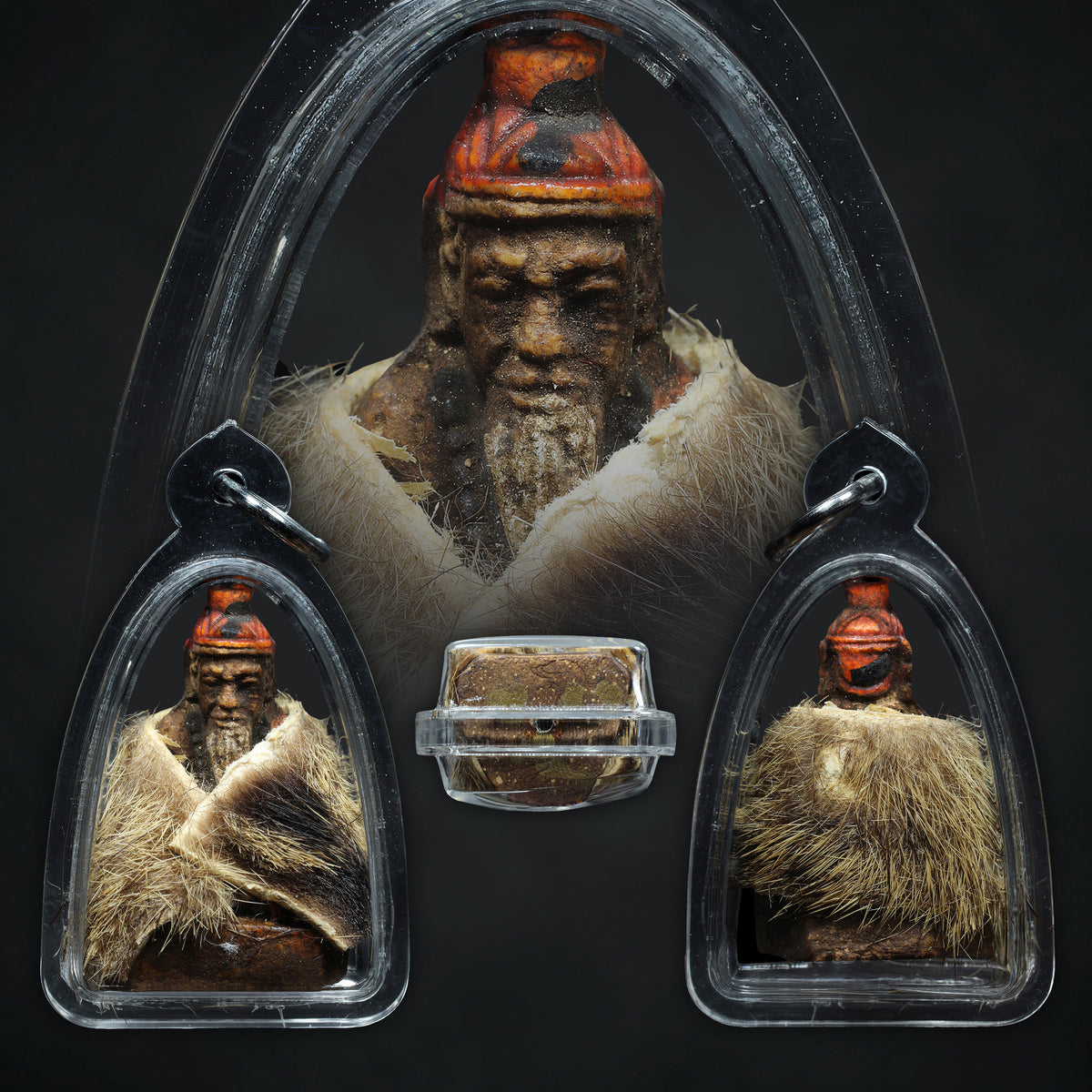
Some examples were additionally dressed with natural material around the body, giving individual pieces a distinctly forest-Lersi character.
Each artifact was individually carved, painted and assembled from natural sacred materials. Differences in grain, surface, pigment, natural covering and form are part of the original workmanship, making every surviving example individually distinctive.
Personal Experiences Shared by Luksits
Among Por Sala Tan's luksits, Lersi pieces were often carried during periods when direction was more important than immediate fortune.
Owners have spoken of turning towards the Lersi when facing difficult choices concerning business, employment, family matters or personal direction. Rather than expecting a sudden answer, they described becoming calmer and gradually seeing the situation more clearly.
Some experienced this simply as a change in judgement — becoming less impulsive, recognising something previously overlooked, or suddenly feeling that a particular route should not be taken.
Others associated their Lersi with protection during travelling or periods of uncertainty. They described moments when plans unexpectedly changed, journeys were delayed, or they reconsidered an action which later appeared to have been fortunate.
Practitioners also valued the image during meditation. Keeping the Lersi nearby became a means of settling the mind and remembering the discipline of the teacher lineage.
Summary
This is an early-period Lersi Narai by Por Sala Tan, carved from Mai Takien Kru Lek and individually hand-painted by him.
Select examples were carved from the inner core of lightning-struck Takien, a material traditionally regarded as carrying a particularly strong natural charge.
A takrut beneath the figure completes the ritual construction.
The principal qualities associated with this piece are Baramee, wisdom, meditation, protection, guidance, clarity of thought and steadiness when facing difficult circumstances.
Rather than being primarily a wealth or attraction artifact, its character is that of the teacher — helping the keeper remain composed, recognise the correct direction and move through uncertainty with greater discipline.
Historical Background
The Lersi occupies an important position within Thai and wider Southeast Asian esoteric traditions.
The Lersi is remembered as the hermit practitioner — one who withdraws from ordinary worldly life to pursue meditation, herbal knowledge, sacred sciences and Wicha.
For this reason, Lersi images are closely associated with teachers and transmission.
Keeping a Lersi is traditionally connected not only with seeking protection, but with showing respect towards the teachers from whom knowledge has descended.
Within Por Sala Tan's work, this relationship was particularly important.
His Lersi artifacts frequently incorporated materials associated with forests, caves, earlier practitioners and old ritual objects. The physical substance of the artifact therefore formed part of its story rather than merely serving as a convenient medium for carving.
This Lersi Narai follows that approach.
The association between Lersi Narai and the Takien tree gave Mai Takien Kru Lek a natural place within the construction. The tree represented the forest environment of practice, while the completed Lersi represented the teacher who practised within it.
Origins of the Materials
The principal material is Mai Takien Kru Lek.
Old Takien is a dense hardwood capable of surviving for long periods, making it suitable for small sacred carvings intended to be kept over generations.
Within the lineage account surrounding this artifact, Takien also carries an older spiritual association. Large and ancient trees were not regarded simply as timber; they could form part of the sacred landscape surrounding forest practice.
The most unusual material within this group came from the core of Takien struck by lightning.
In regional animist understanding, lightning is viewed as a direct elemental event capable of changing the ritual character of natural material. Wood surviving such a strike could therefore be retained for specialised sacred objects.
Not every example should automatically be assumed to come from the lightning-struck portion. It was a select material used for certain pieces within the group.
The remaining construction was completed with traditional pigments and the takrut positioned beneath the base.
Ritual
Once the carving was completed, Por Sala Tan personally worked upon the image.
The application of pigment formed part of this process. Areas of the face, headpiece and body were individually finished, giving these early examples their characteristic appearance.
The takrut beneath the base provided the principal ritual reinforcement.
Its purpose was to establish and stabilise the Wicha within the completed image, bringing together the Takien material and the invoked Lersi teacher-current.
The ritual emphasis centred upon awakening the Lersi image, strengthening Baramee, protecting the keeper and supporting wisdom and correct direction.
For examples containing lightning-struck Takien, the natural force associated with the wood was not treated separately from the Lersi. The intention was to bring the different elements into harmony rather than allowing the raw character of the material to dominate the artifact.
Blessings and Effects
The central quality of this Lersi Narai is guidance.
Within traditional belief, the Lersi is approached as a teacher — supporting clear judgement when the keeper encounters uncertainty or reaches an important turning point.
Baramee is another important aspect. The image is associated with composure, personal presence and the quiet authority that develops from knowledge rather than aggression.
For practitioners, the Lersi is traditionally used to support Samadhi, concentration and steadiness of mind.
Protection forms another layer of the Wicha. Lersi artifacts are commonly kept as guardians during travel, ritual practice and periods when the keeper feels surrounded by difficult or unsettled influences.
Its principal traditional qualities may therefore be understood as guidance, wisdom, Baramee, meditation, protection, mental clarity, obstacle navigation and respect from others.
Modern Application
The character of this piece makes it particularly suitable for people who regularly carry responsibility.
A business owner may use it as a reminder to remain composed before making an important decision.
A manager or leader may approach the Baramee aspect when dealing with people who require calm but firm direction.
A practitioner may keep it nearby during meditation or study.
For someone passing through a difficult period, its traditional purpose is less about producing an instant change than supporting the clarity needed to recognise the better path forward.
This distinction is important.
Some artifacts are traditionally approached for attraction.
Others for immediate Chok Lap.
The Lersi belongs to a different category.
Its value is the teacher-current — wisdom before action, steadiness before decision and protection while travelling one's chosen path.
Physical Details
An early-period seated Lersi Narai individually carved from Mai Takien Kru Lek and hand-painted by Por Sala Tan, with a distinctive reddish-orange headpiece and naturally aged surface. A takrut is inserted beneath the base for ritual reinforcement. This example is additionally dressed with natural material around the body, giving it a strong forest-hermit appearance. Natural differences in carving, grain, pigment, surface ageing and dressing are expected between individual examples.
Recommended Pairing
This Lersi Narai is already a complete artifact for guidance, Baramee, protection and meditation and does not require another piece to function within its traditional purpose.
For business, it can be paired with Maha Pokasap or Chok Lap where financial opportunity is also desired. The wealth piece addresses opportunity and accumulation, while the Lersi represents judgement and direction.
For occupations requiring extensive interaction with people, a Metta Maha Niyom piece can complement the Lersi's firmer Baramee.
For stronger protective emphasis, it may also be paired with Suer, particularly where the keeper regularly travels, manages difficult environments or requires greater authority.
Personal Notes
What makes this early Lersi Narai particularly interesting is not a complicated collection of ingredients, but the relationship between material, teacher and workmanship.
Por Sala Tan selected a wood already connected in his tradition with the Lersi lineage, carved the teacher into that material, personally painted the finished image and placed the takrut beneath it.
The construction is simple to understand, yet deeply rooted in the older logic of sacred craftsmanship.
The examples made from lightning-struck Takien add another dimension. Lightning represents sudden natural force; Lersi represents discipline and controlled knowledge. Bringing the two together symbolically places raw power beneath the direction of the teacher.
For this reason, I regard this piece primarily as one of guidance and Baramee.
When circumstances become complicated, strength alone is rarely enough.
The greater advantage is knowing when to advance, when to wait, and which path should be taken.
-
Free Shipping for Singapore| $15 Worldwide | $100 USA All products