
OOBThaiAmulets
Por Sala Tan
Por Sala Tan
Couldn't load pickup availability
PST06
Phra Phaya Khao Kham
Por Sala Tan
Barang Artifact
1.5 Inches
Sacred Craftsmanship
The reverse was subsequently prepared with Wahn Dok Thong, cemetery soil and the rare red Saneh herb Wahn Gai Daeng, together with Yin Tong, Ngan, takruts and Sai Sin. As each component was individually prepared and assembled by hand, natural differences in carving, texture and arrangement make every such artifact unique.
Personal Experiences Shared by Luksits
Artifacts of this type have produced numerous accounts from users concerning attraction and attention from the opposite sex.
The feedback has been particularly noticeable among people who frequent nightlife environments or work within the nightlife industry, where meeting strangers, social interaction and personal presence form a regular part of daily life.
Some users described receiving considerably more attention than usual, with people approaching them more readily, initiating conversations or showing an immediate interest in getting to know them.
Others associated the artifact with greater confidence when speaking with the opposite sex, easier introductions and a noticeable improvement in their ability to attract attention within crowded social environments.
This corresponds closely with the traditional character of Phaya Khao Kham, whose folklore centres upon exceptional charisma, personal magnetism and the ability to naturally attract admirers.
Summary
Phra Phaya Khao Kham is Por Sala Tan's interpretation of the northern Thai and Tai Yai-influenced charm figure Phaya Khao Kham.
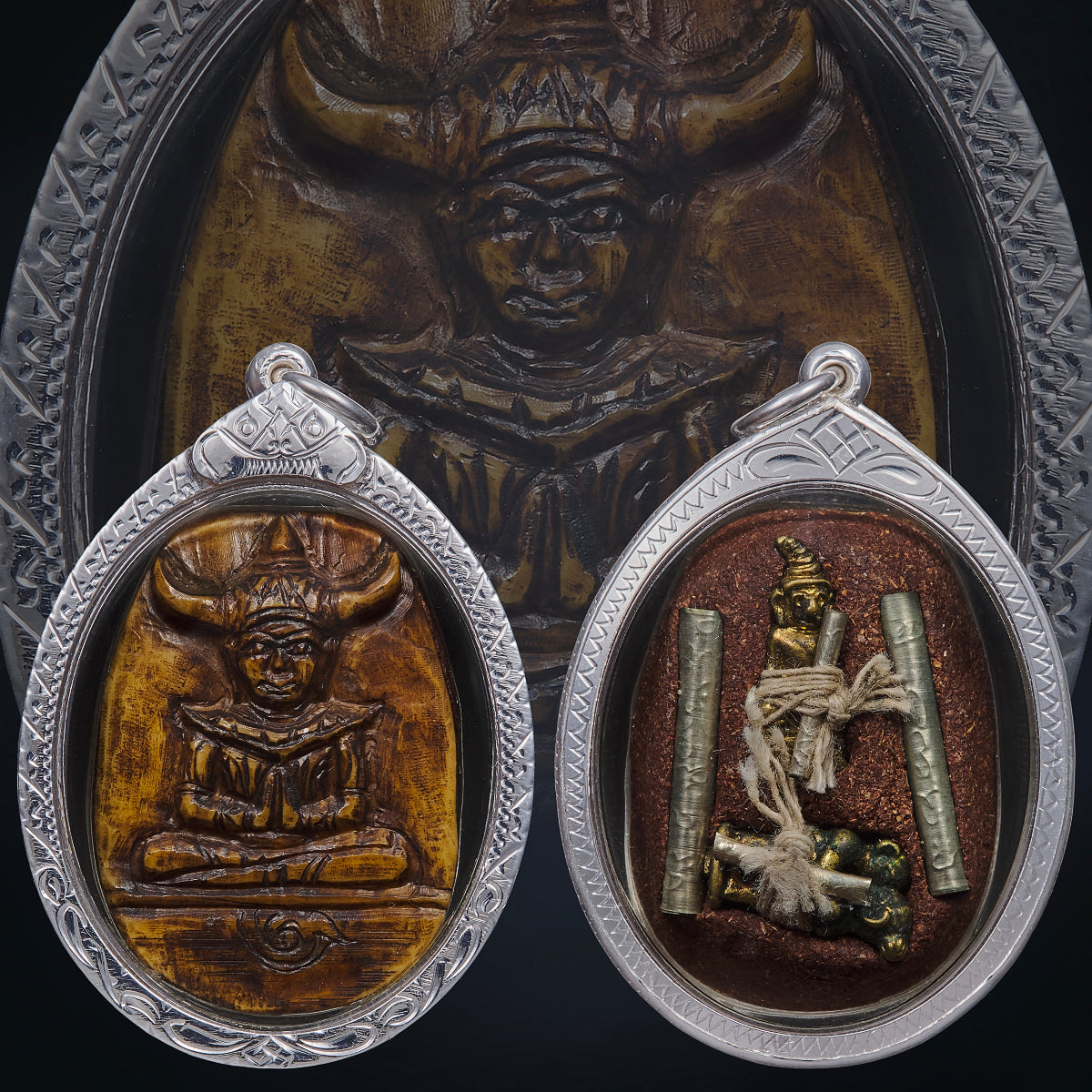
The front was carved directly onto an old hip relic, depicting Phaya Khao Kham seated beneath his distinctive horned form.
The reverse carries the more specialised Saneh component of the artifact. Wahn Dok Thong was combined with cemetery soil and Wahn Gai Daeng, a rare red Saneh herb that Por Sala Tan had obtained. Embedded within this prepared material are Yin Tong, Ngan, takruts and Sai Sin.
The resulting artifact brings together the traditional qualities associated with Phaya Khao Kham — Saneh, Metta, personal attraction, popularity, authority and prosperity — with Por Sala Tan's own Barang methods and sacred materials.
Historical Background
Phaya Khao Kham is a figure encountered within northern Thai, Lanna and Tai Yai-influenced folk traditions. In modern amulet culture, he is sometimes described as the “Khun Phaen of Lanna” because of his strong association with charisma, attraction and popularity.
One commonly related legend tells of a ruler who had no heir and prayed for a child. His wish was eventually answered through the birth of an extraordinary prince.
The prince was distinguished by golden horns, concealed beneath his royal headdress. As he matured, he became renowned for his appearance, prosperity, confidence and extraordinary ability to attract admirers.
In some versions of the story, the horns possessed a particularly intimate symbolism: they could only be removed by those women destined to become his partners.
The golden horn therefore came to represent more than physical attraction. It symbolised exceptional fortune, status, authority and a personal presence capable of drawing people towards its bearer.
For this reason, Phaya Khao Kham gradually became associated with qualities comparable to those sought through Khun Phaen traditions — particularly attraction, popularity, persuasive presence and success in interpersonal affairs.
Some practitioners additionally associate Phaya Khao Kham with the qualities of Indra, particularly sovereignty, authority and celestial protection. This is best understood as part of later spiritual interpretation rather than a single standardised Buddhist account of the figure.
Origins of the Materials
The foundation of this artifact is a piece of hip relic that had already been in Por Sala Tan's possession for some time.
Rather than immediately using it, he retained the relic until he considered that he had accumulated the appropriate materials to complete a Phaya Khao Kham.
The image was then individually carved directly into the relic.
The reverse contains a concentrated mixture centred upon traditional attraction materials. Wahn Dok Thong is associated in Thai occult herbal practice with Metta, Saneh and attraction, while Por Sala Tan also incorporated cemetery soil according to his Barang method.
Of particular importance is Wahn Gai Daeng, described by Por Sala Tan as a rare red Saneh herb that is difficult to obtain. It was incorporated specifically for the attraction aspect of the artifact.
Within this prepared base are Yin Tong and Ngan, both closely associated in Thai folk-occult practice with relationships, attraction and the interaction between male and female energies.
Several takruts provide additional written and consecrated elements, while Sai Sin physically binds together part of the arrangement and connects the piece with ritual blessing.
The complexity of the reverse reflects Por Sala Tan's intention that this should not simply be a carved image of Phaya Khao Kham, but a complete working artifact constructed around his Saneh traditions.
Ritual
Por Sala Tan's preparation began with the selection of the old hip relic and the carving of Phaya Khao Kham directly into its surface.
The fact that the relic had been retained for some time was significant. Por Sala Tan waited until he felt that the appropriate combination of materials was available rather than completing the piece immediately.
The reverse was then prepared with Wahn Dok Thong, Wahn Gai Daeng and cemetery soil, creating the foundation into which the smaller sacred components could be placed.
Yin Tong, Ngan and takruts were embedded into this base, while Sai Sin was incorporated into the completed arrangement.
Through consecration, these different components were brought together under the identity and wicha of Phaya Khao Kham, with particular emphasis upon Saneh, Metta, attraction, popularity and personal presence.
Blessings and Effects
The strongest traditional emphasis of this artifact is Saneh — personal attraction and magnetism.
Phaya Khao Kham is traditionally approached for the ability to make one's presence more noticeable and favourable to others. Within social situations, this may be understood as encouraging easier interaction, greater confidence and increased attention.
The artifact is also traditionally associated with Metta Maha Niyom, encouraging goodwill, friendliness and favourable treatment from people encountered in everyday life.
Its traditional purposes therefore include:
- Saneh and opposite-sex attraction
- Metta and popularity
- Greater confidence and personal presence
- Easier social interaction and conversation
- Persuasive speech and favourable attention
- Customer attraction and business relationships
- Authority, status and personal influence
- Prosperity and opportunity
The presence of Wahn Dok Thong, Wahn Gai Daeng, Yin Tong and Ngan makes the attraction aspect particularly prominent within this example.
Modern Application
Phra Phaya Khao Kham is especially relevant to people whose work depends heavily upon personal interaction, presentation and being remembered favourably.
This may include those working in sales, entertainment, hospitality, nightlife, customer-facing businesses or occupations requiring frequent networking.
It can also be carried before meeting clients, attending social functions, speaking publicly or entering situations where confidence and personal presence are important.
For relationships, its traditional purpose is attraction rather than control. The practical interpretation is therefore to support confidence, approachability and favourable interaction, while leaving another person's choices and boundaries entirely their own.
The repeated feedback from nightlife users is particularly consistent with this character of the artifact: environments involving frequent introductions and social contact naturally provide the clearest setting in which its traditional Saneh qualities would be noticed.
Physical Details
The artifact is an oval carved relic piece, with the front depicting Phaya Khao Kham seated beneath his characteristic prominent horns.
The aged surface of the relic remains visible around the carving, giving the image a distinctly organic character.
The reverse is considerably more complex. A prepared reddish-brown base of Wahn Dok Thong, rare Wahn Gai Daeng and cemetery soil supports an arrangement of Yin Tong, Ngan, takruts and Sai Sin.
Rather than hiding these materials within the artifact, Por Sala Tan left the principal components visible on the reverse, allowing its construction and ritual character to be immediately recognised.
This example is protected within a fitted casing for preservation and everyday wear.
Recommended Pairing
Phra Phaya Khao Kham can be worn alone when the principal intention is Saneh, Metta, social confidence and attraction.
For merchants and those working in sales, it may be paired with a wealth or customer-calling artifact so that Phaya Khao Kham concentrates upon personal magnetism and favourable interaction, while the accompanying piece supports financial movement and commercial opportunity.
For those regularly working late hours or within nightlife environments, a separate protective artifact such as Tao Wessuwan may provide a complementary balance between attraction and protection.
Personal Notes
What distinguishes this particular Phaya Khao Kham is the way Por Sala Tan approached its construction.
The hip relic had already been kept by him for some time. He did not immediately carve and complete it, but waited until he had gathered what he considered the suitable materials for the finished artifact.
Among these, Wahn Gai Daeng was especially notable because of its rarity and its traditional Saneh association.
Together with Wahn Dok Thong, cemetery soil, Yin Tong, Ngan, takruts and Sai Sin, it created a piece heavily centred upon the traditional attraction character of Phaya Khao Kham.
The subsequent feedback from users — particularly those involved in nightlife or frequently entering highly social environments — became one of the more consistent observations surrounding this type of artifact.
For me, this is a particularly interesting example of Por Sala Tan's work because the artifact was not created simply because a suitable relic was available.
He kept the relic and waited until he felt he had the right materials to complete the Phaya Khao Kham properly.
-
Free Shipping for Singapore| $15 Worldwide | $60 USA For Items Below $350