
OOBThaiAmulets
Por Sala Tan
Por Sala Tan
Couldn't load pickup availability
PST07
Suer Yan (Seua Yen)
Por Sala Tan
2 Inches
Mainstream Artifact
Individual Craftsmanship
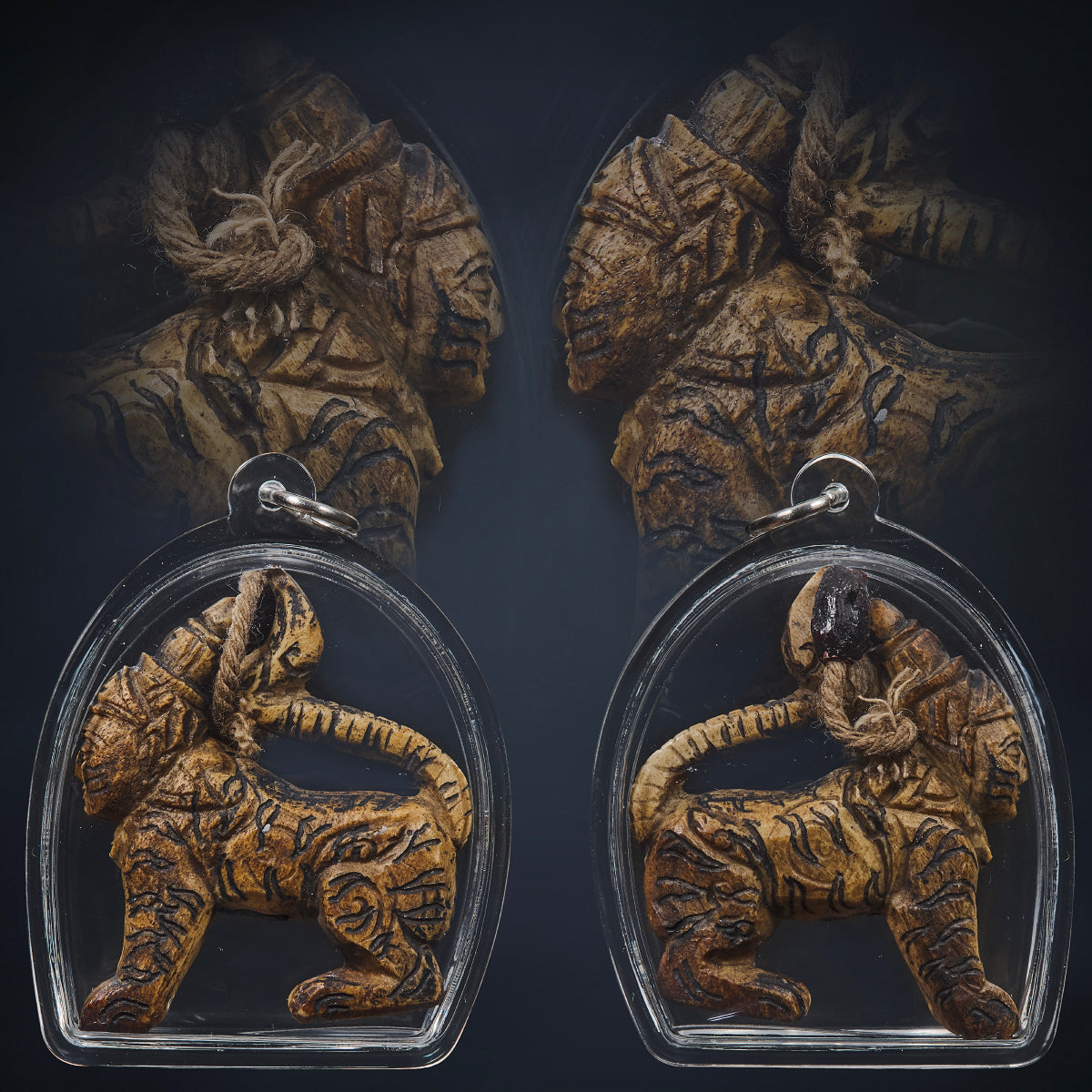
This Suer Yan, also known in this tradition as Seua Yen, is one of Por Sala Tan's more forceful tiger-based artifacts, combining the protective character of traditional tiger wicha with carefully added Metta elements.
Each piece was handmade from prepared sacred material. Natural differences in the Graduk, carving, handwritten yantra, Sai Sin and ritual substances make every example individually distinctive.
Personal Experiences Shared by Luksits
Although Suer Yan originates from much older protective traditions, it has become particularly popular among office workers and people working within competitive organisations.
The reason is practical.
Modern devotees do not necessarily encounter the physical dangers associated with older tiger wicha. Their difficulties may instead involve workplace politics, rivalry, difficult colleagues, competition for promotion, hidden opposition or people attempting to undermine their position.
Luksits traditionally interpret the defensive character of Suer Yan as helping the owner remain protected from such hostility and allowing harmful intentions to return without taking hold.
At the same time, the Si Peng Metta Maha Niyom prevents the piece from being purely confrontational. Devotees associate it with becoming more approachable, persuasive and memorable, particularly when dealing with superiors, customers and colleagues.
For timid personalities, Suer Yan has also traditionally been carried as a source of confidence — encouraging the bearer to stand firmly rather than becoming overwhelmed by stronger personalities.
Summary
Suer Yan is regarded as one of the fiercer expressions of tiger wicha within Northern Thai occult tradition.
Its symbolism centres upon the tiger as a creature that does not easily retreat: alert, territorial, fearless and capable of both attack and defence.
In Southern traditions, closely related ideas are commonly associated with Seur Saming, while Northern Lanna folklore preserves its own stories surrounding supernatural tiger beings and practitioners of tiger wicha.
Por Sala Tan's version brings this older tiger symbolism into a compact artifact carved from Graduk, inscribed with yantra, tied with Sai Sin and enhanced with Si Peng Metta Maha Niyom.
The result combines two apparently opposite qualities: the fierceness to withstand opposition and the Metta to gain cooperation without unnecessary confrontation.
Historical Background
Tiger wicha occupies an important place within older Thai occult traditions.
The tiger naturally came to represent fearlessness, territorial authority, survival and commanding presence. In esoteric practice these characteristics developed into wicha concerning Kongkrapan, Klaew Klaad, Maha Amnaj and protection against hostile spiritual influences.
Within Northern Thailand, one particularly mysterious branch of tiger folklore concerns the Seua Yen and Seur Saming traditions.
Stories vary considerably between communities. Some describe a practitioner who became deeply involved with tiger mantras and transformation rites until the boundary between practitioner and tiger spirit became unstable. Others describe a tiger that had killed or consumed humans and consequently acquired supernatural characteristics through the lingering spirits associated with its victims.
These are best understood as Lanna oral traditions and occult folklore, rather than literal historical accounts.
What remains consistent across the different versions is the idea of a tiger existing at the boundary between the ordinary and spiritual worlds — extremely powerful, difficult to dominate and traditionally approached with considerable respect.
Origins of the Materials
The foundation of this artifact is Graduk, individually selected and carved into the complete figure of a tiger.
The material provides an organic base upon which Por Sala Tan could carve and inscribe his tiger wicha.
Sacred yantra were written directly across the figure rather than being placed on a separate sheet. This makes the carved tiger itself both the image and the physical carrier of the inscriptions.
Sai Sin was tied around the upper part of the piece, further connecting the carving with ritual blessing.
Por Sala Tan then incorporated Si Peng Metta Maha Niyom, traditionally associated with attraction, goodwill, popularity and favourable responses from people.
This additional material is particularly important because it changes the character of the piece from purely fierce tiger wicha into a more balanced artifact suitable for everyday social and professional life.
Ritual
The Graduk was first shaped into the recognisable form of the tiger.
Yantra were then inscribed over the body, transforming the carving from a representation of a tiger into a physical carrier for the relevant wicha.
Sai Sin was tied to the artifact, while Si Peng Metta Maha Niyom was added to strengthen its softer qualities of attraction and goodwill.
Through consecration, the tiger symbolism was directed towards protection, fearlessness, authority and resistance against hostile influences.
The Metta component provided the counterbalance.
Rather than encouraging confrontation, the completed artifact was intended to allow the bearer to remain strong while still receiving cooperation, goodwill and favourable attention from others.
Blessings and Effects
The first traditional quality of Suer Yan is protection. It is associated with maintaining strong personal boundaries against hostile intention, occult interference and unseen disturbances.
Its tiger character also represents Maha Amnaj and Baramee — authority, presence and the confidence to stand firmly when challenged.
Suer Yan is traditionally connected with competitive advantage, particularly where several people are pursuing the same opportunity. In contemporary terms, devotees may relate this to negotiations, professional advancement, business competition or situations in which personal influence matters.
For those who are naturally timid or easily pressured, tiger wicha traditionally represents courage and decisiveness.
The addition of Si Peng Metta Maha Niyom introduces charm, attraction and social goodwill. Instead of authority based solely upon fear or force, the bearer seeks to become someone others notice, respect and are willing to assist.
Its prosperity aspect therefore comes largely through Baramee, professional influence and human relationships — opportunities arising because one's presence, confidence and connections become stronger.
Modern Application
Suer Yan has found a particularly interesting place in contemporary working life.
For an office worker, the "enemy" is rarely a literal attacker. It may instead be office politics, competition, gossip, hidden opposition, difficult negotiations or someone attempting to weaken one's standing with management.
Within traditional interpretation, the protective aspect of Suer Yan helps establish stronger personal boundaries against these pressures.
Its Maha Amnaj quality is relevant for meetings, negotiations and leadership, while Si Peng Metta Maha Niyom supports better relationships with colleagues, customers and superiors.
This combination also makes the piece relevant to people seeking promotion or greater responsibility. The tiger represents the confidence to step forward, while Metta encourages one's abilities and contributions to be received favourably.
For business owners and salespeople, the same principle applies: strong presence without losing approachability.
Physical Details
A hand-carved Suer Yan tiger formed from Graduk, with extensive dark yantra and sacred inscriptions applied directly across the head, body, legs and long curved tail. The carving retains the warm natural tones and irregular surface of the original material, while old Sai Sin is visibly tied around the upper section. Si Peng Metta Maha Niyomwas incorporated during preparation to add charm and goodwill to the otherwise forceful tiger wicha. The piece is now preserved within a clear protective casing.
Recommended Pairing
Suer Yan already provides a strong combination of protection, Maha Amnaj, confidence and Metta, making it suitable as a standalone artifact.
For professional use, it may traditionally be paired with a Buddha or respected monk amulet associated with Baramee and Metta, giving greater emphasis to calm authority and recognition.
For business and sales, pairing with Nang Kwak or Maha Pokasap wicha may place additional emphasis upon customers, commercial opportunity and wealth.
Personal Notes
What makes this Por Sala Tan Suer Yan particularly relevant today is how easily its old symbolism translates into modern circumstances.
The ancient tiger represented survival in an environment where weakness could carry immediate consequences. Today's office or business environment is very different, but people still encounter competition, pressure, hidden rivalry and situations requiring them to defend their position.
This helps explain why Suer Yan has become popular among office workers.
Yet Por Sala Tan did not prepare this piece around fierceness alone. The inclusion of Si Peng Metta Maha Niyom gives it an important balance.
The ideal is not to become aggressive towards every challenge. It is to possess the tiger's confidence when firmness is required, while retaining enough Metta for colleagues, superiors, customers and supporters to remain favourably disposed.
In that sense, this Suer Yan expresses a practical combination of protection against hostility, confidence under pressure, authority in competition and charm in human relationships.
-
Free Shipping for Singapore| $15 Worldwide | $60 USA For Items Below $350