
OOBThaiAmulets
Por Sala Tan
Por Sala Tan
Couldn't load pickup availability
PST07
Takrut Saneh
Por Sala Tan
3 Inches Takrut
Mainstream Artifact
Individual Craftsmanship
Each artifact was individually written, rolled, bound and assembled by hand. Natural differences in the sheets, cord, sacred thread, Phra Ngan and internal stuffings are therefore part of the individual craftsmanship of the piece.
Personal Experiences Shared by Luksits
This particular Takrut Saneh is memorable to me because I encountered it personally on one of Por Sala Tan's luksits in Bangkok.
He is one of the luksits I regularly catch up with whenever I travel to Thailand. Although connected with Por Sala Tan in Chiang Mai, he has been based in Bangkok for work for many years.
The takrut had already been with him for a long time when I saw it. He wore it traditionally around his waist, exactly as the piece had been intended to be used.
When I asked about his experience with it, his response concerning the Saneh effect was difficult for him to put into words.
He described his office colleagues as being extremely friendly towards him, with people frequently approaching him, wanting to interact and giving him attention. At times, he felt that the attention became more than he actually wanted.
For him, this was the most noticeable characteristic of the artifact after carrying it for many years: not one isolated incident, but a continuing pattern of friendliness, approachability and attention from people around him.
Summary
The Takrut Saneh is a particularly interesting Por Sala Tan artifact because its construction preserves a direct connection with Cambodian Maha Saneh wicha.
During a journey towards the Cambodian border, Por Sala Tan encountered a Cambodian monk from whom he learnt a specialised attraction formula.
Por Sala Tan subsequently wrote the Cambodian Maha Saneh yantra onto several separate sacred sheets, rolled them together and formed them into the takrut seen here.
The accompanying Phra Ngan also came from the Cambodian monk.
Rather than being worn around the neck like a conventional amulet, the Phra Ngan and takrut were tied together with cord and intended specifically for wearing below the waist.
This combination of handwritten Cambodian yantra, multiple rolled sheets and an original Cambodian Phra Ngan gives the artifact a clear and focused purpose: Maha Saneh, Metta and personal attraction.
Historical Background
Phra Ngan belongs to a broad family of talismanic figures encountered in Khmer, Thai, Lao and Isan occult traditions.
Its precise historical origin is difficult to establish, and different traditions preserve different explanations. Some connect Phra Ngan with Khmer guardian or spirit traditions, while others interpret the figure through ascetic, attraction, fertility or protective symbolism.
For this reason, an individual Phra Ngan is better understood through its specific maker and lineage rather than by attempting to apply one universal origin story to every example.
This is especially relevant here.
The small Phra Ngan was not added merely because Por Sala Tan generally associated the figure with Saneh. According to the provenance of the artifact, it came directly from the Cambodian monk connected with the wicha Por Sala Tan learnt during the same journey.
Within regional occult practice, Phra Ngan became particularly associated with Metta Maha Niyom, Maha Saneh, personal presence and favourable social interaction.
Those qualities correspond closely with the purpose of the accompanying takrut.
Origins of the Materials
The principal component consists of several sacred sheets individually inscribed by Por Sala Tan.
Each sheet carries Cambodian Maha Saneh wicha derived from the knowledge he received during his encounter with the Cambodian monk. Rather than being used independently, the sheets were rolled together to concentrate them within one takrut.
The accompanying Phra Ngan originated from the Cambodian monk himself.
Beneath the Phra Ngan are additional sacred stuffings connected with its preparation. These were retained together with the figure rather than removed when Por Sala Tan assembled the final artifact.
Cord and sacred bindings bring the two principal components together:
Por Sala Tan's handwritten Cambodian Maha Saneh takrut and the Cambodian monk's Phra Ngan.
Their shared provenance is an important part of the piece.
Ritual
The wicha behind this artifact began during Por Sala Tan's travels towards the Cambodian border.
Rather than simply acquiring a finished object, Por Sala Tan learnt a specialised Maha Saneh method from the Cambodian monk.
He later applied that knowledge himself.
The relevant yantra and formulas were handwritten across several sheets. Each was prepared individually before the sheets were rolled together to form the larger takrut.
The Cambodian Phra Ngan was then incorporated into the same arrangement. Its original sacred stuffings were retained beneath the figure, and both the Ngan and takrut were secured to the cord.
The completed artifact was prepared for below-waist wearing, reflecting the particular tradition in which this Saneh work was transmitted.
This makes the piece especially interesting as an example of knowledge being learnt, adapted and then physically combined with an artifact from the teacher who transmitted the wicha.
Blessings and Effects
Within the tradition surrounding this Takrut Saneh, its principal qualities are associated with:
- Maha Saneh — attraction and personal magnetism.
- Metta Maha Niyom — being liked and favourably received.
- Personal presence — becoming more noticeable to people around the keeper.
- Approachability — encouraging easier social interaction.
- Jeraja — smoother communication and conversation.
- Opposite attraction — a traditional quality strongly associated with this particular Saneh work.
- Social favour — support from colleagues, acquaintances and people encountered in everyday life.
- Business interaction — traditionally relevant where rapport and personal impression are important.
The long-term keeper's own experience particularly emphasised friendliness and attention from people around him, sometimes to a degree he personally regarded as excessive.
Modern Application
This artifact was specifically constructed as a wearable Saneh takrut.
According to the traditional method associated with the piece, it is worn below the waist, with the takrut and Phra Ngan remaining together on the cord rather than being separated.
Its traditional application is particularly relevant to situations where personal interaction matters — social environments, customer-facing occupations, business discussions and work requiring frequent communication with others.
However, its purpose is broader than romantic attraction alone.
Maha Saneh and Metta within this context concern how others respond to the keeper: friendliness, attention, willingness to interact and favourable personal reception.
Physical Details
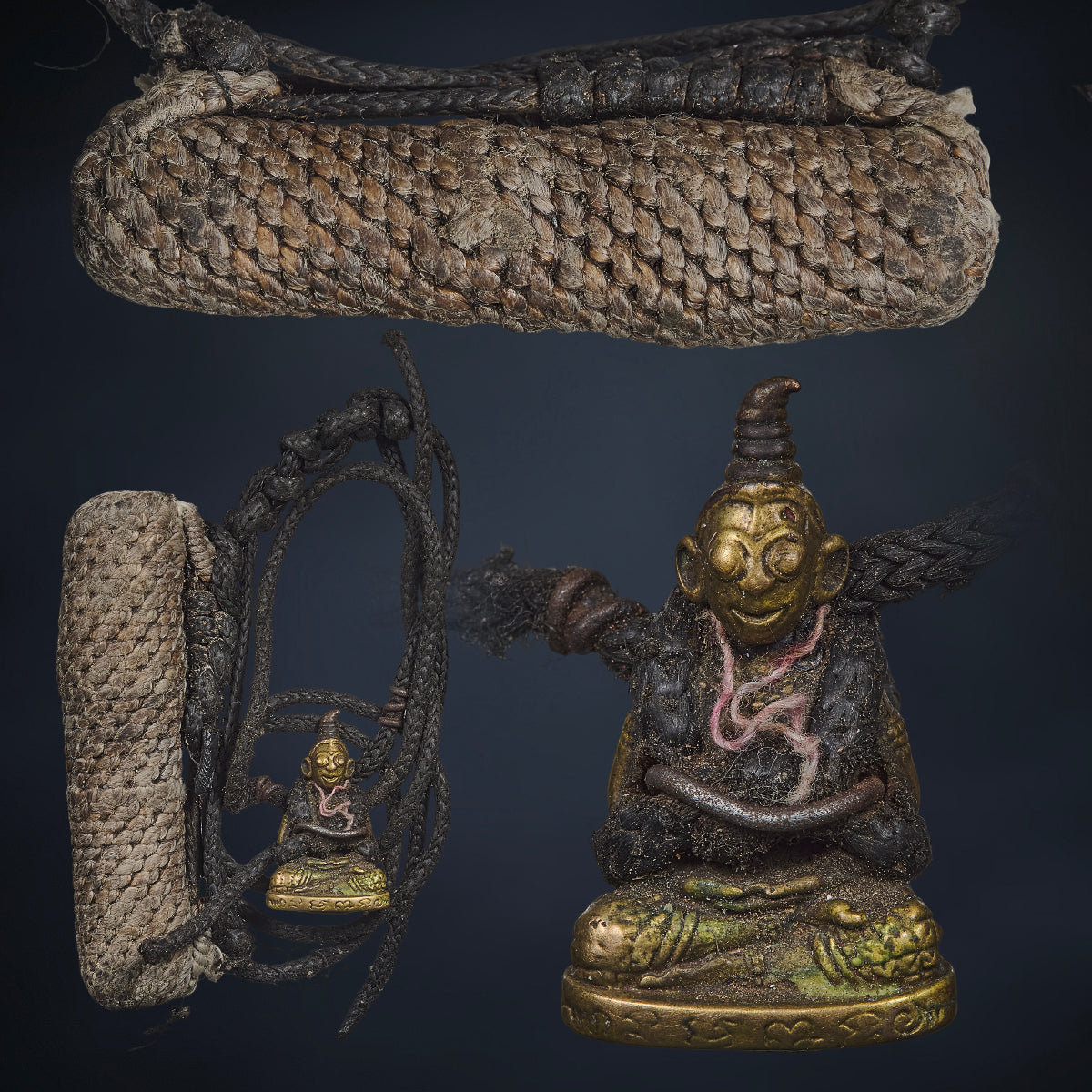
The artifact consists of a substantial multi-sheet rolled takrut secured within aged dark binding and attached to a long cord intended for wearing around the waist.
Attached to the same arrangement is a small seated Cambodian Phra Ngan. The figure has an aged metal surface with visible gold-toned areas and retains the characteristic facial form associated with regional Ngan imagery.
Beneath the Phra Ngan are sacred stuffings, while sacred thread and older bindings remain around the figure and its base.
The wear visible throughout the cord, bindings and surfaces is consistent with the history given by its keeper: this was not simply stored as a collection piece, but carried and worn for many years.
Recommended Pairing
This Takrut Saneh was conceived as a complete personal-wear artifact and does not require another Saneh piece to accompany it.
The combination is already deliberate: multiple Cambodian Maha Saneh yantra sheets provide the written wicha, while the Cambodian Phra Ngan reinforces the attraction and Metta aspect.
For business use, it could traditionally be paired with a Maha Lap or Riak Sap artifact where the keeper wishes to combine social favour with wealth and incoming opportunities.
For everyday personal use, however, keeping the original takrut and Phra Ngan together preserves the construction exactly as intended.
Personal Notes
This is one of those Por Sala Tan artifacts that became much more interesting to me after seeing how it had actually been used.
It belonged to a luksit whom I meet whenever I travel to Thailand. He works in Bangkok, and this takrut had already remained with him for many years.
It was not sitting untouched in a collection.
He was wearing it around his waist.
When we spoke about the piece, he explained that Por Sala Tan had prepared it after learning a special Maha Saneh wicha from a Cambodian monk during his travels towards the border. Por Sala Tan wrote the Cambodian formulas himself across several sheets and rolled them together, while the small Phra Ngan came from the Cambodian monk.
What stayed with me most, however, was the keeper's own experience.
After years of carrying it, he described his colleagues as exceptionally friendly towards him, with attention sometimes coming even when he did not particularly want it. To him, the Saneh effect of the piece needed very little explanation because he felt he had experienced it repeatedly in everyday life.
For me, this makes the Takrut Saneh especially meaningful. It preserves not only Cambodian wicha transmitted to Por Sala Tan, but also the history of an artifact that was genuinely carried and lived with by one of his luksits for many years.
-
Free Shipping for Singapore| $15 Worldwide | $60 USA For Items Below $350