
OOBThaiAmulets
Por Sala Tan
Por Sala Tan
Couldn't load pickup availability
PST07
Si Peng Prai
Por Sala Tan
1.5 Inches
Barang Artifact
Individual Craftsmanship
Each piece was assembled manually from surviving ritual materials, so differences in the relic, hair, cloth, Sai Sin and internal arrangement form part of the individual character of the artifact.
Personal Experiences Shared by Luksits
Among Por Sala Tan's luksits, this type of Si Peng was regarded differently from his more herbal-based Metta preparations.
Because the principal materials were connected to one Prai, followers regarded it as a more concentrated form of Saneh work, particularly where personal attraction, attention and interaction were concerned.
The Si Peng could traditionally be used in a small amount when required, particularly before meeting people, speaking with customers or entering situations where the keeper wished to strengthen personal presence and favourable attention.
Some luksits preferred not to disturb the preparation at all. Instead, they kept or carried the complete artifact, regarding the combination of the single-Prai Si Peng, Yin Tong, Sai Sin and charm takrut as a complete Saneh object in itself.
Summary
This Si Peng is unusual because its construction centres upon the materials of one particular Prai.
According to the account preserved with the artifact, the woman had passed away but remained strongly attached to the living world. Even after the funeral ceremony, her presence was said to linger.
Por Sala Tan was subsequently involved in appeasing the spirit.
After the rites, surviving materials connected with the funeral and cremation were incorporated into this Si Peng rather than being assembled from unrelated sources.
The preparation includes Nam Man Prai, unburnt coffin cloth, the woman's hair, relic material carved into Yin Tong, Sai Sin from the ceremony and a Saneh takrut.
For this reason, it is best understood as a single-Prai concentrated Si Peng, with its principal materials maintaining one continuous provenance.
Historical Background
Within Por Sala Tan's practice, Prai work refers to a distinct branch of wicha involving materials and ritual traditions associated with the deceased.
Such artifacts should not all be treated as identical. Their construction, provenance and purpose can vary considerably depending upon the circumstances surrounding the materials and the particular ritual undertaken by the practitioner.
This piece is especially notable because its provenance does not involve the gathering of miscellaneous funeral materials from different sources.
Instead, the principal components are said to originate from one woman and the rites surrounding her passing.
The Yin Tong symbolism adds another layer. Traditionally representing a paired male and female principle, Yin Tong is commonly connected with Maha Saneh, attraction and the drawing together of people.
Here, that symbolism was physically carved into relic material associated with the same Prai.
Origins of the Materials
The principal material is the Si Peng itself, prepared with Nam Man Prai associated with the deceased woman.
Several surviving materials from her funeral and cremation were then incorporated.
A portion of unburnt coffin cloth was retained. Hair belonging to the woman was also included, preserving another direct physical connection to the original source.
Surviving relic material was carved into a small Yin Tong rather than simply being inserted in its original form.
This Yin Tong was then tied using Sai Sin that had been used during the funeral ceremony, maintaining the connection between the carved relic and the rites conducted for the deceased.
Finally, a takrut for strengthening Saneh and charm was incorporated into the preparation.
The materials therefore share a closely connected provenance rather than being assembled merely for variety.
Ritual
The preparation began with Por Sala Tan's involvement in the circumstances surrounding the lingering spirit.
According to the lineage account, although the woman's funeral had already taken place, her attachment to the living world remained. Her spirit was consequently said to linger rather than depart peacefully.
Por Sala Tan undertook the work of appeasing the spirit.
After the necessary rites, surviving materials from the funeral and cremation became the foundation for this artifact.
The Nam Man Prai was incorporated into the Si Peng. Unburnt coffin cloth and hair were retained, while a surviving relic was carefully carved into Yin Tong.
The carved Yin Tong was bound with the same Sai Sin associated with the ceremony, creating a direct connection between the relic and the rites performed for the deceased.
A dedicated Saneh takrut completed the preparation.
Rather than combining many unrelated Prai sources, the entire construction remained centred upon one spirit, one funeral provenance and one body of materials.
Blessings and Effects
Within Por Sala Tan's tradition, this Si Peng is principally associated with:
- Maha Saneh — attraction and personal magnetism.
- Metta Maha Niyom — favourable reception and goodwill.
- Jeraja — smoother speech and interpersonal communication.
- Personal presence — traditionally used when wishing to be noticed or remembered.
- Opposite attraction — associated with the Yin Tong and Saneh aspect of the preparation.
- Customer interaction — traditionally relevant to sales and occupations involving direct contact with people.
- Social favour — encouraging warmer and more receptive interaction.
- Prai assistance — understood within the lineage through the concentrated single-Prai nature of the artifact.
The central character of this piece remains Saneh and Metta, strengthened through materials maintaining a direct connection to the same Prai.
Modern Application
Traditionally, a small amount of the Si Peng may be applied when required, particularly before situations involving important personal interaction.
This may include meeting customers, discussing business, negotiating or entering a social situation where speech, presence and favourable reception are important.
Because this is a concentrated Prai preparation, some keepers may instead choose to leave the internal materials undisturbed and carry or keep the complete artifact as it is.
It may also be placed respectfully in an appropriate personal sacred space rather than used physically.
The defining point is that the Si Peng, Yin Tong, funeral Sai Sin, hair, coffin cloth and takrut were prepared as one complete ritual arrangement.
Physical Details
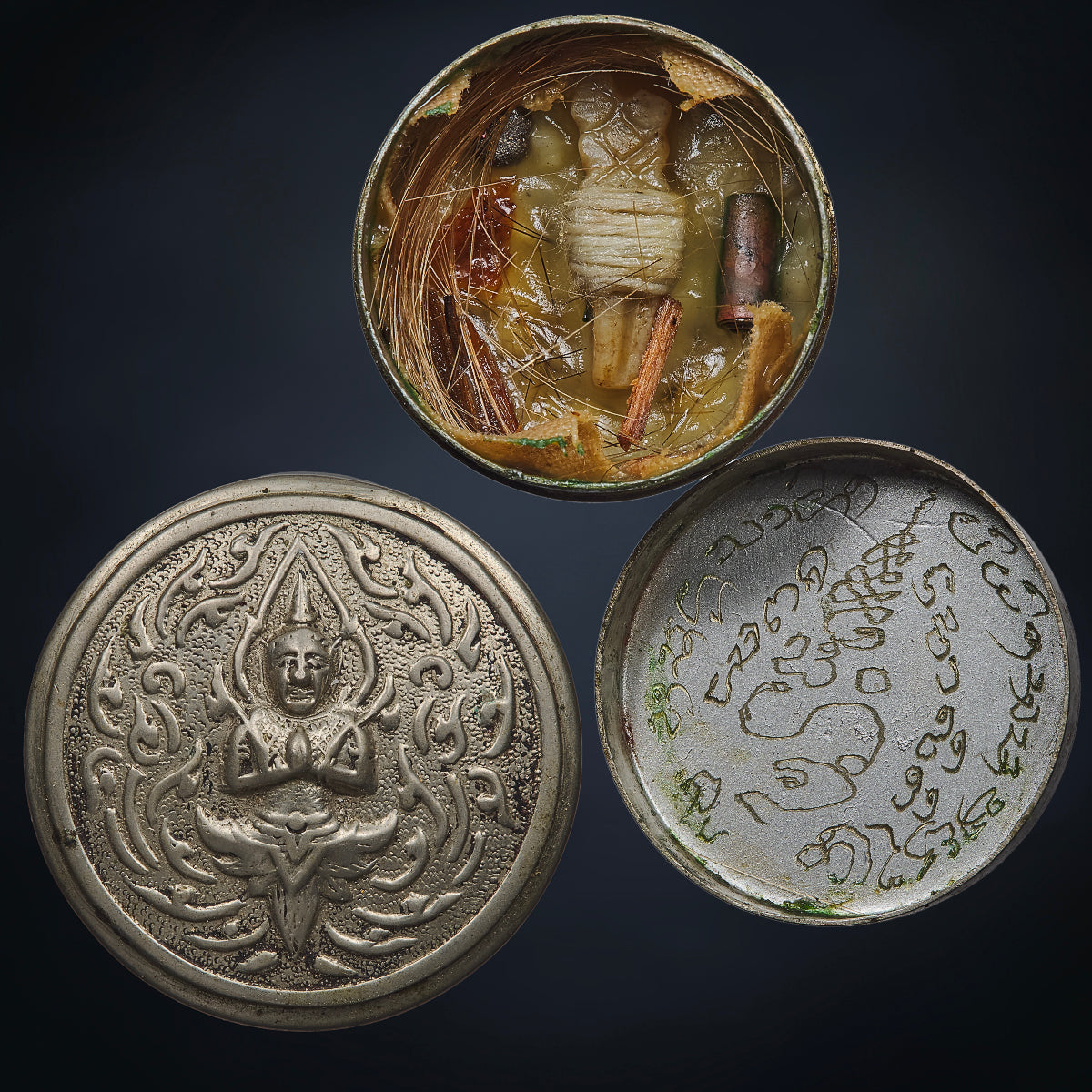
The artifact is housed within a round metal container. The exterior lid carries a raised sacred figure surrounded by ornamental motifs, while the inside of the opposing cover bears handwritten sacred inscriptions and yant.
Within the main chamber is the aged Si Peng preparation. Visible among it are the relic-carved Yin Tong bound with Sai Sin, a rolled takrut, hair and surviving ritual materials associated with the funeral and cremation.
The arrangement remains deliberately exposed rather than hidden beneath a decorative covering, allowing the individual components of the original preparation to remain visible.
Recommended Pairing
This Si Peng is already a highly concentrated Prai and Maha Saneh artifact, so additional Saneh pieces are not necessary.
For business purposes, it may traditionally be paired with a Riak Sap or Maha Lap artifact, separating the functions clearly: this piece for Metta, Saneh and human interaction, and the accompanying piece for wealth and opportunity.
For someone whose work relies heavily upon speaking, a Jeraja takrut would also be a natural complement.
However, because all of its principal components originate from one connected ritual account, there is also good reason to preserve and use the artifact as a complete standalone piece.
Personal Notes
What stands out to me about this Si Peng is its single-Prai provenance.
It was not made by gathering powerful-looking materials from numerous unrelated sources. The story, rites and physical components all return to one woman whose attachment to the living world was said to remain after her funeral.
Por Sala Tan undertook the task of appeasing her spirit, and materials remaining from those rites were subsequently incorporated into this artifact.
The details preserve that connection particularly well: her hair, unburnt coffin cloth, Nam Man Prai, Sai Sin from the ceremony and relic material carved into Yin Tong.
A Saneh takrut was then added to complete the intended direction of the work.
For me, this makes the piece an important example of Por Sala Tan's more concentrated Prai practice. Its significance is not simply the number of unusual materials inside, but that those materials belong to one continuous story, one funeral ceremony and one Prai.
-
Free Shipping for Singapore| $15 Worldwide | $60 USA For Items Below $350