
OOBThaiAmulets
Por Sala Tan
Por Sala Tan
Couldn't load pickup availability
PST07
Si Peng Maha Saneh
Por Sala Tan
3cm x 2cm
Barang Artifact
Individual Craftsmanship
Each container was individually carved from natural wood and prepared by hand. Differences in grain, shape, surface, Si Peng texture and the placement of the internal materials make every surviving piece naturally unique.
Personal Experiences Shared by Luksits
Por Sala Tan's luksits traditionally used this Si Peng particularly when speech, personal interaction and favourable reception were important.
A small amount could be applied when required before meeting someone, discussing business, speaking with customers or entering a situation where gaining goodwill was considered useful.
Luksits commonly associated the preparation with making one's speech feel softer and easier for others to receive, while strengthening Metta and personal charm.
For people involved in business or sales, its use naturally extended to customer interaction — particularly situations where conversation, trust and personal impression could influence whether an enquiry progressed further.
Not every keeper applied the Si Peng directly. Some simply carried the entire Mai Rak container on themselves as a personal Metta artifact, keeping the old Si Peng, Nam Man Prai, Yin Tong and yantra together.
These remain traditional understandings and experiences shared within the lineage rather than guaranteed effects.
Summary
This is an earlier form of Por Sala Tan's Si Peng Maha Saneh, prepared differently from some of his later Si Peng pieces.
Its foundation is a hand-carved Mai Rak container, made from the highest upward-pointing branch selected according to Por Sala Tan's instructions.
Inside is his old Si Peng preparation mixed with Nam Man Prai.
A small Yin Tong carved from relic material was then embedded within the Si Peng to strengthen its Maha Saneh aspect, while a small Metta yantra was added to reinforce goodwill, favourable reception and personal interaction.
The completed artifact could therefore be used in two ways: a small amount of Si Peng could be applied when needed, or the entire wooden container could simply be carried as a Metta Maha Saneh artifact.
Historical Background
Si Peng belongs to the traditional family of ritual preparations associated with Metta Maha Niyom and Maha Saneh.
Although Maha Saneh is often immediately associated with attraction, its traditional application can be considerably broader. Such preparations may be used where a person wishes to be liked, listened to, remembered or treated favourably.
This makes Si Peng relevant not only to relationships but also to commerce, negotiation and everyday social interaction.
The choice of Mai Rak for the container strengthens this symbolism.
In Thai, rak carries the meaning of love and affection. Within the wicha surrounding this artifact, the wood was therefore selected specifically for its association with fondness, goodwill and attraction.
Por Sala Tan further developed these qualities through the addition of Nam Man Prai, Yin Tong and Metta yantra work.
Origins of the Materials
The container begins with Mai Rak wood.
Por Sala Tan did not instruct his luksits to take just any available section of the tree. They were required to identify the highest branch growing upwards, after which the selected wood was brought back and carved into the container.
Inside was placed an earlier batch of Si Peng mixed with Nam Man Prai.
A small Yin Tong was carved from relic material and embedded directly into the preparation. Yin Tong traditionally represents the paired male and female principle and is closely associated in occult practice with attraction, affection and relationship-oriented wicha.
Beside it was placed a small Metta yantra, providing another layer directed towards goodwill and favourable reception.
The materials therefore follow a consistent theme: Mai Rak, Si Peng, Nam Man Prai, Yin Tong and Metta yantra, all brought together around Metta Maha Niyom and Maha Saneh.
Ritual
The preparation began with the selection of the Mai Rak tree.
Following Por Sala Tan's requirements, luksits searched for an appropriate tree and took the highest upward-pointing branch. The selected wood was then individually hollowed and shaped into a small container with its own fitted cover.
Por Sala Tan's earlier Si Peng preparation was mixed with Nam Man Prai before being placed inside.
The relic material was separately carved into the form of Yin Tong and positioned directly within the Si Peng. A small yantra prepared for Metta was then added beside it.
Rather than keeping these components separate, they were physically brought together inside the Mai Rak container.
The completed construction therefore combines several related branches of the same work:
Mai Rak for love and fondness.
Si Peng for Metta and Saneh.
Nam Man Prai for attraction.
Yin Tong for the drawing together of people.
Metta yantra for favourable reception.
Blessings and Effects
Within Por Sala Tan's tradition, this preparation is principally associated with:
- Metta Maha Niyom — goodwill and favourable treatment.
- Maha Saneh — attraction and personal charm.
- Jeraja — smoother speech and communication.
- Personal presence — helping the keeper to be noticed and remembered.
- Likeness and affection — encouraging warmer reception from others.
- Business and sales — particularly where success depends upon personal interaction.
- Customer relations — supporting smoother conversations and rapport.
- Relationship harmony — traditionally associated with warmth and closeness.
The emphasis is therefore not simply upon attraction, but upon speech, interaction and how one is received by other people.
Modern Application
This Si Peng was intended to remain practical.
According to the traditional instructions passed with the piece, a small amount may be applied when needed, particularly before situations where speech and Metta are important.
This may include customer meetings, negotiations, business discussions or occasions where the keeper wishes to communicate more smoothly and make a favourable impression.
Alternatively, there is no requirement to remove or use the Si Peng itself.
The complete Mai Rak container can simply be carried on the person as a Metta artifact. In this way, all of its original components remain together and undisturbed.
Physical Details
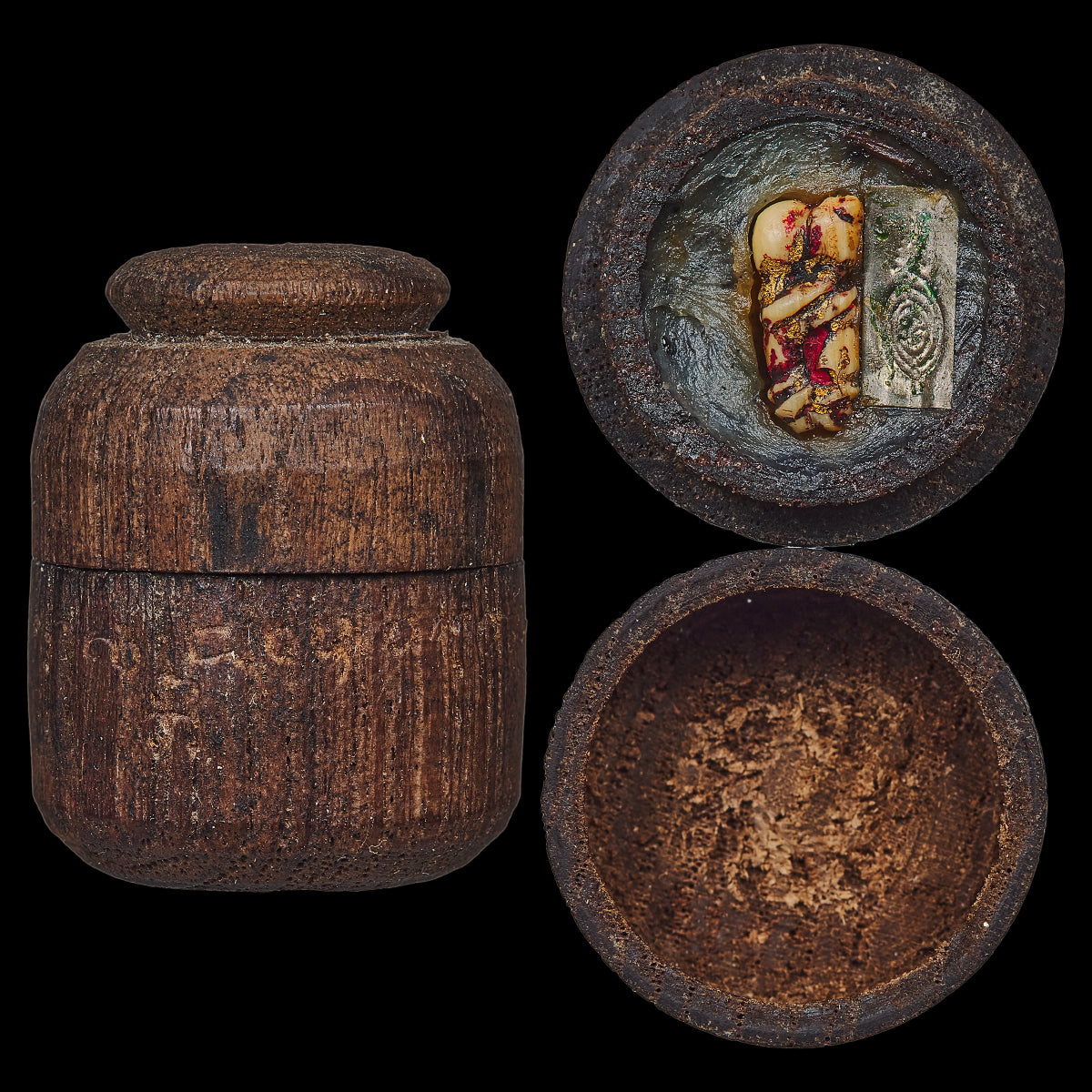
The artifact consists of a compact cylindrical container individually carved from Mai Rak wood, with a fitted wooden lid. The exterior retains its natural dark-brown grain, aged surface and visible hand-worked character.
Inside is the dense, aged Si Peng and Nam Man Prai preparation. Embedded prominently within it is a small Yin Tong carved from relic material, alongside a small metal Metta yantra.
The simple exterior contrasts strongly with the internal construction. When closed, it appears to be a small old wooden container; when opened, the principal ritual materials of the artifact are revealed.
Recommended Pairing
Because this Si Peng already combines several complementary forms of Metta Maha Niyom and Maha Saneh wicha, it can comfortably be carried by itself.
For someone using it primarily for business, it may be paired with a Riak Sap, Maha Lap or Choke Lap artifact, combining favourable human interaction with wealth and opportunity.
For professions heavily dependent upon speaking, negotiation or customer relationships, a Jeraja takrut would also form a natural pairing.
However, its original combination of Mai Rak, Si Peng, Nam Man Prai, relic Yin Tong and Metta yantra already makes it a complete personal Metta artifact.
Personal Notes
What distinguishes this piece from the other Si Peng preparations is that it belongs to an earlier formulation in which Por Sala Tan mixed the Si Peng with Nam Man Prai.
The Mai Rak container itself was also not incidental.
Por Sala Tan specifically instructed his luksits to locate the tree and select its highest branch pointing upwards before carving the container. This meant that preparation began with the selection of the wood, long before anything was placed inside.
The relic-carved Yin Tong is another feature I particularly appreciate. Rather than simply adding a small manufactured figure, relic material was carved into Yin Tong and placed directly into the old Si Peng alongside the Metta yantra.
The completed piece is therefore very compact, but everything within it follows the same purpose.
Mai Rak for fondness, old Si Peng and Nam Man Prai for Saneh, Yin Tong for attraction, and the yantra for Metta.
It is a very characteristic early Por Sala Tan creation — simple from the outside, but carefully layered with several forms of Metta Maha Saneh wicha inside.
-
Free Shipping for Singapore| $15 Worldwide | $60 USA For Items Below $350