
OOBThaiAmulets
Por Sala Tan
Por Sala Tan
Couldn't load pickup availability
PST07
Bobo Aung
Por Sala Tan
3 inches x 2 Inches
Mainstream Artifact
Individual Craftsmanship
Each mini Bucha of this nature was individually carved and ritually assembled. Differences in the grain of the Pyung wood, painted surface, inscriptions and finishing are therefore part of its individual craftsmanship and history.
Personal Experiences Shared by Luksits
Among followers familiar with Burmese Weizza objects, Bobo Aung is approached somewhat differently from many of Por Sala Tan's spirit-related artifacts.
The emphasis is often upon guidance, protection, opportunity and overcoming obstacles.
Luksits who respect this tradition commonly keep such an image in the home, workplace or business as a representation of the teacher lineage. Rather than asking only for material gains, they may seek clarity when facing an uncertain decision, protection while travelling, assistance when circumstances become difficult, or an opening when progress appears blocked.
The wish-granting takruts placed beneath this particular Bucha naturally add another dimension. Within the tradition, requests may concern livelihood, work, business, protection or an important personal objective.
These understandings belong to the devotional and occult traditions surrounding the artifact rather than representing guaranteed outcomes.
Summary
This Bobo Aung Bucha preserves an unusual connection between Por Sala Tan's northern practice and a Burmese Weizza lineage encountered around Mount Popa.
Por Sala Tan travelled to the Mount Popa region for several purposes. He spent time meditating there while searching the surrounding landscape for sacred herbs and other natural materials that could later be incorporated into his spiritual work.
But collecting materials was only one part of the journey.
During his time around Mount Popa, Por Sala Tan also met practitioners whose traditions were deeply rooted in Burma. One particularly important encounter was with a Burmese Weizza practitioner.
Although they came from different backgrounds, the two were able to discuss and exchange their respective wicha. Through this meeting, Por Sala Tan gained further understanding of Burmese Weizza practice and the importance given to its principal teachers.
The Weizza subsequently presented Por Sala Tan with a small number of artifacts connected with Burmese occult practice and his own lineage of wicha.
This Bobo Aung Bucha was one of them.
Historical Background
Bobo Aung, also written Bo Bo Aung or Bo Bo Ong, is one of the best-known figures associated with the Burmese Weikza or Weizza tradition. Rather than being represented simply as an ordinary historical monk, his identity is preserved through a mixture of Burmese religious tradition, sacred biography, royal folklore and esoteric practice.
Traditions commonly associate Bobo Aung with the Konbaung period, although accounts differ considerably concerning his exact lifetime. Some place him around the reign of King Bodawpaya, while other traditions give him an earlier origin. This uncertainty is one reason his story is better understood as sacred or hagiographic tradition rather than a completely documented modern biography.
The Weizza tradition itself brings together Buddhist practice with meditation, mantra, sacred writing, healing and alchemical knowledge. Accomplished Weizza figures are traditionally regarded as teachers and protectors capable of continuing to assist later generations of practitioners.
Bobo Aung therefore represents more than an individual figure. For many devotees, his image represents the continuity of Burmese esoteric knowledge and the baramee of the teacher lineage.
Origins of the Materials
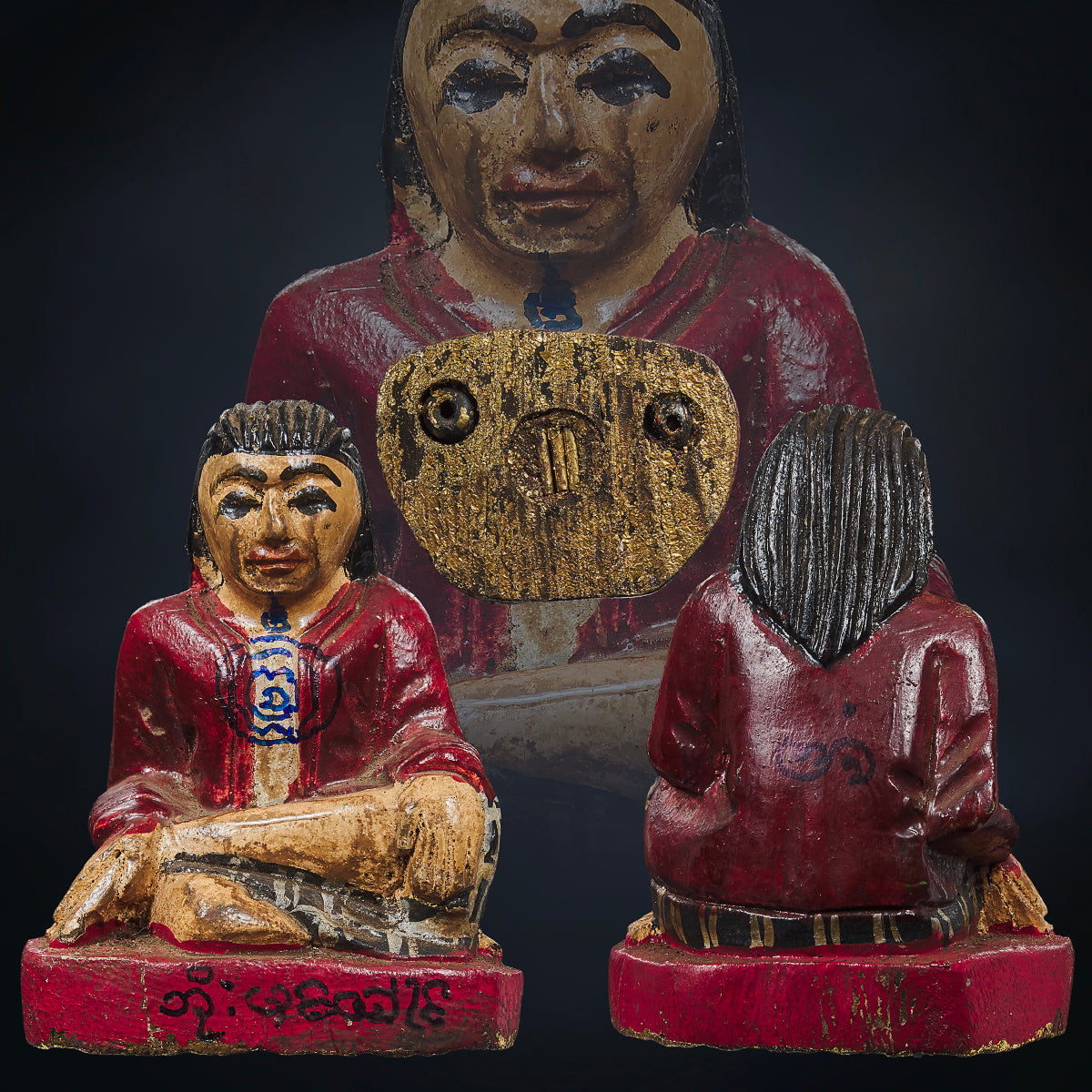
The principal material of this Bucha is said to be Pyung Wood, a wood regarded within the lineage as auspicious and traditionally associated with protective carving.
The image was carved into the seated form of Bobo Aung and subsequently painted by hand. Its strong red clothing, facial detailing and aged surface give it the characteristic appearance of an individually prepared Burmese devotional figure.
More significant materials are concealed underneath.
Chanting beads belonging to the Burmese Weizza practitioner himself were taken from his chanting necklace and embedded beneath the Bucha. Their importance is therefore one of lineage: they preserve a physical connection to the practitioner through whom the artifact reached Por Sala Tan.
Also contained within the base is Din Chet Wat, or sacred earth from seven temple grounds in Burma. Within the practice surrounding the piece, the seven temple soils provide an auspicious and cleansing foundation, balancing the more explicitly occult components of the artifact.
Finally, wish-granting takruts were inserted into the base, completing the internal preparation.
Ritual
The Bucha originated within the Burmese Weizza practitioner's tradition before being passed to Por Sala Tan.
Its preparation centred upon the carved Bobo Aung image and the establishment of a physical connection with the teacher lineage through the materials concealed beneath it.
The personal chanting beads are particularly meaningful in this respect. A bead repeatedly used during recitation is not treated simply as decorative material within such traditions. Its significance comes from its association with the practitioner's accumulated prayers and practice.
The seven temple soils established the sacred Buddhist foundation beneath the image, while the accompanying takruts were directed towards the fulfilment of appropriate wishes and aspirations.
The exchange between Por Sala Tan and the Burmese practitioner was equally important. Their meeting was not simply an occasion on which an artifact changed hands; knowledge and wicha were exchanged between them.
The Bucha therefore became a physical record of that encounter.
Blessings and Effects
Bobo Aung is traditionally associated with a broad range of qualities within Burmese Weizza devotion. These include:
- Protection — particularly against danger and harmful spiritual influences.
- Klaew Klad — avoidance of danger and difficult circumstances.
- Baramee — spiritual presence, authority and support.
- Metta — goodwill and favourable assistance from others.
- Wisdom and guidance — particularly when confronting difficult decisions.
- Choke Lap — luck, opportunity and prosperity.
- Work and livelihood — smoother progress in career and business.
- Overcoming obstacles — finding a way forward when circumstances appear blocked.
- Wish granting — particularly relevant to the takruts concealed beneath this Bucha.
Modern Application
As a Bucha rather than a small wearable amulet, this piece is naturally suited to a home altar, office, shop or dedicated sacred space.
For business owners, it may traditionally be respected for opportunity, livelihood and favourable progress. For practitioners, its deeper significance lies in its association with the Burmese Weizza teacher lineage, meditation and the transmission of sacred knowledge.
It may also serve as a focus before travelling or undertaking something important, particularly when the devotee seeks protection, clear judgement or assistance in overcoming an obstacle.
In this sense, the Bucha should not be understood merely as an object for requesting wealth. Its traditional symbolism is considerably broader: teacher, protector, guide and representation of accumulated wicha.
Physical Details
The Bucha depicts Bobo Aung seated in Burmese dress, carved from what the lineage identifies as Pyung Wood and finished by hand with red, cream, black, blue and gold-painted details. The reverse retains the pronounced vertical grain and carved texture of the wooden body, together with a handwritten sacred marking.
The underside forms the concealed ritual chamber of the artifact. Embedded within are chanting beads from the Burmese Weizza practitioner's own chanting necklace, Din Chet Wat from seven sacred temple grounds in Burma, and wish-granting takruts.
Its hand-carved facial features, aged painted surface and visible wear remain part of the character of the original piece rather than something intended to appear mechanically uniform.
Recommended Pairing
This Bobo Aung Bucha already carries a broad combination of teacher-lineage, protection, guidance and wish-granting symbolism, so it can comfortably serve as the principal object within a small altar arrangement.
It may be paired with Burmese or Lanna artifacts associated with Klaew Klad and protection when the emphasis is travel and personal safety, or with Riak Sap and Choke Lap pieces where the intention centres upon livelihood and opportunity.
For practitioners studying wicha, however, the most natural interpretation is simply to keep Bobo Aung in the position of a respected teacher figure, rather than surrounding the Bucha with too many unrelated artifacts.
Personal Notes
What interests me most about this Bobo Aung Bucha is its connection to Por Sala Tan's journey to Mount Popa.
He did not travel there simply looking for unusual materials. He spent time meditating, searching for sacred herbs and meeting practitioners whose knowledge came from traditions different from his own.
It was during this period that he encountered the Burmese Weizza practitioner.
Despite their different backgrounds, they were able to sit together and exchange knowledge and wicha. The Burmese practitioner subsequently gave Por Sala Tan several artifacts connected with his practice and teacher lineage, and this Bobo Aung Bucha was among them.
The chanting beads hidden beneath the image make that provenance particularly meaningful. They had belonged to the Weizza himself and had formed part of his chanting necklace before being incorporated into the Bucha.
Together with the seven temple soils and wish-granting takruts, they make this much more than a carved representation of Bobo Aung.
For me, it is a surviving record of an encounter at Mount Popa — a Burmese Weizza artifact that entered Por Sala Tan's collection through the direct exchange of wicha between practitioners.
-
SG: Free | Worldwide except USA: $20 Registered | USA: $25 Registered / $100 Courier (SGD)