
OOBThaiAmulets
Por Sala Tan
Por Sala Tan
Couldn't load pickup availability
PST07
Phra Khun Paen
Por Sala Tan
2 Inches
Mainstream Artifact
Individual Craftsmanship
As each example was mixed, pressed, soaked, assembled and tied by hand, variations in colour, surface, pressing depth, lead-sheet markings and Sai Sin are natural. Each artifact has its own individual character.
Personal Experiences Shared by Luksits
These Khun Paen were particularly favoured by luksits working in sales and customer-facing occupations.
Those who carried them generally sought something that could support the human side of business: being easier to approach, creating a good first impression, speaking comfortably with customers and encouraging discussions to continue rather than ending quickly.
Salespeople have associated Por Sala Tan's Metta and Saneh works with customers appearing more receptive and understanding, especially during negotiations or when explaining products and services.
Others speak of easier introductions, customers returning after an initial enquiry, and conversations developing more naturally.
For this reason, the piece was not regarded simply as a romantic Saneh amulet. Its attraction qualities were equally relevant to sales, negotiation, networking and customer relationships.
Summary
This Phra Khun Paen represents a comparatively uncommon style of Por Sala Tan's work: a traditional hand-pressed powder Khun Paen.
The front takes the familiar Khun Paen form, while its construction concentrates strongly upon Metta Maha Niyom and Maha Saneh.
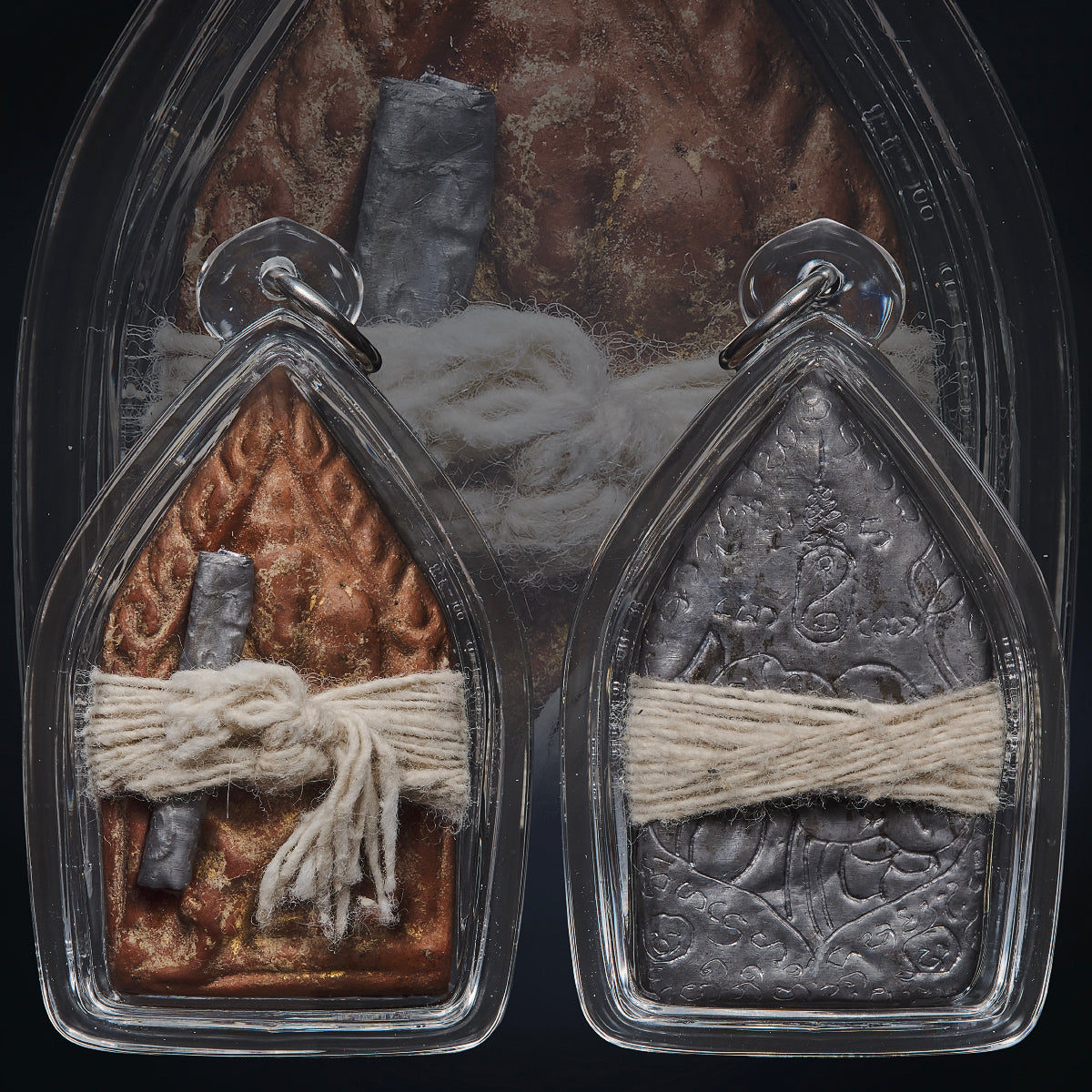
The powder body was made from Phong Wahn Maha Niyom and subsequently soaked in Nam Man Saneh. On the reverse, Por Sala Tan fitted a lead sheet carrying Yant Mah Sek Nang, before adding a takrut and binding the completed artifact with Sai Sin.
The combination was intended particularly for people whose success depends upon how others receive them—salespeople, business owners, agents and those regularly dealing with customers.
Historical Background
Phra Khun Paen is one of the best-known forms in Thai sacred-object tradition.
Its symbolism developed around the legendary Khun Paen of the Khun Chang Khun Paen tradition, remembered for courage, personal magnetism, intelligence and mastery of wicha.
As the Khun Paen amulet tradition developed, different masters created their own formulas. Some emphasised protection and courage; others wealth and opportunity. A particularly important branch concentrated upon Metta Maha Niyom and Maha Saneh.
Por Sala Tan's hand-pressed version clearly belongs to this latter approach.
Rather than relying on the image alone, he reinforced the Khun Paen symbolism through the choice of herbs, Saneh oil, yantra, takrut and Sai Sin.
Origins of the Materials
The foundation of the artifact is Phong Wahn Maha Niyom.
In traditional Thai wicha, wahn refers to plants and herbal materials selected not only for their physical characteristics but also for their symbolic and ritual associations. Maha Niyom formulas concentrate upon popularity, goodwill and being favourably received by others.
These ingredients were prepared into the powder body from which the Khun Paen was individually pressed.
The completed powder tablet was then soaked with Nam Man Saneh, an attraction oil used within Por Sala Tan's practice to strengthen the Saneh character of an artifact.
The lead sheet on the reverse carries Yant Mah Sek Nang, adding a more concentrated attraction formula to the softer Metta qualities already present within the powder.
Finally, the takrut and Sai Sin complete the construction, bringing the separate components together into a single wearable artifact.
Ritual
Por Sala Tan first prepared the Nur Phong Wahn Maha Niyom before pressing the Khun Paen individually by hand.
Once formed, the powder body was soaked in Nam Man Saneh. Because sacred powder is naturally porous, the oil could absorb into the material rather than remaining merely as a surface application.
A sheet of lead was separately prepared with Yant Mah Sek Nang and fitted across the reverse of the Khun Paen.
A takrut was then placed with the artifact, after which Sai Sin was wound tightly around the body, securing the components together.
This layered construction is characteristic of Por Sala Tan's approach: powder and herbs establish the foundation, oil strengthens the intended quality, yantra directs the wicha, and takrut adds another concentrated sacred formula.
Blessings and Effects
The principal emphasis of this Khun Paen is Metta combined with Saneh.
Metta Maha Niyom concerns goodwill—being liked, welcomed and treated favourably. Maha Saneh adds personal magnetism, attraction and the ability to draw attention.
Yant Mah Sek Nang strengthens this attraction-oriented character, while the takrut provides an additional layer of inscribed wicha.
Together, the artifact is traditionally associated with Metta Maha Niyom, Maha Saneh, personal charisma, favourable speech, customer attraction, smoother negotiation, sales, returning customers and opportunity through interpersonal relationships.
The emphasis is therefore not simply upon romance. In practical terms, this is a Khun Paen intended for situations where personal connection can open the way to opportunity.
Modern Application
This is particularly suitable for people working in sales, retail, property, insurance, hospitality, client servicing or other customer-facing roles.
For a salesperson, the traditional intention is to encourage an atmosphere in which customers are comfortable listening and discussing. For a business owner, it relates to customer goodwill and the possibility of people returning after their first interaction.
It can likewise be carried for meetings, presentations, negotiations, networking and contract discussions.
The underlying principle is straightforward: before a sale, agreement or opportunity can develop, there must first be a favourable connection between people.
Physical Details
The artifact is a hand-pressed Khun Paen formed from Nur Phong Wahn Maha Niyom, with the aged powder body showing warm reddish-brown tones and natural surface variation from its preparation and oil treatment. The reverse is substantially covered by a hand-inscribed lead Yant Mah Sek Nang, while a separate takrut is positioned with the piece. White Sai Sin is wound several times around the centre and tied by hand. The artifact is presently preserved within a clear protective casing.
Recommended Pairing
This Khun Paen can be worn alongside a Phra Somdej or another mainstream Buddha image, particularly for everyday work.
The Buddha image can remain the principal devotional artifact, while this Khun Paen serves the more specialised purpose of Metta, Maha Saneh, customer relations and negotiation.
For someone primarily concerned with commerce, it can also complement a wealth-oriented artifact, combining attraction and favourable reception with the movement of business opportunity.
Personal Notes
Hand-pressed Khun Paen of this type are not commonly seen among Por Sala Tan's works.
Only a limited number were prepared, and their construction required considerably more individual work than simply pressing a powder tablet. Each piece was made from Maha Niyom herbal powder, soaked in Nam Man Saneh, backed with an individually prepared lead yantra, fitted with a takrut and finally bound with Sai Sin.
They became particularly associated with luksits in sales and customer-facing work, where Metta and Saneh were understood in a practical way: customers approaching more easily, conversations lasting longer, negotiations becoming smoother and people remembering the wearer favourably.
The combination of Phong Wahn Maha Niyom, Nam Man Saneh and Yant Mah Sek Nang makes the purpose of the piece very clear.
It is a comparatively rare Por Sala Tan Khun Paen made not simply for attraction, but for the broader power of favourable human connection—especially where relationships, communication and opportunity meet.
-
SG: Free | Worldwide except USA: $20 Registered | USA: $25 Registered / $100 Courier (SGD)