
OOBThaiAmulets
Por Sala Tan
Por Sala Tan
Couldn't load pickup availability
PST07
Phra Khun Paen
Por Sala Tan
1.5 Inches
Mainstream Artifact
Individual Craftsmanship
As with Por Sala Tan's other individually prepared natural-material artifacts, differences in colour, grain, carving and surface are part of the piece itself. No two hand-carved examples can be completely identical.
Personal Experiences Shared by Luksits
This piece carries particularly close provenance within Por Sala Tan's own circle.
It was kept by AC Lek, Por Sala Tan's son, who obtained it directly from among Por Sala Tan's possessions during the earlier years.
Unlike pieces that subsequently passed through several collectors, this Khun Paen remained closely connected with the family. AC Lek personally carried and kept the artifact with him.
That history gives the piece a different character from Por Sala Tan's later works made specifically for distribution among luksits. It represents an earlier and more personal period, when individual sacred objects could remain within his immediate circle rather than becoming part of a formal release.
Summary
This is an early Phra Khun Paen hand-carved by Por Sala Tan upon old Nga Chang, later kept personally by his son, AC Lek.
The artifact combines two important elements of Por Sala Tan's practice: the traditional symbolism of Khun Paen and the use of an old natural sacred material selected for individual carving.
Khun Paen is traditionally associated with Metta Maha Niyom, Maha Saneh, confidence, favourable relationships and success in dealings with others. In wider Thai amulet culture, the figure is also connected with courage, protection and the ability to overcome difficult circumstances.
The use of old Nga Chang adds another layer of symbolism traditionally associated with strength, dignity, authority, endurance and Baramee.
Historical Background
Khun Paen occupies an unusual position within Thai sacred tradition.
The figure is connected with the famous warrior of the Khun Chang Khun Paen literary tradition, whose character became associated in popular belief with courage, personal magnetism, martial ability and mastery of traditional wicha.
Over time, Phra Khun Paen developed into one of Thailand's recognised amulet forms. Different masters emphasised different qualities: some concentrated on Metta and Maha Saneh, others on protection, authority, wealth or advancement.
Within Por Sala Tan's practice, Khun Paen fits naturally with his knowledge of Metta, Saneh, protective wicha and sacred natural materials.
This example is particularly distinctive because the image was not created as a conventional powder tablet. Instead, the familiar Khun Paen form was translated directly into an old piece of elephant tusk.
Origins of the Materials
Nga Chang has long carried strong symbolism throughout Southeast Asian culture.
It represents physical strength, patience, intelligence and endurance, while historically it was also closely connected with rulers, warfare, ceremonial authority and social status.
Within traditional belief, it could be associated with Baramee, Maha Amnaj, protection and stability.
Ritual
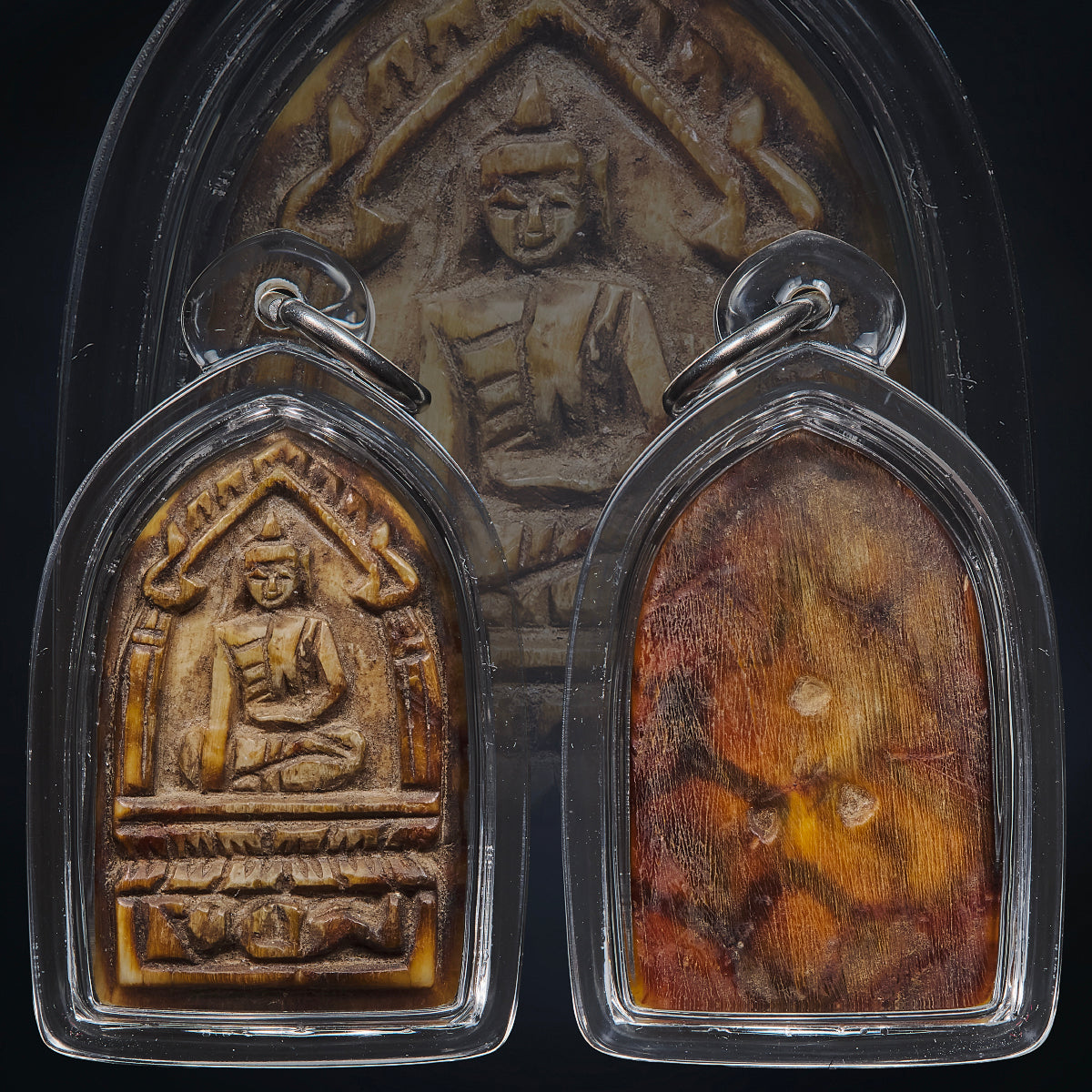
Por Sala Tan carved the Khun Paen image directly onto the Nga Chang, working the figure, surrounding arch and lower decorative details into the face of the tusk.
The reverse remained substantially untouched, allowing the original surface of the old material to remain visible.
This approach differs from his composite artifacts in which numerous powders, oils, takruts and sacred substances were assembled together. Here, the emphasis is much simpler: one old sacred material, one hand-carved image and the wicha placed into it by the maker.
Its later passage into the hands of AC Lek also kept the artifact close to its original source rather than separating it from Por Sala Tan's immediate family circle.
Blessings and Effects
The traditional qualities of this piece arise from the combination of Khun Paen symbolism and Nga Chang.
Khun Paen is principally associated with Metta Maha Niyom—being received favourably by others—and Maha Saneh, personal attraction and magnetism. These qualities extend naturally into business, negotiation and circumstances where confidence and interpersonal relationships matter.
Nga Chang adds the symbolism of Baramee and authority: presence, dignity, endurance and the ability to remain steady when facing difficult circumstances.
Together, the artifact is traditionally associated with Metta Maha Niyom, Maha Saneh, personal charisma, Baramee, confidence, favourable negotiation, business relationships, protection and overcoming obstacles.
These are traditional spiritual associations rather than guaranteed outcomes.
Modern Application
Although Khun Paen is often described simply as an attraction amulet, its traditional application is considerably broader.
For someone in sales or business, Metta can mean customers being more comfortable approaching and speaking with them. For management or leadership, the combination of Metta and Baramee represents being respected without creating unnecessary confrontation.
It can similarly be carried for negotiations, contracts, client relationships, networking and situations where personal presence matters.
The Nga Chang construction makes this example particularly appropriate for someone seeking a Khun Paen with a stronger emphasis on presence, stability and authority, rather than attraction alone.
Physical Details
The artifact is carved from a single section of aged Nga Chang. The front depicts Phra Khun Paen seated beneath a traditional pointed arch, with architectural and ornamental carving surrounding the central figure. Natural cream, amber and darker brown tones remain visible throughout the old material. The reverse is largely plain and retains the natural grain and mottled ageing of the tusk. The piece is currently preserved within a fitted clear protective casing.
Recommended Pairing
This Khun Paen may be worn alone or paired with a Phra Somdej or another mainstream Buddha image.
The Buddha image can serve as the principal devotional artifact, while the Khun Paen provides the more specialised traditional emphasis on Metta, Baramee, confidence and favourable human relationships.
Because the Nga Chang itself already carries strong symbolism of authority and endurance, the piece does not require a complicated combination of additional artifacts.
Personal Notes
The strongest aspect of this piece is its direct family provenance.
It was not simply attributed to Por Sala Tan through later collector history. AC Lek, Por Sala Tan's son, obtained the piece from Por Sala Tan's own possessions during the early days and subsequently kept it with him.
That history places the artifact unusually close to its maker.
The construction is equally characteristic of an earlier, simpler form of Por Sala Tan's work. There are no elaborate layers of oils, powders or numerous inserts. An old piece of Nga Chang was selected, and the image of Phra Khun Paen was carved directly into it by hand.
The untouched grain across the reverse still preserves much of the original character of the tusk, while the carved front records Por Sala Tan's workmanship.
Together with AC Lek's personal ownership, this makes the piece particularly meaningful as an early family-held artifact with a direct connection to Por Sala Tan himself.
-
SG: Free | Worldwide except USA: $20 Registered | USA: $25 Registered / $100 Courier (SGD)