
OOBThaiAmulets
Por Sala Tan
Por Sala Tan
Couldn't load pickup availability
PST07
Suer Khao Gwang
Por Sala Tan
1.5 Inches
Mainstream Artifact
Individual Craftsmanship
For Por Sala Tan, natural materials are not selected simply because they are old or unusual. Their origin, condition and history are considered before they are accepted for sacred work. As each section of antler differs naturally in grain, density, curvature and colour, every finished carving possesses its own character.
Personal Experiences Shared by Luksits
Among Por Sala Tan's luksits, tiger artifacts are commonly carried when courage, authority and protection are important — particularly for people who regularly meet difficult personalities, manage others or work in environments where they must remain composed under pressure.
The character of this particular piece is especially interesting because its materials represent two very different animals.
The tiger is the predator: decisive, commanding and feared.
The deer is the survivor: watchful, sensitive and able to recognise danger before it arrives.
Rather than representing strength through aggression alone, the combination can therefore be understood as the strength to confront danger together with the instinct to avoid unnecessary danger in the first place.
Summary
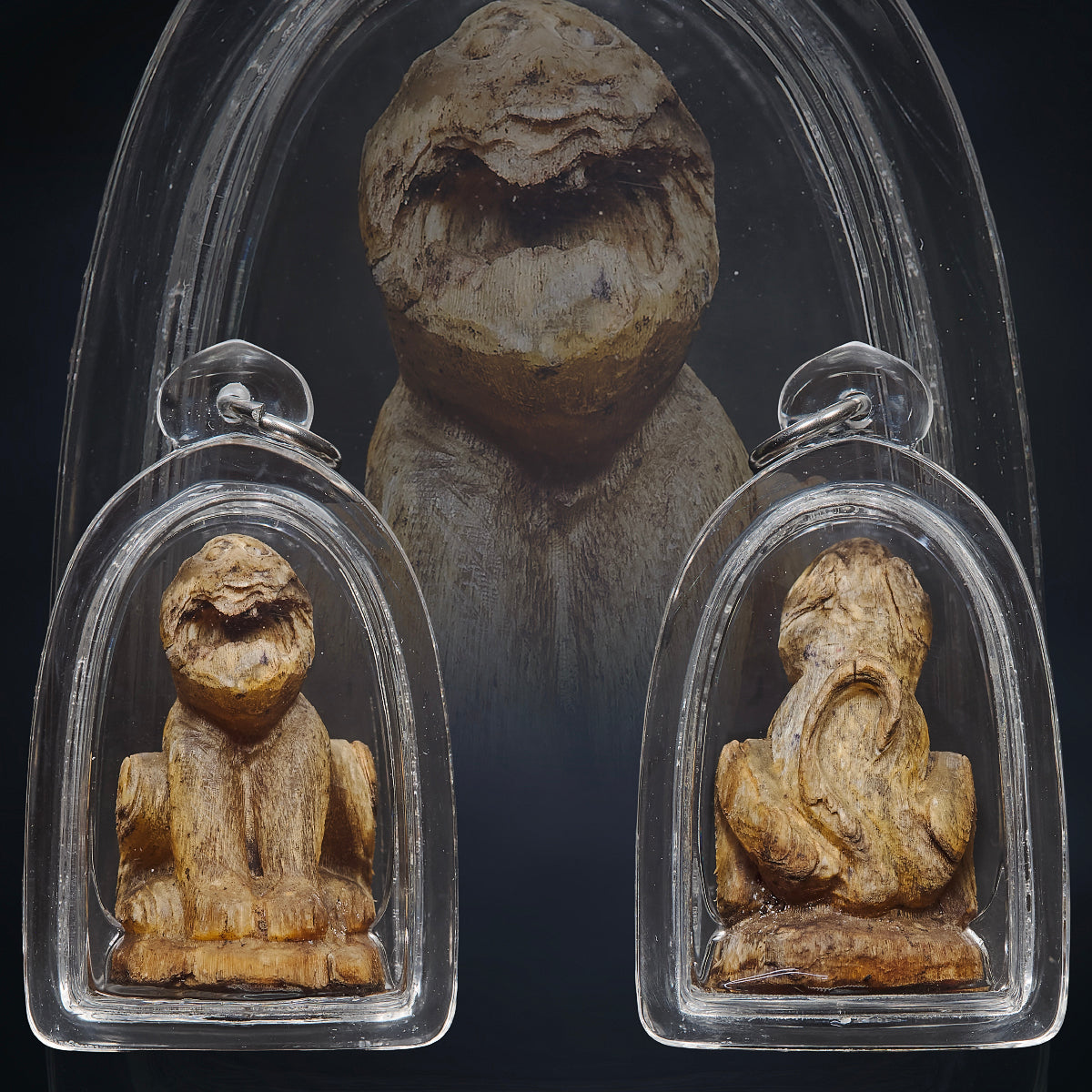
The Suer Khao Gwang is Por Sala Tan's tiger carved from Khao Gwang or deer antler.
According to the provenance passed down with this material, the antler came from an old deer remembered for repeatedly escaping attacks and danger from wild animals throughout its life. It was not said to have been killed by a predator; the animal eventually died naturally from old age.
This history was the reason the antler was considered particularly suitable.
Por Sala Tan subsequently carved the material into the form of a tiger and incorporated Fang Suer and a takrut beneath the figure. The resulting artifact brings together the survival character associated with the deer, the commanding protective symbolism of the tiger, and the written wicha contained within the takrut.
Its principal traditional themes are protection, Klaew Klaad, courage, authority, awareness of danger and overcoming difficult circumstances.
Historical Background
Both tiger and horn materials have long occupied important places within Southeast Asian sacred-object traditions.
The tiger was one of the most formidable animals encountered in the forests of the region. Within Thai occult imagery it consequently became associated with power, courage, authority and protection. Tiger yantras, carvings and related talismans are traditionally carried by those seeking firmness of character and the ability to withstand opposition.
Deer antler carries a different character.
Known in Thai as Khao Gwang, antler is a natural forest material associated with endurance, alertness and survival. A deer survives not through the overwhelming physical strength of a tiger, but through sensitivity to its surroundings, speed and the instinct to withdraw from danger at the correct moment.
These contrasting qualities make the combination particularly appropriate: the awareness of the deer and the strength of the tiger.
Origins of the Materials
The story of this artifact begins before Por Sala Tan carved the tiger.
The Deer That Survived
According to the history accompanying the Khao Gwang, the antler came from a deer that had lived for many years in an environment where predators were a constant danger.
Villagers familiar with the animal remembered that it had escaped harm from wild animals on numerous occasions. Each escape added to the story surrounding it: the deer had survived not because it was the strongest animal in the forest, but because it was alert enough to recognise danger and quick enough to escape it.
Eventually, the deer reached old age and died naturally.
The antler was preserved rather than discarded.
In traditional thinking, the circumstances surrounding a natural material can be as important as the material itself. For Por Sala Tan, not every horn, bone or relic is automatically suitable for sacred work. Pieces are examined and selected according to their origin and the purpose for which an artifact is being created.
The history of this particular deer made its antler especially meaningful for an object concerned with survival and Klaew Klaad — escaping danger.
From Deer to Tiger
Por Sala Tan then transformed the antler into something deliberately different.
He carved a Suer — tiger.
The choice creates an interesting relationship between material and image. The original animal survived by avoiding predators; the finished artifact takes the form of the predator itself.
The deer contributes alertness and survival.
The tiger contributes courage, authority and the strength to confront a threat when avoidance is no longer possible.
Fang Suer
Beneath the carving, Por Sala Tan added Fang Suer — tiger fang.
The fang represents the physical defensive power of the tiger. Within traditional tiger symbolism it is associated with courage, commanding presence and protection against hostile forces.
Its placement beneath the carving means that the tiger is therefore represented twice: externally through the carved image and internally through an actual tiger-associated material.
The Takrut
A takrut was placed together with the Fang Suer.
Unlike the natural materials, whose meanings arise from their animal origins and provenance, the takrut represents the practitioner's wicha. It carries the sacred inscriptions and ritual intention introduced by the master.
The completed artifact therefore develops through three layers:
Khao Gwang — survival and awareness.
Fang Suer — courage and protective force.
Takrut — the master's wicha binding the purpose together.
Ritual
After selecting the Khao Gwang, Por Sala Tan carved the tiger directly from the old antler, allowing much of the original texture and natural grain to remain visible.
The Fang Suer and takrut were subsequently placed beneath the carving as the internal sacred components of the piece.
The completed tiger was then prepared and consecrated according to Por Sala Tan's wicha, bringing the separate symbolic qualities of the materials together within a single artifact.
Rather than treating the deer antler merely as a convenient carving medium, its known history formed part of the reason it was chosen.
The central intention is therefore not simply power.
It is survival with power.
Blessings and Effects
Traditionally, the Suer Khao Gwang is associated primarily with protection, survival, authority and courage.
The history of the deer gives particular emphasis to Klaew Klaad — escaping or passing safely through danger. The tiger adds the qualities of Maha Amnat and Baramee: confidence, command and the ability to remain firm when challenged.
The artifact may therefore be carried traditionally for protection during travel, awareness of approaching trouble, courage during difficult situations, stronger personal authority, resilience under pressure and support when dealing with hostile or difficult people.
There is also a useful distinction within its symbolism: not every danger needs to be fought. Sometimes protection means recognising trouble early enough to avoid it.
These qualities belong to traditional spiritual belief and the provenance associated with the artifact rather than scientifically established effects.
Modern Application
The combination of deer and tiger remains surprisingly relevant outside its original forest symbolism.
Modern dangers are rarely predators in the literal sense. They may instead take the form of a poor agreement, an unreliable person, a dangerous journey, workplace conflict or a situation that does not feel right.
The deer represents the instinct to notice.
The tiger represents the confidence to act.
For someone responsible for a business or team, this can also be understood as the balance between diplomacy and authority — knowing when to remain quiet, when to withdraw and when to stand firmly behind a decision.
This makes the Suer Khao Gwang particularly suited in traditional terms to those whose work requires judgement, leadership, travel, negotiation or regular interaction with unfamiliar people.
Physical Details
The artifact is a compact three-dimensional seated tiger individually carved from old Khao Gwang, or deer antler. The tiger faces forward with its forelegs planted firmly upon the base, while the head and open mouth are shaped from the naturally thicker upper section of the antler. The original grain, age lines, tonal variation and irregularities of the Khao Gwang remain visible throughout the carving rather than being polished away, giving the piece a distinctly organic character.
The reverse preserves the natural flowing structure of the antler and clearly shows the hand-carved nature of the piece. Beneath the tiger, Por Sala Tan concealed Fang Suer together with a takrut, combining the deer-antler body with tiger material and ritual inscription. The complete artifact is now protected within a fitted clear casing with a metal suspension ring, while both the front and reverse remain fully visible.
Recommended Pairing
Because the Suer Khao Gwang already combines Klaew Klaad, protection and authority, it can be worn independently as a principal guardian piece.
For business or customer-facing work, it can be paired with a metta-oriented artifact such as Nang Kwak or Phaya Khao Kham, balancing the tiger's authority with goodwill and social approachability.
Within Por Sala Tan's own lineage, Yant Kru is also a natural pairing, maintaining the connection between the luksit and the master's foundational wicha.
Personal Notes
What interests me most about this piece is not simply that it is a tiger carved from deer antler.
It is the story of how three very different materials came together.
The Khao Gwang came from an old deer remembered for repeatedly escaping predators and eventually dying from old age. Por Sala Tan selected that surviving antler and transformed it into the very animal that a deer would ordinarily fear — the tiger.
He then placed Fang Suer beneath it, adding the physical symbolism of the predator itself, before completing the interior with a takrut carrying his wicha.
The finished artifact therefore tells its story through its construction.
The deer knew when to escape. The tiger knows when to stand its ground.
Together, they express an older understanding of protection that is not based on force alone: remain alert enough to avoid unnecessary danger, but possess the courage and strength to face it when there is no other choice.
-
SG: Free | Worldwide except USA: $20 Registered | USA: $25 Registered / $100 Courier (SGD)