
OOBThaiAmulets
Por Sala Tan
Por Sala Tan
Couldn't load pickup availability
PST07
Message from Brett
This piece is from his 1st Batch that was blessed with both Ac Bed and once more with Por Tan Suksabai those days I was not very close to Por Tan Suksabai but slowly realised that his contribution to this batch is vital to it's efficacy. This batch was beautifully moulded and then donated to Temples whom do not have any Amulets for rent to raise funds, this batch was initiated by Ac Bed as he went around the north and many Abbots seeke his help for fund raising. Incidentally when I met Por Tan many years later he told me that this batch was only available in those temples many of which have sold out I went to a total of over 15 temples to gather them an only mange to get a small handful these are from that trip more than 10 years ago.
I and many of my customer and friends have had very good experiences with this batch in terms of wealth, business, safety during travel (I've been to over 50 countries with this as my keychain), obviously it helps with back stabbers, legal battles, past debts not paid etc etc
One mystical incident I remember was a Malaysian Customer whom obtain this for his mom in Ipoh realised that her garden which was previously full of snakes were all gone.
Few pieces left for those whom want to obtain a piece pls do, pls do not buy multiple pcs as I wish everyone to receive the blessing of this batch.
Wua Thanu
Por Sala Tan
B.E. 254x
1 Inch
Mainstream Artifact
Individual Craftsmanship
The photographs are representative only. A piece will be selected at random, and the amulet supplied may differ from the exact piece shown in the images.
Each example was individually prepared and finished by hand, so variations in casting, inscriptions, placement of materials and the tying of the Sai Sin are natural characteristics of these early pieces.
Personal Experiences Shared by Luksits
Among Por Sala Tan's luksits, Wua Thanu has always been regarded primarily as a guardian.
Older followers commonly kept such pieces for the home, workplace or business, particularly when they wanted an artifact centred upon protection rather than attraction alone. Its role was traditionally understood as standing watch — against troublesome people, theft, spiritual disturbance, hostile intentions and circumstances that might threaten the stability of one's livelihood.
For business owners, this protective character has another meaning. It is not only about guarding the person; it is also about guarding what has already been built — the shop, income, property, staff and accumulated resources.
This first batch is particularly interesting because it comes from an earlier period of Por Sala Tan's work, when his Wua Thanu were prepared in a comparatively direct and traditional manner.
Summary
Wua Thanu — is one of the classic guardian figures of Thai folk-occult tradition.
Represented as a bull or ox, it belongs to the broader family of spiritually empowered guardian effigies sometimes discussed alongside Hoon Phayon traditions. Its principal role is traditionally protective: guarding its owner, household, land, business or other important property.
This particular example is significant as the first batch of old-style Wua Thanu made by Por Sala Tan in the B.E. 254x period.
Its construction is straightforward but meaningful. The bull carries sacred inscriptions upon its body; beneath it are auspicious soil and Fang Kwai; and around its head remains Sai Sin from the actual chanting and consecration ceremony.
For collectors of Por Sala Tan, it represents an early expression of one of the most recognisable protective forms within his body of work.
Historical Background
The Wua Thanu tradition grew from an environment in which cattle and buffalo were central to everyday rural life.
Before mechanised agriculture, these animals represented considerably more than livestock. They ploughed fields, transported goods and supported the household's ability to produce food and income.
The bull therefore became a natural symbol of strength, endurance, livelihood and defence of territory.
Within Thai folk traditions, these qualities were developed into the idea of an empowered guardian. A properly prepared Wua Thanu was traditionally kept to watch over a home, field, livestock, shop or its owner.
Different traditions exist across Thailand and neighbouring regions, including influences associated with Lanna, Lao/Lan Xang, Khmer and Central Thai practices. Consequently, there is no single universal formula for making a Wua Thanu.
Some were carved from horn or wood. Others were moulded from wax, herbal compounds or sacred powders, while metal versions became increasingly familiar in later amulet culture.
The common principle remained the same: the strength and watchfulness of the bull transformed into the symbolism of a guardian.
Origins of the Materials
Por Sala Tan's first-batch Wua Thanu incorporates materials selected specifically around this idea of guardianship and livelihood.
Beneath the bull he placed soil taken from prosperous and auspicious ground.
In traditional sacred-object practice, soil can carry symbolic importance according to where it was collected. Ground associated with prosperity and successful livelihood is selected not simply as physical earth, but as a representation of established fortune, stability and continuing abundance.
Por Sala Tan combined this with Fang Kwai, further connecting the artifact to the traditional strength and endurance represented by the buffalo.
The Sai Sin has a different provenance.
Rather than being ordinary thread added afterwards for appearance, it came from the chanting and consecration ceremony performed for the Wua Thanu. After the ceremony, the thread was retained and tied directly around the figure.
The artifact therefore physically carries a material connection to its own consecration.
Ritual
The preparation of Wua Thanu traditionally involves more than simply producing the animal form.
The figure must first be prepared according to the practitioner's wicha, after which sacred characters, materials and ritual components establish its intended protective character.
For this first batch, Por Sala Tan inscribed sacred characters directly onto the body of the bull and incorporated the prepared materials beneath it.
The Wua Thanu then underwent its chanting and consecration ceremony.
Sai Sin used during that ceremony was afterwards tied around the head and horn area of the finished figure. This surviving thread is particularly important to the identity of the piece because it creates a direct physical link between the artifact and the ritual during which it was consecrated.
The intention was fundamentally defensive: to establish a guardian capable of watching over its bearer, home and livelihood.
Blessings and Effects
The principal traditional purpose of Wua Thanu is protection.
It is associated with guarding against danger, troublesome individuals, theft and intrusion. Within older spiritual traditions it is also regarded as protection against Khun Sai, harmful occult influences and unwanted spiritual disturbances.
The bull itself contributes further symbolism. It represents the courage to stand one's ground, endurance during prolonged difficulty and the physical strength to continue working even under demanding conditions.
For this reason, Wua Thanu is traditionally associated with:
- Protection of the owner and family
- Guarding the home, shop and property
- Protection against theft and intrusion
- Resistance to hostile spiritual influences
- Courage and resilience
- Stability of livelihood
- Protection of accumulated wealth and resources
- Strength when facing difficult circumstances
These are traditional beliefs surrounding the artifact rather than guaranteed effects.
Modern Application
The old agricultural symbolism of Wua Thanu translates naturally into modern life.
A shop is today's equivalent of the rice store that once needed guarding. A business represents accumulated livelihood. A home contains the family and possessions one has spent years building.
For this reason, Wua Thanu remains particularly meaningful for business owners, shopkeepers, people responsible for property and those working in difficult or competitive environments.
It can also be understood more personally. The bull does not represent uncontrolled aggression. Its strength lies in remaining firm when confronted.
In that sense, Wua Thanu represents alertness, courage, boundaries and the determination to protect what one has worked to build.
Physical Details
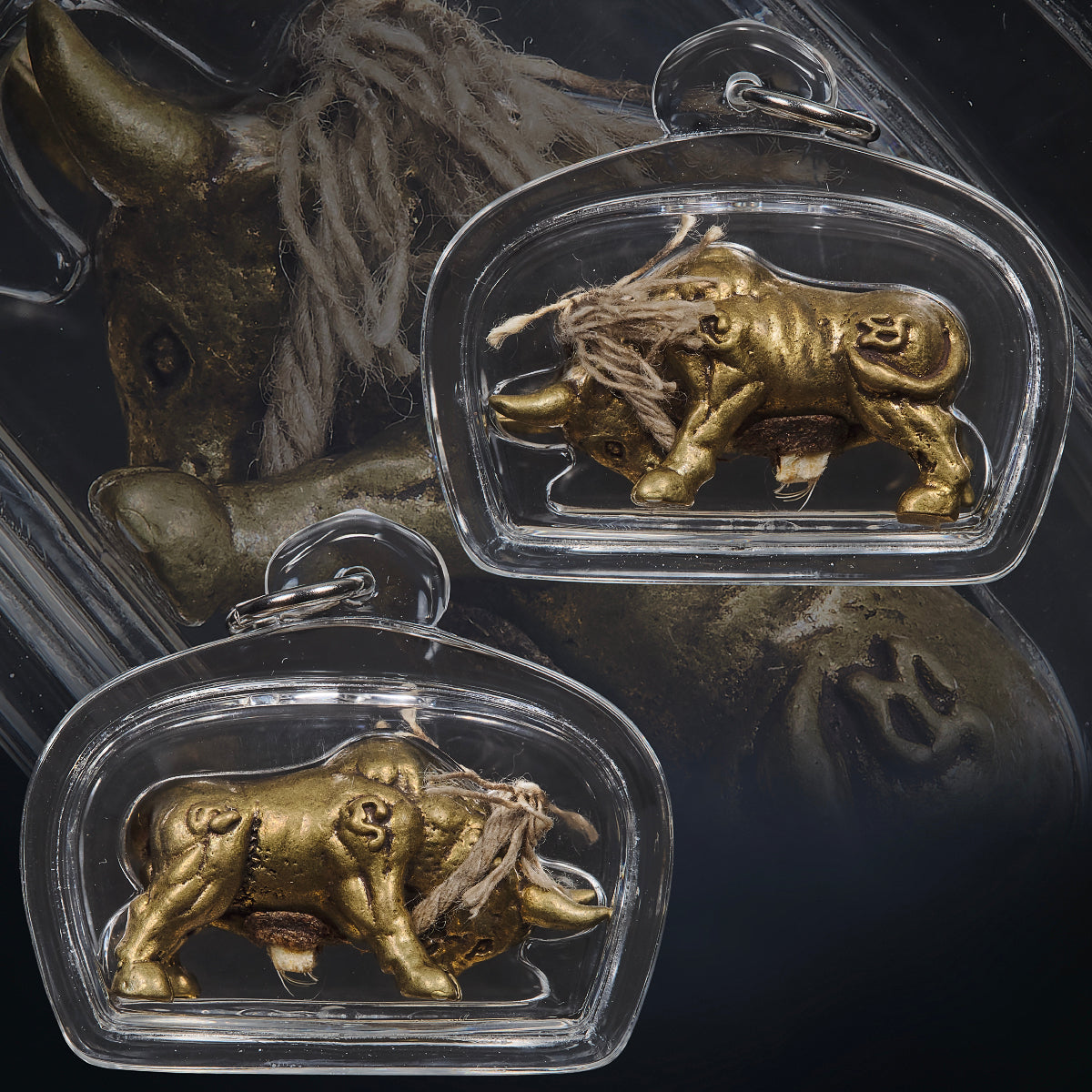
This first-batch Wua Thanu is a compact three-dimensional bull figure finished in an aged golden tone, with a muscular body, lowered head and prominent forward-pointing horns. Sacred characters are visibly inscribed or raised upon both sides of the body, identifying the figure as a ritual artifact rather than a purely decorative animal casting.
A particularly distinctive feature is the original aged Sai Sin wrapped repeatedly around the head and between the horns. The thread remains coarse and naturally frayed from age, contrasting strongly with the metallic body. It originated from the chanting and consecration ceremony of the Wua Thanu and was retained as part of the finished artifact.
Beneath the body is the prepared material containing soil from prosperous and auspicious ground together with Fang Kwai. Portions remain visibly attached below the abdomen, preserving the original construction rather than concealing it.
The complete Wua Thanu is now housed within a clear fitted protective casing with a metal suspension ring. Both sides remain visible, including the sacred markings, ritual Sai Sin and material beneath the body.
Recommended Pairing
Wua Thanu is already a strongly specialised guardian artifact and does not require complicated pairing.
For broader protection, it may be carried alongside a Buddha amulet or another protective artifact associated with the wearer's teacher lineage.
For business use, pairing it with Nang Kwak, Phra Sivali or another metta/wealth artifact creates a complementary arrangement: the second artifact concerns attracting opportunity and customers, while Wua Thanu symbolically guards the business and what has already been accumulated.
Within Por Sala Tan's own body of work, Yant Kru is also a natural companion, representing the foundational connection between luksit and master.
Personal Notes
What makes this Wua Thanu especially interesting to me is that it comes from Por Sala Tan's first batch, dating back to the B.E. 254x period.
Later Por Sala Tan artifacts can contain elaborate combinations of relics, oils, herbs, takruts and other spiritually prepared materials. This early Wua Thanu is comparatively direct in its construction, and that simplicity gives it considerable character.
There is the bull itself, the sacred inscriptions, auspicious soil, Fang Kwai and the original Sai Sin from its consecration ceremony.
Even after many years, the old thread remains visibly tied around its head. The material beneath the body is still present, and the sacred characters remain visible upon the casting.
For a collector following the development of Por Sala Tan's work, this is therefore more than simply another Wua Thanu. It represents an early stage of his guardian wicha — old in style, straightforward in construction and centred upon one clear purpose: to stand guard and protect.
-
Free Shipping for Singapore| $15 Worldwide | $60 USA For Items Below $350