
OOBThaiAmulets
Por Sala Tan
Por Sala Tan
Couldn't load pickup availability
PST07
Yant Kru
Por Sala Tan
1 Inch
Mainstream Artifact
Individual Craftsmanship
For Por Sala Tan's luksits, pieces of this nature represent some of the most characteristic and personal artifacts of his practice.
The natural grain, colour and surface of Graduk Chang remain visible beneath the inscriptions, making every example individual in appearance.
Personal Experiences Shared by Luksits
Among Por Sala Tan's followers, the Yant Kru is regarded as one of the fundamental pieces for a luksit to carry.
Before considering more specialised artifacts for particular purposes, many luksits keep their master's Yant Kru as the basic connection to his wicha and teachings. It represents the relationship between kru and luksit — master and disciple.
Luksits traditionally carry it for smoother interactions with people, greater receptiveness from others and support in situations where goodwill and personal connection matter. In business, this may be interpreted through customers being easier to approach, conversations developing naturally, returning customers and opportunities arising through relationships.
For this reason, a Yant Kru personally inscribed by Por Sala Tan is often considered a core artifact for serious followers and collectors of his work, rather than simply another variation within his wider portfolio.
Summary
The Yant Kru on Graduk Chang is a classic Por Sala Tan artifact centred upon his personal master yantra.
Por Sala Tan inscribed the Yant Kru directly onto one face of the Graduk Chang. The yantra is traditionally associated with metta, saneh, attraction, favourable attention and social magnetism.
The reverse carries Yant Nang Kwak, bringing another established Thai symbolism into the composition. Nang Kwak is traditionally connected with attracting customers, commerce, favourable opportunities and the movement of wealth towards a shop or livelihood.
Together, the two sides create a straightforward but meaningful combination: Yant Kru for the master's wicha and interpersonal attraction, and Nang Kwak for customers, opportunity and livelihood.
More importantly, the artifact represents the luksit's direct connection to Por Sala Tan as their kru.
Historical Background
The concept of Yant Kru occupies an important position within traditional Thai and Southeast Asian esoteric practice.
Kru means teacher or master. A Yant Kru is therefore not simply a yantra chosen for a particular effect; it represents the practitioner's lineage, teachings and the body of wicha transmitted through that tradition.
Por Sala Tan's practice draws upon traditions found across Northern Thailand, Lanna and Burma, together with knowledge concerning sacred natural materials, spirit practices and individually inscribed yantra.
Within his work, metta and saneh appear alongside protective and authority-based wicha. His artifacts may therefore range from gentle attraction pieces to considerably stronger protective or spirit-related constructions.
The Yant Kru sits close to the foundation of this wider practice.
It represents the kru before the specialised wicha.
Origins of the Materials
The physical foundation of this artifact is Graduk Chang.
Natural sacred materials such as this have traditionally been valued not simply as surfaces upon which yantra are written, but as materials possessing their own symbolic weight and history.
Por Sala Tan selected the Graduk Chang and used its broad, flat surfaces to carry two complementary inscriptions.
Unlike an artifact built from numerous powders, oils and embedded components, the strength of this piece lies in its simplicity: natural material, the master's own hand and the yantra itself.
The visible grain and natural markings have deliberately been retained. These are part of the material rather than imperfections to be concealed.
Ritual
Por Sala Tan personally inscribed his Yant Kru onto the Graduk Chang.
Within traditional yantra practice, the act of writing is itself part of the ritual. The sacred geometry and characters are formed according to the practitioner's wicha, with the completed yantra subsequently activated through concentration, katha and adhitthana.
The Yant Kru was prepared specifically around metta and saneh, traditionally directed towards favourable attention, affection, approachability and social magnetism.
Rather than functioning merely as decoration, the yantra forms the spiritual structure through which the intended wicha is organised and stabilised within the artifact.
On the opposite face, Por Sala Tan inscribed Yant Nang Kwak.
This creates a deliberate relationship between the two sides. The Yant Kru concerns the master's lineage and the attraction of people towards the bearer, while Nang Kwak traditionally calls customers, opportunity and favourable commerce towards one's livelihood.
Blessings and Effects
The principal traditional qualities of this Yant Kru are metta, saneh and maha niyom.
Metta concerns goodwill and favourable reception. Maha niyom extends towards popularity and being welcomed or supported by others, while saneh introduces the stronger element of personal attraction and magnetism.
In everyday use, these qualities are traditionally sought for social interaction, negotiation, customer relationships, sales, business influence and personal relationships.
The reverse Yant Nang Kwak adds a clear commercial dimension. Nang Kwak has long been associated in Thai popular tradition with calling customers and encouraging the circulation of trade and livelihood.
For someone running a shop or business, the combination may therefore be approached for customer attraction, returning customers and smoother commercial relationships.
For those who do not operate a business, the same symbolism can be understood more generally as attracting opportunities, supportive people and favourable circumstances.
These remain traditional spiritual interpretations rather than guaranteed outcomes.
Modern Application
The simplicity and compact form of the Yant Kru make it suitable for daily carrying.
A business owner may keep it close when meeting customers or conducting negotiations. Someone working in sales or a client-facing profession may carry it with the traditional intention of improving approachability and communication.
For a luksit, however, its most important application is broader.
It serves as a personal connection to the kru.
This is why many followers regard the Yant Kru as something fundamental to carry regardless of whether they are presently seeking wealth, protection, attraction or another specific result. Specialised artifacts may change according to circumstances; the Yant Kru remains the underlying connection to the master's tradition.
Physical Details
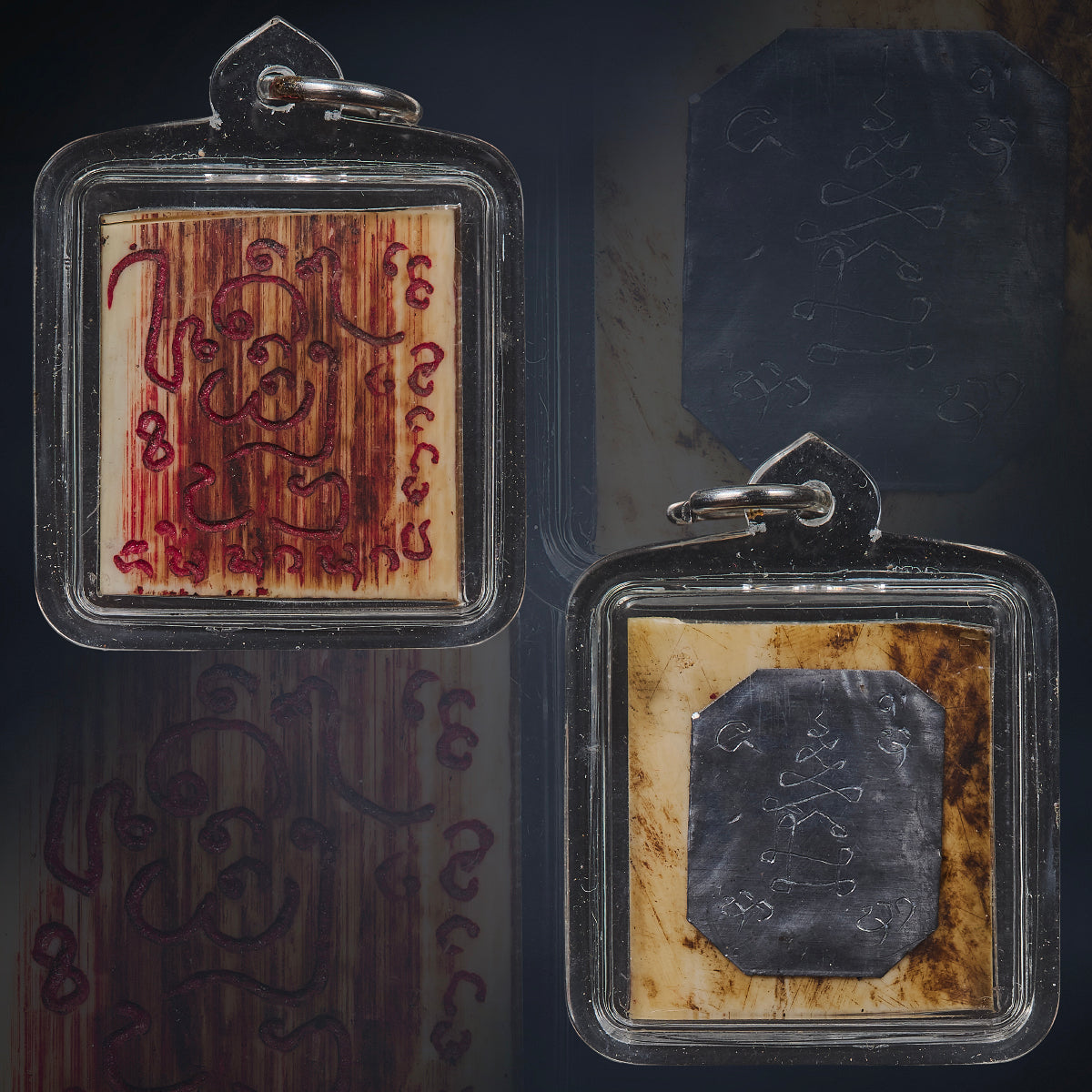
This artifact is a compact rectangular piece of Graduk Chang, retaining the natural cream and warm brown grain of the original material. Por Sala Tan used both broad faces of the piece rather than treating one side simply as a reverse.
The principal face is dominated by his hand-inscribed Yant Kru, formed from large flowing sacred characters surrounded by smaller inscriptions. The writing has been filled or emphasised with a deep reddish tone, making the individual strokes clearly visible against the pale natural surface of the Graduk Chang.
The opposite side carries a separate Yant Nang Kwak configuration. Here, a dark metal yantra plate bearing Por Sala Tan's hand-inscribed sacred geometry and characters has been positioned against the Graduk Chang, creating a visually distinct reverse while preserving the relationship between the two systems of wicha.
The natural grain, age marks and tonal variation of the Graduk Chang remain visible throughout the piece. These characteristics, together with the individually handwritten inscriptions, mean that no two handmade examples should be expected to appear completely identical.
The complete artifact is housed within a clear rectangular protective casing, allowing the Yant Kru, Yant Nang Kwak and natural material to remain visible from both sides while protecting the handwritten surfaces during regular carrying.
Recommended Pairing
For a Por Sala Tan luksit, this Yant Kru does not require a specialised pairing. It can appropriately serve as the foundation piece around which other artifacts are selected.
For business and livelihood, it pairs naturally with Nang Kwak, Phra Sivali or another wealth-oriented artifact. Where stronger metta and saneh are desired, it may accompany one of Por Sala Tan's dedicated attraction pieces.
For protection, a separate protective artifact may be carried alongside it without changing the fundamental role of the Yant Kru.
The Yant Kru remains the connection to the master; the accompanying artifact can then be selected according to the particular purpose.
Personal Notes
For me, this is one of the pieces that best represents what it means to collect Por Sala Tan's work as a luksit rather than simply as a collector.
There are far more elaborate Por Sala Tan artifacts. Some contain rare relics, Prai materials, multiple takruts, sacred oils and complicated constructions. The Yant Kru does not need this complexity.
Its importance comes from something more fundamental: Por Sala Tan personally wrote his own master's yantra onto the Graduk Chang.
On one side is the Yant Kru, representing the master's wicha and the qualities of metta, saneh and favourable attention. On the other is Yant Nang Kwak, directing those qualities towards customers, opportunity and livelihood.
This is why I regard the Yant Kru as a must-have foundation artifact for a serious Por Sala Tan luksit. It represents the starting point — the connection between the practitioner, his wicha and the person who follows his tradition.
Other artifacts may be carried for particular needs at different periods of life. The Yant Kru remains the piece that represents the kru himself.
-
SG: Free | Worldwide except USA: $20 Registered | USA: $25 Registered / $100 Courier (SGD)