
OOBThaiAmulets
Por Sala Tan
Por Sala Tan
Couldn't load pickup availability
PST07
Mae Nak
Por Sala Tan
4.5cm
Barang Artifact
Individual Craftsmanship
Because the powders, relic materials and ritual components were prepared and assembled by hand, differences in texture, placement and finish are natural to each artifact.
Personal Experiences Shared by Luksits
Mae Nak artifacts are traditionally approached differently from ordinary Buddha amulets. Luksits who keep such pieces generally regard the spirit as a Prai companion rather than simply an object for attraction.
Experiences are often described in subtle everyday terms: strangers becoming more receptive, conversations opening more easily, customers returning, assistance appearing at an appropriate moment, or someone becoming unexpectedly willing to listen and cooperate.
For those involved in business or work requiring regular interaction with people, the combination of metta maha niyom and saneh is traditionally sought for approachability, favourable attention and stronger interpersonal connection.
In this particular piece, however, the underlying story is equally important. Por Sala Tan's intention was that the wandering spirit should no longer remain without purpose, but instead reside with her recovered remains and assist others while receiving merit in return.
Summary
This Mae Nak by Por Sala Tan originated from an encounter during one of his journeys through Laos.
According to the account preserved with the artifact, Por Sala Tan encountered the presence of a restless female spirit near the foot of a mountain. Through communication, he understood that she had died in an accident while pregnant.
Her death had occurred during the monsoon season. Heavy rainfall and difficult mountain conditions prevented villagers from recovering her body, and the water eventually carried or scattered her remains away from the original location.
Years passed, but the spirit was believed to have continued wandering around the lower mountain area.
When Por Sala Tan encountered her, she requested his assistance. He agreed to help locate what remained of her physical remains and perform the necessary rites.
After considerable searching, the remains were eventually recovered.
Rather than leaving the spirit bound to the place where she had died, Por Sala Tan invited her to reside with the recovered relics. His intention was to provide a physical anchor through which she could assist others, receive merit from their good deeds and gradually transform a restless existence into one of useful spiritual service.
Historical Background
In Thai, Lao and neighbouring folk traditions, Mae Nak can refer broadly to the image of a female Prai spirit, particularly one whose death occurred while pregnant or under tragic circumstances.
The best-known Thai Mae Nak tradition comes from the famous story of Mae Nak Phra Khanong, but not every artifact called Mae Nak represents that historical or legendary figure.
This piece has its own individual origin.
Por Sala Tan's Mae Nak is associated with the spirit of a woman he encountered in Laos, whose death and recovered remains form the basis of the artifact's lineage.
Her pregnancy is particularly significant within traditional Prai practice. A woman who dies unexpectedly while carrying a child may be regarded by practitioners as possessing unusually concentrated spiritual circumstances surrounding both mother and unborn child.
Por Sala Tan's work with the spirit was therefore centred not merely upon attraction wicha, but upon giving the restless presence a recognised place, purpose and continuing relationship with merit.
Origins of the Materials
After recovering the remains, Por Sala Tan retained selected relic material for the creation of the Mae Nak.
Small portions were combined with his own sacred phong, connecting the physical remains with powders already prepared through his personal wicha.
The Mae Nak figure itself was moulded mainly from Phong Plai Guman, a material traditionally associated with Prai and child-spirit practices.
The surrounding base incorporated Wahn Maha Saneh, traditional attraction herbs, together with soil collected from the location where her remains were found. This soil served as an important physical connection between the finished artifact and the place where the spirit had remained for many years.
The construction was completed with two takruts, Nam Man Prai and a yoni seed.
Rather than being decorative additions, each material occupies a particular role within the traditional construction: the relic and soil establish provenance, the powders form the spiritual body, while the herbs, oil, takruts and yoni component reinforce the intended wicha.
Ritual
Por Sala Tan first communicated with the wandering spirit and agreed to assist in recovering her remains.
Once they were located, he performed the necessary rites and requested that the spirit reside with the recovered relic material rather than continue wandering around the mountain.
The intention was reciprocal. The Mae Nak would assist the person caring for the artifact, while the keeper could dedicate merit to her through prayer, offerings and good deeds.
During construction, Por Sala Tan combined the relic material with his own sacred powders and formed the Mae Nak image from Phong Plai Guman.
The prepared figure was then embedded into the base containing Wahn Maha Saneh and soil from the recovery location.
Two takruts associated with metta maha niyom were positioned beside the figure and coated with Nam Man Prai. A yoni seed was incorporated as a further spiritual anchor associated in this tradition with feminine energy, attraction and fertility symbolism.
Finally, Por Sala Tan prepared a sheet of lead and personally inscribed it with a metta maha niyom yantra. Rather than using a small yantra insert, the entire lead sheet became the backing of the artifact, sealing the ritual composition from behind.
Blessings and Effects
The principal traditional qualities of this Mae Nak centre upon metta maha niyom, saneh, attraction and spiritual assistance.
Metta maha niyom concerns favourable reception from others — being welcomed, listened to and treated with goodwill. In practical terms, devotees traditionally seek these qualities when meeting customers, negotiating agreements, building relationships or working in environments where cooperation is important.
Saneh carries a stronger attraction aspect. Here it may be understood more broadly than romantic attraction alone, extending towards personal magnetism, attention and the ability to draw people towards the bearer.
The yoni seed strengthens the feminine symbolism of the artifact. Within this form of traditional practice, it is associated with feminine generative energy, fertility symbolism and interpersonal attraction, while also serving as an anchoring component within the physical construction.
The Prai itself is traditionally regarded as a spiritual companion capable of providing assistance, attracting favourable circumstances and offering intuitive warnings when something around the keeper is not right.
These qualities belong to traditional spiritual belief and the experiences reported by practitioners rather than guaranteed outcomes.
Modern Application
This Mae Nak is particularly associated with situations where human relationships and favourable interaction are important.
Business owners may traditionally keep such an artifact for customer attraction and returning customers. Those working in sales, negotiation or service industries may focus upon metta and smoother communication, while others may approach the piece for personal charm and relationships.
It may also be kept as a spiritual companion for guidance and protection rather than worn specifically for attraction.
Within Por Sala Tan's tradition, maintaining the relationship through merit-making is especially appropriate. Acts of generosity, temple donations, helping others or other wholesome deeds may be dedicated to the Mae Nak in acknowledgement of the reciprocal relationship established during the original ritual.
Physical Details
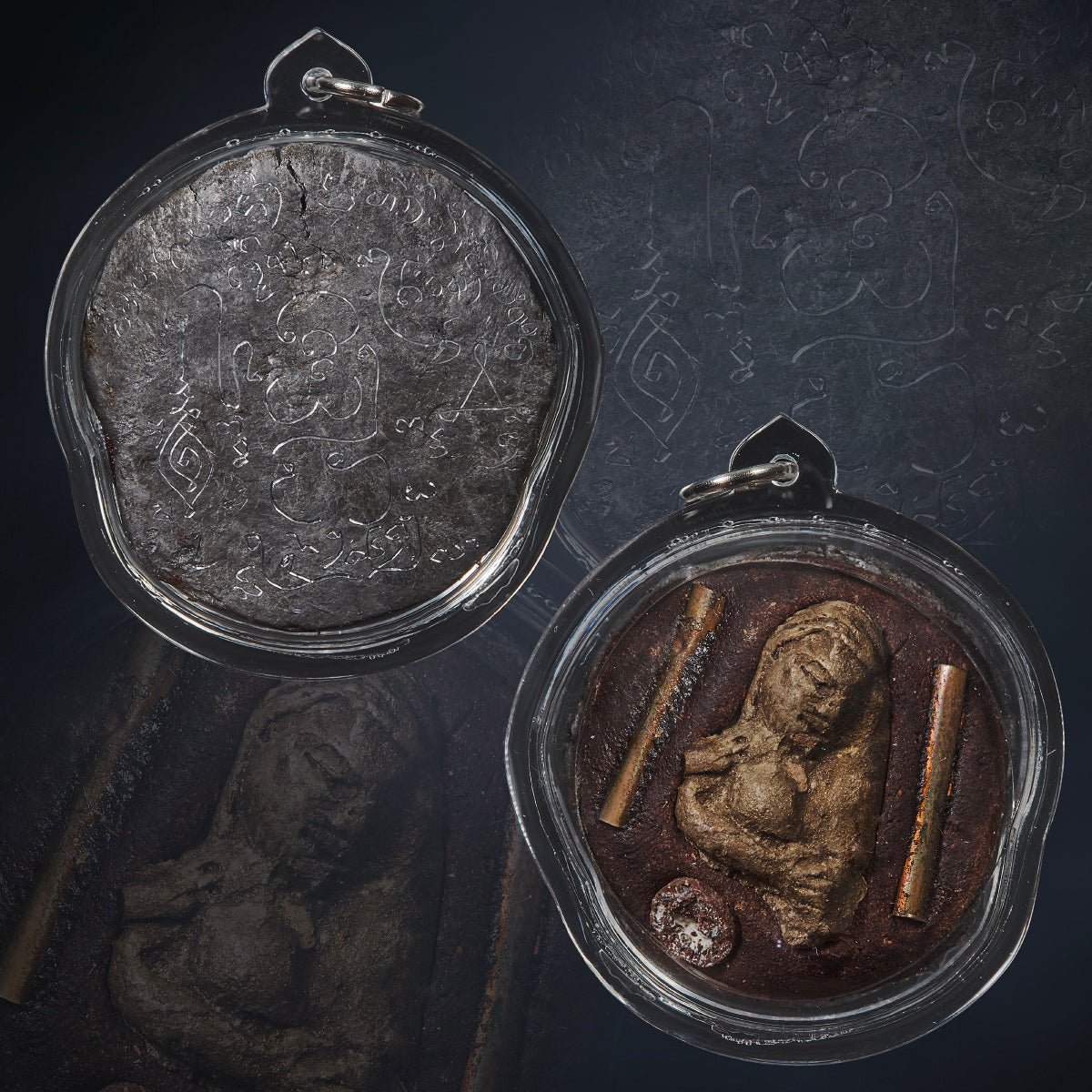
This is a circular Mae Nak Prai artifact handmade by Por Sala Tan, with the three-dimensional female figure set prominently into a dark reddish-brown sacred-material base. The Mae Nak image was moulded primarily from Phong Plai Guman mixed with selected relic material and Por Sala Tan's prepared sacred powders, giving the figure its naturally irregular, hand-formed appearance.
The base surrounding the figure contains Wahn Maha Saneh together with soil recovered from the location where the woman's remains were found in Laos. Positioned vertically on either side of Mae Nak are two takruts prepared for metta maha niyom and coated with Nam Man Prai. A small yoni seed is embedded near the lower portion of the composition, completing the principal materials visible from the front.
The reverse is particularly important to the construction. Por Sala Tan used a full lead sheet as the backing of the artifact and personally covered its surface with handwritten yantra, sacred characters and ritual inscriptions. The extensive hand inscription is clearly visible across the aged grey lead surface, effectively forming a ritual seal behind the complete composition rather than serving merely as a decorative reverse.
The finished artifact is protected within a clear circular casing, allowing both the constructed front and the fully handwritten lead backing to remain visible.
Recommended Pairing
Because this Mae Nak already combines Prai material, metta herbs, Nam Man Prai, two takruts, a yoni component and a complete handwritten yantra backing, it is a substantial spiritual composition on its own.
For those who prefer balance, it may be paired with a Buddha amulet representing mindfulness and stability, or Phra Sivali where livelihood and opportunities are the principal focus.
It may also be kept independently rather than combined with numerous other Prai artifacts, allowing the keeper to maintain a clear devotional relationship with the spirit connected to the piece.
Personal Notes
What makes this Mae Nak especially significant is that the artifact began with an encounter rather than an intention to create an amulet.
According to Por Sala Tan's account, the woman had died while pregnant in a mountain accident during the monsoon season. Her remains could not be recovered at the time, and for years her spirit was believed to have remained around the foot of the mountain.
When Por Sala Tan encountered her during his travels in Laos, she asked him for help.
Finding the remains required considerable effort, but once they were recovered, Por Sala Tan gave the spirit an alternative to continuing as a restless presence. He asked her to reside with the relics and help others so that merit could be dedicated back to her in return.
This gives meaning to every part of the construction. The soil connects the artifact with the place where she was found. The relic material provides a physical connection to the Mae Nak herself. Phong Plai Guman and Wahn Maha Saneh form the spiritual body and attraction base. The two takruts and Nam Man Prai reinforce metta maha niyom, while the yoni seed serves as a feminine and spiritual anchoring component.
Finally, the entire composition rests against a lead sheet handwritten by Por Sala Tan himself, turning the reverse into a complete yantra seal.
For me, this is therefore more than a Mae Nak created simply for saneh. Its central story is about taking a spirit believed to have wandered for years after a tragic death and giving her a physical home, a purpose and a continuing path through assistance given and merit returned.
-
SG: Free | Worldwide except USA: $20 Registered | USA: $25 Registered / $100 Courier (SGD)