
OOBThaiAmulets
Por Sala Tan
Por Sala Tan
Couldn't load pickup availability
PST07
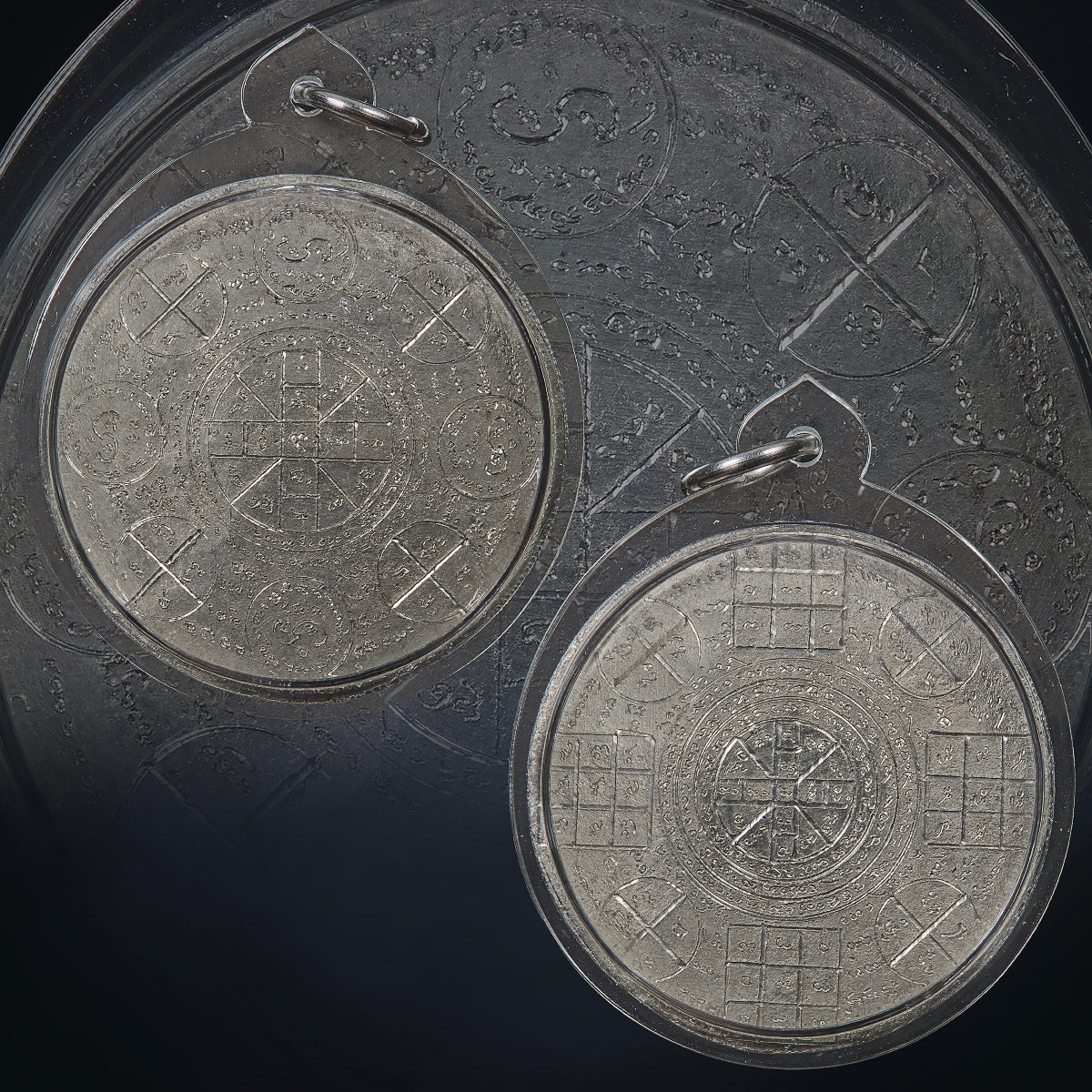
Yant 9 Phaen Din Suriyan Jantri
Por Sala Tan
B.E. 250x
1.5 Inches
Mainstream Artifact
Individual Craftsmanship
Every example was therefore individually written by hand. Differences in line depth, spacing, characters, surface texture and oxidation are natural characteristics of these early pieces.
Personal Experiences Shared by Luksits
According to Por Sala Tan's older luksits, this was not a yantra commonly requested simply for general luck.
It was particularly valued by practitioners who wanted to strengthen their baramee, as well as lay luksits whose responsibilities required authority and the confidence of those around them.
Among those said to have requested this yantra were village chiefs, local officials and members of the police and military. For such wearers, the intention was not merely protection. The yantra was carried for stronger personal presence, leadership, stability, health and prosperity.
Practitioners had another reason for keeping it.
Those who maintained numerous Yin or spirit-oriented artifacts regarded the Suriyan-Jantri system as a means of strengthening their own baramee while maintaining balance around a collection containing heavier spiritual materials.
Older luksits therefore regarded it as a particularly complete practitioner's yantra — one concerned with authority above, spiritual movement below, and balance between the two.
Summary
Yant 9 Phaen Din Suriyan Jantri is an early lead yantra attributed to Por Sala Tan's younger period.
Its construction brings together three principal forces: the nine planetary powers, Jantra — the Moon, and Suriyan — the Sun.
The planetary arrangement is associated within the lineage with fortune and the symbolic gathering of wealth. The lunar formulas concern attraction, Saneh and the movement of subtler or Yin influences, while the solar aspect represents baramee, authority, vitality and sustained power.
Por Sala Tan is said to have stopped making this particular form around B.E. 2515, as its densely proportioned handwritten construction required extremely precise eyesight.
Surviving early examples are consequently seldom encountered.
Historical Background
Astrological yantras occupy an important place within older Thai and regional esoteric traditions. Rather than relying upon a single image, they combine numbers, planetary correspondences, sacred syllables, geometrical arrangements and mantra into a structured ritual diagram.
Por Sala Tan's Yant 9 Phaen Din Suriyan Jantri follows this broader cosmological approach.
According to the lineage explanation, 9 Phaen Din — “Nine Lands” — relates to the nine planetary influences, interpreted here through the auspicious imagery of nine vessels or pots of wealth.
The visible circular arrangements represent the planetary system, with the principal central position given particular importance within the composition.
Surrounding this are the complementary forces of Suriyan and Jantra — Sun and Moon.
Rather than treating wealth, attraction and authority as separate wishes, the yantra places them within one larger celestial arrangement.
Origins of the Materials
The base material is lead, but its importance lies in the history attributed to the metal rather than lead alone.
According to Por Sala Tan's tradition, old lead donated by followers was gathered together with lead from earlier sacred artifacts and material connected with temples and sacred places. These sources were melted and combined before being prepared for inscription.
Reusing older sacred metal follows the principle that material which has already participated in religious or ritual activity carries a history of prayer, dedication and contact with sacred places.
The resulting lead surface was then individually inscribed.
With age, such material naturally develops a dark grey appearance, oxidation and variations across the surface. The handwritten lines can likewise vary in depth according to the pressure of the stylus and the condition of the metal.
Ritual
The consecration of this yantra was unusually prolonged.
According to the history accompanying these pieces, Por Sala Tan worked with them for more than one year, returning to the yantras during different solar and lunar events rather than completing the entire consecration in a single ceremony.
This reflects the internal structure of the design.
The lunar aspect — Jantra was connected with Yin qualities, Saneh, attraction and subtler forms of fortune.
The solar aspect — Suriyan represented the opposite but complementary principle: illumination, vitality, authority and baramee — a continuous force traditionally compared with the Sun's ability to radiate energy without interruption.
The planetary formulas completed the system by introducing different celestial influences around these two major forces.
The intention was therefore not simply to “bless a lead plate”, but to progressively establish and seal its different cosmological components at appropriate stages.
Blessings and Effects
The central quality of Yant 9 Phaen Din Suriyan Jantri is Baramee.
For practitioners, this traditionally concerns strengthening spiritual authority and maintaining sufficient personal presence when working with powerful or Yin-oriented artifacts.
For lay devotees, the same principle is interpreted more practically as leadership, confidence, respect and stronger personal standing — particularly relevant to those carrying responsibility for other people.
The planetary and lunar components broaden the traditional purposes towards wealth, Choke Lap, opportunity, Metta and Saneh. Rather than representing wealth alone, they concern circumstances becoming more favourable: assistance arriving, opportunities becoming visible and relationships moving more smoothly.
The solar component provides the balancing force of vitality, stability and authority.
Taken as a whole, the yantra was traditionally understood as a system for baramee, health, prosperity, attraction, opportunity and the balancing of strong spiritual influences.
Modern Application
For a modern collector, this piece has particular relevance to someone already keeping a substantial collection of Barang, spirit-oriented or Yin-based artifacts.
Within Por Sala Tan's system, it can serve as a central baramee piece rather than adding another spirit-oriented presence to the collection.
It is equally appropriate for business owners, managers and people in positions of responsibility. Its traditional emphasis upon authority and baramee complements situations requiring leadership, negotiation, recognition and the confidence to make decisions under pressure.
For collectors, however, its strongest appeal may simply be historical.
This belongs to an early period of Por Sala Tan's work when complicated yantras were still being personally inscribed onto prepared lead, long before such surviving pieces became difficult to encounter.
Physical Details
This is a large circular hand-inscribed lead yantra dating to Por Sala Tan's early B.E. 250x period. Both faces contain densely arranged sacred diagrams, planetary forms, numerical grids, Khom inscriptions and surrounding formulas.
One face centres upon a large planetary arrangement surrounded by additional circular and divided yantras. The opposite face carries another central celestial diagram together with four prominent numerical grids and further surrounding inscriptions. The entire composition was executed directly into the prepared lead rather than produced as a modern printed design.
The aged lead has developed a deep grey surface with natural oxidation, while variations in the handwritten lines preserve the individual character of the original inscription.
Recommended Pairing
For practitioners keeping many Yin or spirit-based artifacts, this yantra can act as the principal baramee and balancing piece within the collection. There is no need to surround it with additional complicated yantras.
For ordinary wear, it pairs naturally with a respected Buddha image, monk Roop Lor or Lersi artifact. The companion piece provides a clear devotional centre, while the Suriyan-Jantri yantra contributes its broader planetary, lunar and solar symbolism.
It can equally be kept alone, particularly when the intention is baramee, leadership, prosperity and maintaining balance around an existing collection.
Personal Notes
What makes this piece especially significant to me is its age and the amount of work required to produce it.
This is not one of Por Sala Tan's later, more readily encountered artifacts. It comes from his younger period, when he was still personally writing this extremely detailed form for selected practitioners and luksits.
According to the lineage, he ceased producing it around B.E. 2515 because the proportions and extremely fine inscriptions demanded perfect eyesight. The consecration itself was also not completed in a single sitting, but developed over more than a year through different solar and lunar occasions.
That combination — old sacred lead, handwritten construction, an extended celestial consecration and a form eventually discontinued by Por Sala Tan — is why surviving examples are rarely seen today.
For a serious Por Sala Tan collection, I regard this less as another individual amulet and more as an early master yantra representing his understanding of baramee, planetary influence and the balance between Suriyan and Jantra — Sun and Moon.
-
Free Shipping for Singapore| $15 Worldwide | $60 USA For Items Below $350