
OOBThaiAmulets
Por Sala Tan
Por Sala Tan
Couldn't load pickup availability
PST07
Keow Mii Suea Ngoei Na
Por Sala Tan
4 Inches
Mainstream Artifact
Individual Craftsmanship
As the tooth and bone are natural materials, their form, colour and surface differ from piece to piece. Por Sala Tan therefore worked around the original relic rather than forcing it into a standardised form, making each completed artifact individually distinctive.
Personal Experiences Shared by Luksits
Among Por Sala Tan's luksits, pieces combining rare relics with wealth and Metta-oriented imagery were often kept for livelihood and business use.
Feedback surrounding this type of artifact commonly concerns a combination of being better received by others and encountering smoother financial opportunities.
Some users describe customers becoming easier to approach, conversations lasting longer, or negotiations developing with less resistance. Others associate such pieces with receiving useful introductions, returning customers or assistance from people encountered through work.
The Suea Ngoei Na adds another dimension. Rather than simply waiting for fortune, its raised posture represents remaining alert and having the confidence to recognise and pursue an opportunity when it appears.
Lersi guides. Phra Sivali attracts support. The bear endures. The tiger rises to meet opportunity.
Summary
Keow Mii Suea Ngoei Na is a rare composite artifact centred upon Metta, prosperity, opportunity, baramee and advancement.
Its foundation is a natural Keow Mii obtained by Por Sala Tan from a remote northern cave associated in local accounts with Lersi practice and the remains of wild animals.
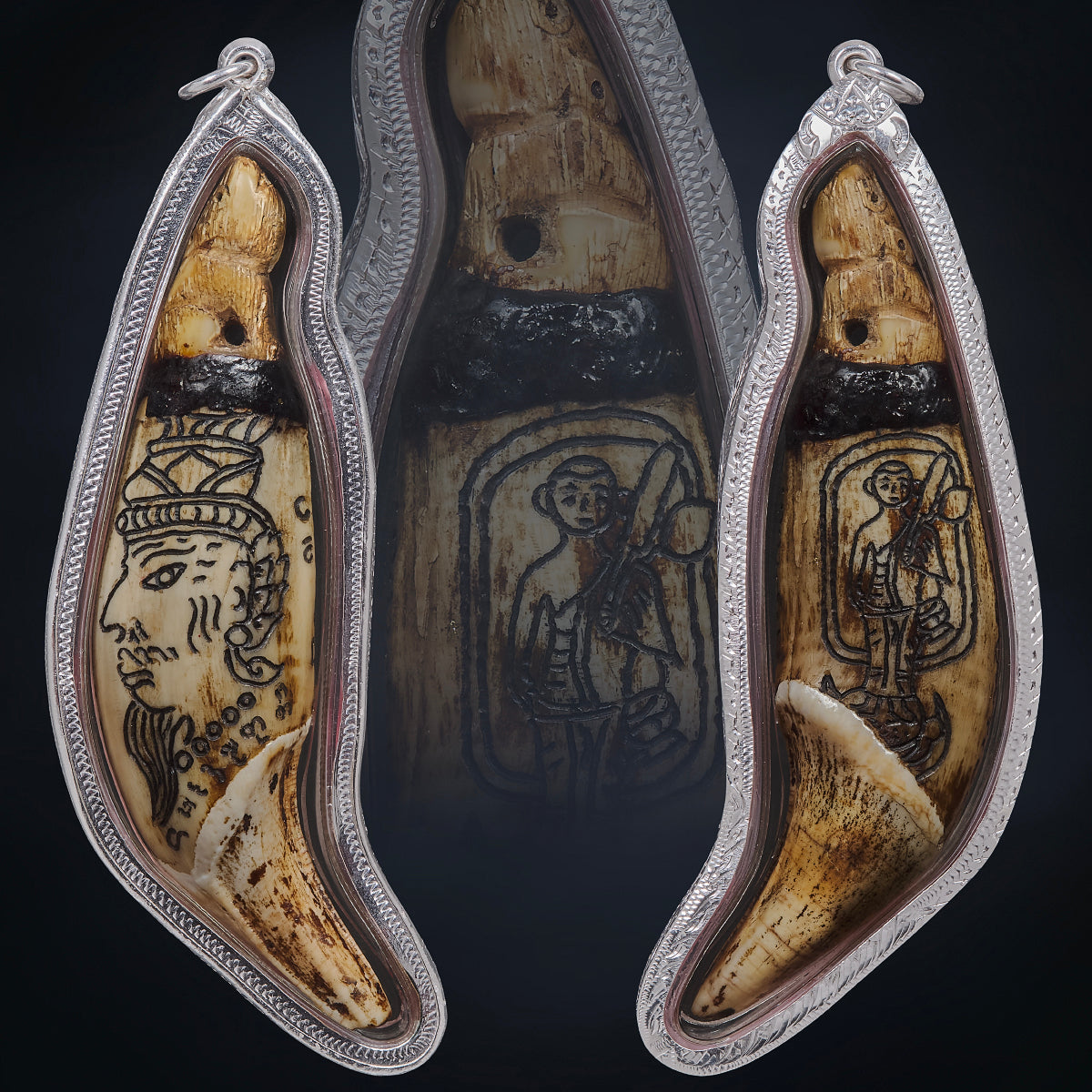
The two sides of the tooth carry complementary sacred figures. Lersi represents wisdom, guidance and mastery, while Phra Sivali represents abundance, support and sufficiency.
Above them is Suea Ngoei Na — the Tiger Raising Its Head, carved from Graduk Mii. Its upward posture gives the piece its central message:
remain strong, recognise the opening, and rise when opportunity arrives.
Historical Background
Por Sala Tan was once invited by a fellow practitioner to visit a remote cave in the far north, both to practise and to seek traditional spiritual materials.
Local accounts surrounding the cave were unusual. It was said that Lersi and hermit practitioners had long used the location for meditation because of its peaceful and concentrated atmosphere.
There were also stories that wild animals occasionally entered the cave towards the end of their lives. In local animist interpretation, they were believed to be drawn towards the calm spiritual quality of the place during their final moments.
When Por Sala Tan entered the area, he regarded the atmosphere as particularly positive. The surrounding forest was dense and flourishing, with thick vegetation growing around the cave.
Within the cave he encountered old animal relics, including remains associated with Mii — bear.
Rather than taking everything available, Por Sala Tan selected only several suitable relics. Part of the initial preparation was undertaken while he was still at the cave before the materials were brought back for completion.
Origins of the Materials
The principal relic is Keow Mii, traditionally associated with strength, endurance and the ability to remain firm under difficult conditions.
This makes the bear particularly appropriate for an artifact concerned with livelihood. Prosperity is not represented merely as obtaining money, but also as possessing the resilience required to maintain one's position and continue through difficult periods.
A second bear relic, Graduk Mii, was used to carve the small tiger mounted at the upper section.
This creates an unusual pairing of two powerful animal symbols within the same artifact:
Mii provides stability and endurance.
Suea provides courage, command and forward movement.
Ritual
Por Sala Tan selected the natural Keow Mii and inscribed sacred imagery directly onto its two faces.
On one side he placed Lersi, connecting the artifact with knowledge, guidance, wicha and the disciplined qualities of the teacher.
The opposite side was inscribed with Phra Sivali, whose traditional association with plentiful offerings makes his image particularly significant for prosperity and livelihood.
The interior of the tooth was then filled with Phong Wan Roi Paet. The term refers to a traditional 108-herb preparation, with 108 carrying the wider ritual meaning of completeness and abundance.
The opening was sealed with traditional Burmese wax.
Finally, Por Sala Tan carved a Suea Roop from Graduk Mii and positioned it at the upper section of the tooth, completing the artifact as Suea Ngoei Na.
Blessings and Effects
The central blessings of this piece concern loving-kindness, prosperity, opportunity and advancement.
Metta Maha Niyom is represented through the intention that others receive the wearer favourably. In practical terms, devotees associate this with smoother communication, customer goodwill, helpful relationships and being remembered positively.
Phra Sivali strengthens the prosperity aspect. Within Theravada tradition he is remembered as a disciple of the Buddha distinguished for receiving abundant offerings. In Thai devotional culture, this developed into a strong association with sufficiency, plentiful support, travel and livelihood.
Lersi contributes wisdom and baramee — knowing when to act, recognising circumstances clearly and carrying oneself with greater authority.
The bear contributes endurance.
The tiger contributes the willingness to advance.
Together, these qualities make the artifact particularly relevant to business, sales, career development and periods when greater movement is needed in life.
The Meaning of Suea Ngoei Na
The small tiger is carved with its head raised upwards — Ngoei Na.
This posture gives it a different meaning from the crouching tiger, attacking tiger or tiger looking down upon an opponent.
Here, the tiger is looking upward and ahead.
Traditionally, this can be interpreted as Ngoei Na Rap Chok — raising one's head to receive fortune. It also represents aspiration, alertness, increased standing and refusing to remain bowed by difficult circumstances.
For career and business, it carries a particularly appropriate message: be visible, recognise opportunity and have the confidence to move towards a higher position.
The symbolism is strengthened by the material beneath it:
the bear gives the stability to hold one's ground; the tiger gives the ambition to rise beyond it.
Modern Application
For business owners, Keow Mii Suea Ngoei Na can represent customer goodwill, repeat business, financial opportunities and the persistence required to build something over time.
For those working in sales, the combination of Metta and tiger symbolism is particularly relevant — being approachable without becoming passive, and persuasive without unnecessary aggression.
For career development, Ngoei Na carries the theme of raising one's standing: becoming more visible for good work, accepting greater responsibility and having the confidence to pursue advancement.
Phra Sivali adds the quieter principle of having sufficient resources and receiving support along the journey, while Lersi represents judgement and direction.
Physical Details
The main body is a naturally curved Keow Mii, retaining the original surface, colour and form of the tooth.
One face is individually inscribed with Lersi, while the opposite face carries Phra Sivali. The cavity within contains Phong Wan Roi Paet, sealed with traditional Burmese wax.
At the upper section is a small Suea Ngoei Na carved from Graduk Mii, distinguished by its raised-head posture.
The combination of natural Keow Mii, carved Graduk Mii, sacred imagery, herbal material and hand finishing makes this an individually constructed piece rather than a conventional moulded artifact.
Recommended Pairing
This piece already combines Metta, prosperity, baramee, resilience and advancement, making it particularly complete for business or career use.
For stronger wealth emphasis, it can be paired with a Riak Sap or Phok Sap artifact, concentrating further upon financial circulation and opportunity.
For someone pursuing promotion or greater professional recognition, a Serm Yos piece is a natural complement. Suea Ngoei Na represents rising and recognising the opportunity, while Serm Yos concentrates upon status and recognition.
Personal Notes
This piece is particularly meaningful because its materials were not simply acquired for routine artifact production.
According to the account surrounding it, Por Sala Tan personally entered the remote cave, experienced the atmosphere of the place and selected only a small number of the old relics he encountered there. The Keow Mii was then transformed individually through inscription, herbal filling, sealing and the addition of the Graduk Mii tiger.
Materials obtained under such circumstances were naturally limited, and pieces made from them were not something that could simply be reproduced once the original relics had been used.
For me, the most interesting feature is the relationship between the four principal symbols:
Lersi gives direction.
Phra Sivali brings abundance.
Mii gives endurance.
Suea Ngoei Na raises its head towards the next opportunity.
-
Free Shipping for Singapore| $15 Worldwide | $60 USA For Items Below $350