
OOBThaiAmulets
Por Sala Tan
Por Sala Tan
Couldn't load pickup availability
PST07
Keow Mii Riak Sap
Por Sala Tan
6cm
Mainstream Artifact
Individual Craftsmanship
As each Keow Mii has its own natural curvature, surface and proportions, every completed artifact differs slightly. These were individually assembled pieces rather than standard moulded amulets.
Personal Experiences Shared by Luksits
Artifacts made from rare natural relics such as Keow Mii were never commonly available. Por Sala Tan had only a limited quantity of suitable material, and pieces of this nature were generally kept within a relatively close circle of luksits.
The intention of Riak Sap — calling wealth is not limited to sudden money. Luksits commonly understand it more broadly as creating financial movement: customers appearing, enquiries increasing, opportunities opening and money circulating more steadily through work or business.
The bear symbolism adds another dimension. Rather than simply attracting an opportunity, it represents the strength to hold one's ground and preserve what has already been gained.
This particular artifact eventually came to me through one of Por Sala Tan's luksits, rather than directly through ordinary circulation.
Summary
Keow Mii Riak Sap - Calling wealth
It is a compact wealth artifact built around a genuine Keow Mii presented to Por Sala Tan by a Lersi whom he encountered in Myanmar.
Its construction brings together four complementary elements:
Keow Mii for strength, endurance and protecting resources; a wealth takrut for Riak Sap and financial movement; Phong Wan Roi Paet as the herbal foundation; and Yan Chok Lap with an old Thai coin for luck, opportunity and the symbolism of circulating money.
The outward-facing Garuda completes the arrangement as a symbol of authority and guarding the wealth gathered within.
Historical Background
Por Sala Tan encountered the Lersi while travelling in Myanmar to attend a ceremony.
The Lersi practised Lersi Serming Pai wicha, and their meeting developed into an exchange of traditional knowledge and methods. Por Sala Tan remembered the encounter as one of mutual respect, with both practitioners openly discussing their respective wicha.
Before they parted, the Lersi presented Por Sala Tan with several unusual relics as a gesture of goodwill.
Among them were rare Keow Mii.
For Por Sala Tan, the provenance was important. These were not simply bear teeth obtained as raw material; they had come directly through another practitioner following an exchange of wicha.
He therefore reserved the material for individual artifacts rather than general production.
Origins of the Materials
The Keow Mii forms the foundation of the entire piece.
Within traditional animal symbolism, the bear represents strength, endurance, territorial protection and persistence under pressure. Applied to a wealth artifact, these qualities take on a practical meaning: having the strength to pursue resources, withstand difficult periods and protect what has already been accumulated.
Por Sala Tan combined the tooth with Phong Wan Roi Paet, literally “108-herb powder”.
The number 108 traditionally conveys completeness and abundance. The herbal mixture therefore provides a broad ritual foundation around the more specifically directed wealth components.
An old 25-satang coin dated B.E. 2489 (1946) was also incorporated. Rather than money being represented only symbolically, the artifact therefore contains actual historical currency — something created to circulate from person to person through everyday economic life.
Ritual
Por Sala Tan first prepared the Keow Mii to receive a wealth takrut, giving the artifact its principal Riak Sap intention — calling resources and encouraging financial movement.
The tooth was then coated with Phong Wan Roi Paet and lacquered, enclosing the herbal preparation around the relic.
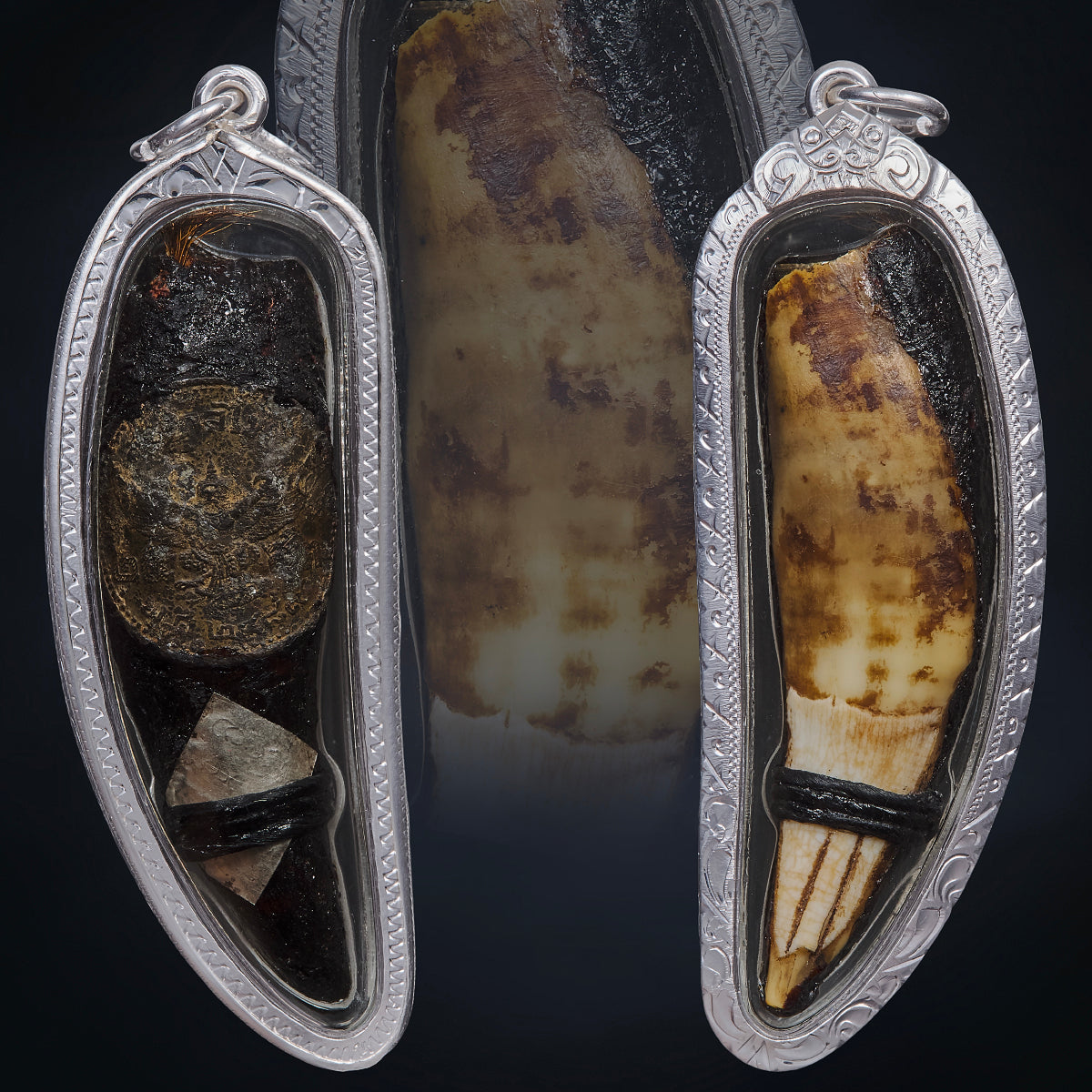
A metal sheet bearing Yan Chok Lap — the yantra of luck and fortunate opportunities — was incorporated alongside the tooth.
The old 25-satang coin was positioned with its Garuda side facing outward.
This creates a simple ritual structure:
wealth is called inward, while the Garuda faces outward to guard the boundary.
Blessings and Effects
The principal traditional purpose is Riak Sap — calling wealth.
Rather than representing money appearing without effort, the composition is particularly suited to the idea of increasing the circumstances through which wealth can arise: customers, enquiries, opportunities, successful negotiations, favourable timing and continued financial circulation.
Yan Chok Lap supports fortunate opportunities and timing, while the wealth takrut provides the direct wealth-calling intention.
The Keow Mii contributes persistence and the ability to retain one's position during difficult periods.
The old coin represents money already in circulation, while the outward-facing Garuda traditionally adds authority, protection and the overcoming of obstacles.
Together, the traditional concept becomes:
Call wealth. Create opportunity. Protect resources. Keep moving forward.
Modern Application
Keow Mii Riak Sap is particularly appropriate for people whose livelihood depends upon continuous financial movement rather than a fixed income alone.
For a business owner, this can mean customer traffic, repeat business and maintaining steady turnover. For someone in sales, it represents enquiries becoming conversations and conversations creating opportunities to close business.
For professionals, the same symbolism may be understood through new projects, contracts, useful introductions and opportunities to increase income.
The bear symbolism is equally important during difficult periods. It represents not abandoning one's position simply because progress becomes demanding — endurance alongside opportunity.
Physical Details
The artifact is built around a naturally formed Keow Mii, with its original curvature, colour and surface characteristics retained. Por Sala Tan inserted a wealth takrut into the relic before coating sections with Phong Wan Roi Paet and traditional lacquer.
Alongside the tooth is a Yan Chok Lap metal sheet and an old 25-satang coin dated B.E. 2489 (1946), positioned with the Garuda facing outward.
The construction is deliberately compact, bringing animal relic, herbal powder, takrut, yantra and historical currency together within a single wealth-focused artifact.
Recommended Pairing
Keow Mii Riak Sap already has a very focused purpose and can comfortably be carried alone for wealth, business and financial movement.
For someone working heavily in sales or customer-facing business, it pairs naturally with a Metta Maha Niyomartifact. The Metta element supports goodwill and customer relationships, while Keow Mii Riak Sap concentrates upon opportunities and financial movement.
For someone managing substantial assets or a business, pairing it with a stronger protective artifact creates another useful balance: drawing resources while guarding what has already been established.
Personal Notes
The part I value most about this piece is its provenance.
Por Sala Tan received the Keow Mii from a Lersi he personally encountered in Myanmar, following an exchange of Serming Pai wicha and traditional knowledge. Only several rare relics were presented to him during that meeting.
This naturally limited how many artifacts could ever be prepared.
Pieces made from such materials were therefore generally associated with direct and close luksits, rather than being produced as an ordinary batch.
I eventually came across this Keow Mii Riak Sap through one of Por Sala Tan's luksits.
For me, that gives the artifact a particularly complete story: a rare relic received through an exchange of wicha, subsequently prepared by Por Sala Tan specifically for Riak Sap, and eventually passed onwards through his own circle of luksits.
-
Free Shipping for Singapore| $15 Worldwide | $60 USA For Items Below $350