
OOBThaiAmulets
Por Sala Tan
Por Sala Tan
Couldn't load pickup availability
PST06
Guman Thong
Por Sala Tan
1.5 Inches
Barang Artifact
Individual Craftsmanship
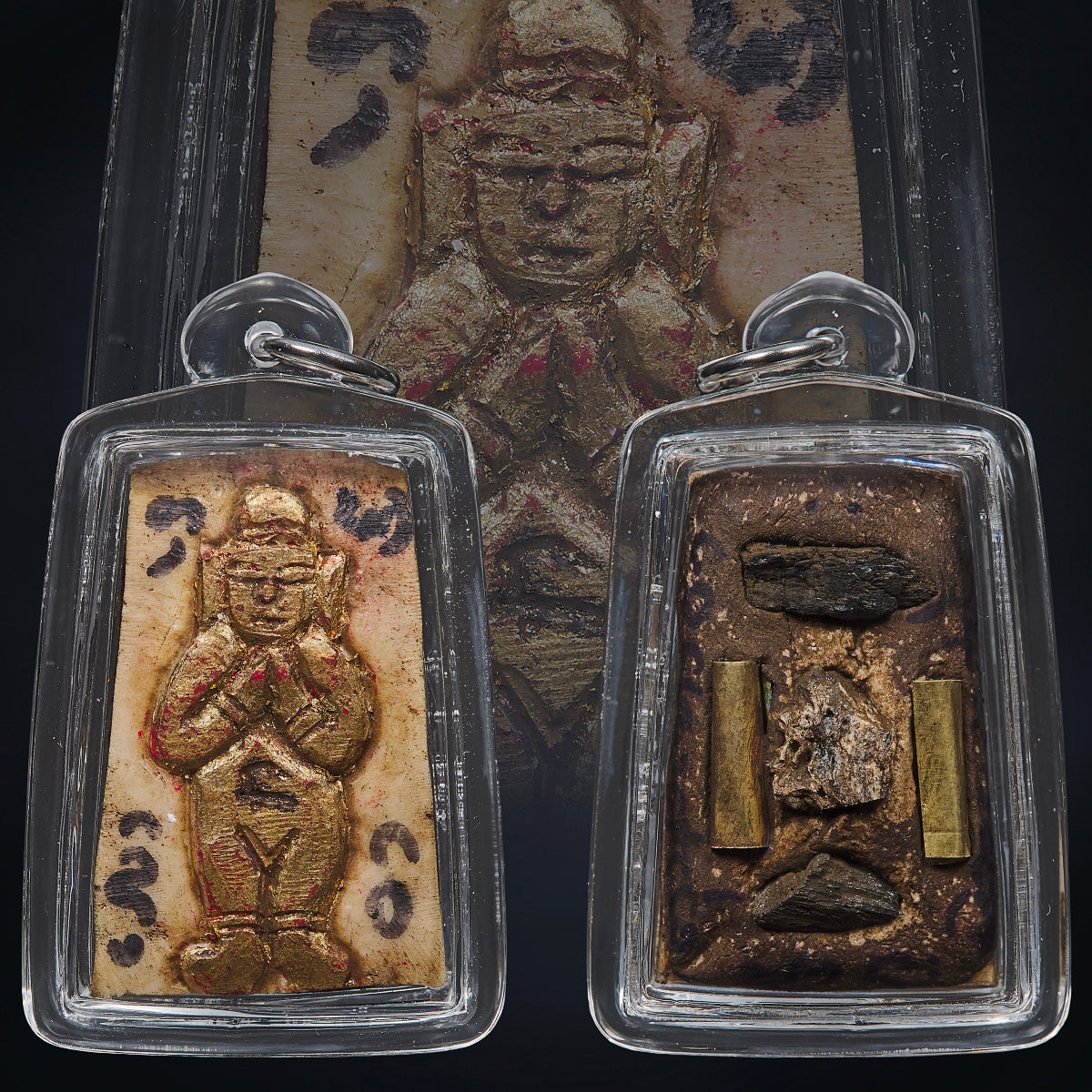
This Guman Thong was individually hand-carved from a piece of Paneang, a relic associated with Mae Hong Prai.
The reverse was prepared with soil collected from seven cemeteries, together with Paneang fragments and small relic chips mixed directly into the soil. Takruts for Maha Saneh and Metta Maha Niyom were embedded alongside these materials.
The finished figure was given its traditional golden appearance while retaining the irregular surface and character of the original relic.
Each artifact was individually carved and prepared by hand. Natural differences in the Paneang, carving, relic fragments and cemetery-soil mixture therefore make every piece unique.
Personal Experiences Shared by Luksits
Guman Thong has traditionally been especially popular among luksits involved in shops, sales and businesses where customer relationships are important.
The experiences shared are often quite practical: customers becoming easier to speak with, returning more frequently, introductions arriving through existing contacts, or business beginning to move again after a quiet period.
One of close follower of Por Sala Tan said that on the 1st day of receiving Guman Thong, he felt that everyone is looking at him. A sort of attraction that brings everyone to him. Everyone is friendly to him, talking to him.
Within this particular Guman Thong, Maha Saneh and Metta Maha Niyom are especially important. The intention is not simply attraction, but being remembered positively, creating warmth in conversation and encouraging others to feel comfortable dealing with the owner.
This is why Guman Thong has traditionally found a natural place in shops and businesses: goodwill brings people through the door, while trust encourages them to return.
Summary
This is an unusual Guman Thong by Por Sala Tan, carved directly from Paneang associated with Mae Hong Prai.
The reverse combines seven cemetery soils, Paneang fragments, relic chips and takruts for Maha Saneh and Metta Maha Niyom.
The history of the Paneang is particularly important. It came from the remains of a woman who died following complications during pregnancy. She had worked in the entertainment industry and, according to the history passed with the relic, had been a popular leading performer during her lifetime.
Por Sala Tan recognised a spiritual presence associated with the relic and subsequently prepared part of the Paneang as this Guman Thong.
Its traditional focus is upon metta, attraction, customer goodwill, opportunity, household guardianship and favourable fortune.
Historical Background
Guman Thong, literally associated with the idea of the "Golden Boy", occupies a distinctive place within Thai sacred and folk traditions.
Older traditions surrounding Guman Thong vary considerably according to period and lineage. In later practice, many forms are understood more broadly as child guardians or spiritual companions, traditionally cared for and dedicated towards beneficial purposes.
Their reputation became particularly strong among merchants and shopkeepers. A Guman Thong might traditionally be kept near a shop or household to watch over the premises, encourage favourable activity and attract beneficial people.
The golden appearance carries an appropriately auspicious meaning — brightness, prosperity and good fortune entering the household.
Por Sala Tan's example belongs to the more specialised Barang side of this tradition because the physical figure itself was carved from spirit-associated Paneang rather than made from ordinary clay or metal.
Origins of the Materials
The Paneang used for this Guman Thong came from relic associated with Mae Hong Prai — a woman who died during pregnancy.
According to the history accompanying the material, she had worked within the entertainment industry and had been particularly popular during her lifetime. Pregnancy complications subsequently resulted in her death.
The original luk rop, or complete foetal form, could not be recovered. However, Por Sala Tan regarded the remaining Paneang as retaining the spiritual association.
When he worked with the relic, he believed the presence was already receptive to his ritual intention. The initial consecration was therefore described as lasting only around five minutes, with Por Sala Tan understanding the spirit as willing to assist while accumulating merit towards eventual rebirth.
Part of this Paneang was then carved into the Guman Thong seen here.
Ritual
After carving the Guman Thong from Paneang, Por Sala Tan prepared the reverse with soil gathered from seven cemeteries.
Small Paneang fragments and relic chips were mixed into the cemetery soil, creating a material base rather than simply attaching the components separately.
Two takruts associated with Maha Saneh and Metta Maha Niyom were incorporated into the reverse to direct the preparation towards attraction, goodwill and favourable human relationships.
The completed Guman Thong was consecrated as a child guardian intended to assist through beneficial rather than harmful purposes.
Blessings and Effects
The central qualities of this Guman Thong are Maha Saneh and Metta Maha Niyom.
Here, Maha Saneh can be understood as personal attraction and memorability — the ability to make a favourable impression and draw people's attention.
Metta Maha Niyom concerns goodwill: being welcomed, trusted and treated favourably by others.
For business owners, these qualities traditionally translate into customer attraction, smoother communication, repeat customers and stronger relationships. For everyday use, they may relate to social acceptance, useful introductions and favourable opportunities.
Guman Thong is also traditionally regarded as a guardian and companion, watching over the owner's surroundings and helping draw attention towards beneficial circumstances.
Modern Application
This Guman Thong is particularly relevant for shops, businesses, sales and customer-facing work.
Its traditional purpose is not simply to draw people indiscriminately. The more useful interpretation is to create the conditions through which beneficial relationships can develop — a welcoming presence, memorable communication and greater goodwill between people.
It may also be kept within the household as a guardian artifact associated with opportunity and favourable fortune.
The underlying principle is simple: be received well, build trust and allow good relationships to create opportunity.
Physical Details
A Guman Thong hand-carved from Paneang by Por Sala Tan. The reverse contains a mixture of seven cemetery soils, Paneang fragments and relic chips, together with takruts prepared for Maha Saneh and Metta Maha Niyom.
Traditional focus: Metta · Maha Saneh · Customer Attraction · Goodwill · Opportunity · Guardianship
Recommended Pairing
For business use, this Guman Thong pairs naturally with a wealth or baramee artifact.
The Guman Thong traditionally supports customer attraction, goodwill and opportunities through people, while the accompanying artifact may provide a complementary emphasis upon wealth accumulation, stability or authority.
It may equally be kept alone in a shop or household where its principal purpose remains goodwill, opportunity and guardianship.
-
Free Shipping for Singapore| $15 Worldwide | $60 USA For Items Below $350