
OOBThaiAmulets
Por Sala Tan
Por Sala Tan
Couldn't load pickup availability
PST06
Phra Ngan
Por Sala Tan
1.5 Inches
Barang Artifact
Individual Craftsmanship
As every piece was carved and assembled individually by hand, natural differences in the relic material, carving and placement of the sacred components make each artifact unique.
Personal Experiences Shared by Luksits
My connection with Por Sala Tan's Phra Ngan goes back to 2012, when I restarted my amulet business after an earlier business failure.
When I first met Por Sala Tan, I was immediately struck by the unusual occult materials kept around him. At that time, I already had some understanding of mantras and traditional methods of preparing sacred objects, so I paid close attention to how he worked.
What stayed with me was how meticulous and sincere he was towards his wicha.
I began using his artifacts while operating my shop at Golden Mile Complex. During that period, I noticed a remarkable flow of customers. People would sometimes walk into the shop, choose something and purchase it without much hesitation.
Regular customers became curious about the Por Sala Tan artifacts I was using and began trying them themselves. After their own experiences, several became serious collectors of his work, with some continuing to collect his artifacts for many years.
Over time, luksits from different occupations also shared experiences with his Phra Ngan. Teachers spoke of better rapport with students, while those involved in business or government work described smoother discussions, greater confidence and people becoming more receptive towards them.
These are personal experiences rather than guaranteed outcomes, but they help explain why Por Sala Tan's Phra Ngan became particularly appreciated for the combination of metta and luck.
Summary
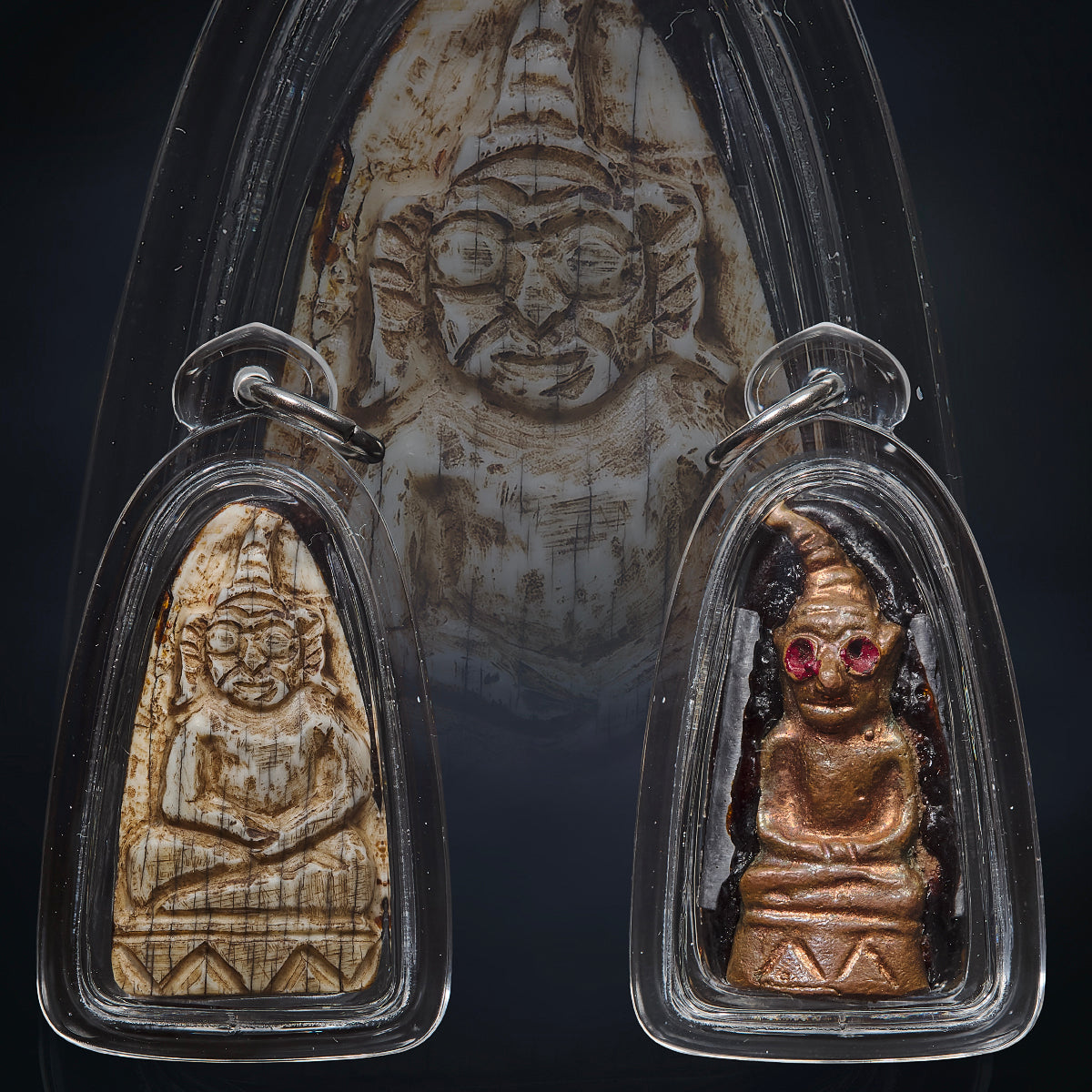
This is a classic Phra Ngan by Por Sala Tan, combining a simple hand-carved exterior with a much more elaborate ritual construction on the reverse.
The main figure was carved from relic material collected by Por Sala Tan. Behind it are Nam Man Metta, takruts, a separate Phra Ngan roop and cemetery soil.
Its traditional emphasis is straightforward: metta with luck — favourable human relationships combined with opportunities and circumstances moving in one's favour.
It represents the old-style character of Por Sala Tan's work particularly well: individually made, material-focused and filled with components selected for a specific purpose.
Historical Background
Phra Ngan, also encountered under spellings such as Phra Ngang and Prah Ngan, belongs to a wider family of occult figures found across Thailand, Cambodia, Laos and neighbouring Southeast Asian traditions.
It is generally better understood as a talismanic figure rather than a conventional Buddha image.
Its precise historical origin is difficult to establish. Different traditions connect Phra Ngan with old Khmer imagery, guardian spirits, ascetics, fertility symbolism, warrior talismans and other forms of regional folk belief. Over generations, these traditions overlapped with Buddhist, Hindu and animist practices.
One popular story concerns an attractive ascetic who found that attention from others continually disturbed his spiritual practice. He wished to lose his beauty and eventually assumed the unusual appearance associated with Phra Ngan. In this interpretation, the figure concerns not only attraction but also the control and direction of desire.
Other traditions place greater emphasis upon protection, courage, spirit assistance or good fortune.
There is therefore no single historical explanation that applies to every Phra Ngan. The maker, materials and individual lineage remain especially important when understanding a particular example.
Origins of the Materials
Por Sala Tan became known among his luksits for working with unusual natural and ritual materials, many of which he personally collected or obtained through his traditional networks.
For this particular Phra Ngan, the principal body was carved directly from relic material collected by Por Sala Tan.
The reverse was then prepared with Nam Man Metta and takruts. A smaller Phra Ngan roop was incorporated into the construction, with cemetery soil placed beneath it.
Rather than treating these simply as separate ingredients, Por Sala Tan combined them into a single artifact in which the carved material, oils, inscriptions and soil supported the intended wicha.
Ritual
The preparation began with the relic material itself, which Por Sala Tan individually carved into the form of Phra Ngan.
The reverse was coated with Nam Man Metta, traditionally connected with goodwill, attraction and favourable reception from others. Takruts were then incorporated for luck and favourable circumstances.
A separate Phra Ngan roop formed another ritual focal point on the reverse. Beneath it, cemetery soil was packed into the lower section before the artifact was completed.
The result is characteristic of Por Sala Tan's approach: relatively simple from the front, yet containing several layers of traditional preparation behind the carving.
Blessings and Effects
The central purpose of this Phra Ngan is metta combined with luck.
Metta is traditionally understood as encouraging people to respond more warmly and favourably. In everyday life, this may be sought for smoother conversations, stronger customer relations, better cooperation and greater acceptance from those around the wearer.
Phra Ngan is also traditionally associated with Maha Sanaeh, or personal charm and attraction. This does not need to be understood only romantically; it may also concern charisma, presence and the ability to leave a favourable impression.
The luck aspect concerns opportunity and timing — meeting the right person, receiving unexpected assistance, attracting customers or encountering a useful opening at an important moment.
For this reason, Phra Ngan has long appealed particularly to those whose work depends upon people, communication and opportunity.
Modern Application
This Phra Ngan is particularly suited to business owners, salespeople, service professionals and those who regularly meet customers or negotiate with others.
Its traditional qualities may also appeal to anyone seeking better interpersonal relationships, stronger confidence and favourable opportunities in everyday life.
For collectors of Por Sala Tan's work, it is also an interesting example of his older Barang approach: natural relic material individually carved and combined with oils, takruts and cemetery material, rather than relying upon a conventional mass-produced form.
Physical Details
A hand-carved relic Phra Ngan by Por Sala Tan, individually prepared with Nam Man Metta and takruts on the reverse. A smaller Phra Ngan roop is embedded at the back, with cemetery soil stuffed beneath it.
Traditional focus: Metta · Luck · Opportunity · Favourable Dealings
Category: Barang Artifact
Recommended Pairing
This Phra Ngan is already a balanced piece for metta and luck and may comfortably be worn or carried by itself.
It may also be paired with a mainstream Buddha or monk amulet associated with baramee and protection, leaving the Phra Ngan to focus upon interpersonal matters, opportunity and favourable circumstances.
Personal Notes
What I appreciate about this Phra Ngan is how clearly it reflects the character of Por Sala Tan's older handmade work.
From the front, it is uncomplicated — a Phra Ngan carved directly from a natural relic, with the marks and irregularities of the handwork still visible.
The reverse tells the deeper story. Nam Man Metta, takruts, another Phra Ngan roop and cemetery soil were brought together within one small artifact.
Having known and collected from Por Sala Tan since 2012, pieces such as this are particularly representative of what originally drew me towards his work: individually prepared materials, unusual construction and a clear purpose behind what was placed inside.
A very classic Por Sala Tan Phra Ngan — metta supported by luck.
-
Free Shipping for Singapore| $15 Worldwide | $100 USA All products