
OOBThaiAmulets
Por Sala Tan
Por Sala Tan
Couldn't load pickup availability
PST06
Phra Ngan
Por Sala Tan
4.5cm
Mainstream Artifact
Individual Craftsmanship
Each artifact was individually carved and assembled by hand. Differences in the original relic, carving, surface ageing and bindings therefore make every example naturally unique.
Personal Experiences Shared by Luksits
My own interest in Por Sala Tan's Phra Ngan goes back many years.
I first met Por Sala Tan around 2012, when I had restarted my amulet business following the failure of an earlier furniture business. At the time, I was operating from #02-38 Golden Mile Complex.
His appearance and the unusual ritual materials kept around him made a strong first impression. More importantly, having already spent considerable time studying mantras and traditional methods of preparing amulets, I could see that he approached his work with considerable care and sincerity.
I began using some of his artifacts personally.
During that period, I noticed unusually strong customer movement through my shop. People would come in, look through the pieces and often make purchases with relatively little hesitation. Naturally, some regular customers became curious about what I was carrying and began obtaining Por Sala Tan's pieces themselves.
Several subsequently became serious collectors of his work, and some continue collecting it today.
Other luksits have shared similarly practical experiences with his Phra Ngan. Teachers have spoken about being better received by students, while people working in government or client-facing roles have associated them with smoother communication and greater personal presence. Shopkeepers and other working people have likewise spoken of customer movement, social acceptance and improved confidence.
These remain personal experiences rather than guarantees, but they explain why Phra Ngan became one of the forms I most strongly associated with Por Sala Tan's work.
Summary
This Phra Ngan combines one of Por Sala Tan's characteristic occult forms with an important old natural material: Graduk Chang.
According to the provenance preserved with the piece, it had passed on naturally from old age.
In rural areas, remains of old elephants encountered by villagers or farmers could sometimes be retained rather than simply discarded. Materials regarded as unusual or spiritually significant might subsequently be passed to a village shaman, ajarn or practitioner for the creation of sacred objects.
This relic eventually reached Por Sala Tan.
He carved the elephant material into Phra Ngan, added takruts and bound the construction with Sai Sin.
Within his lineage, the finished artifact is principally associated with metta, maha saneh, personal influence, livelihood, protection and opportunity.
Historical Background
Phra Ngan occupies an unusual position within the occult traditions of mainland Southeast Asia.
It should not simply be described as a conventional Buddha image. The figure is more appropriately understood within the overlapping world of Thai, Khmer, Lao and Isan folk-talisman traditions, where Buddhist, Brahmanic and older spirit practices have influenced one another over long periods.
Its precise historical origin remains uncertain.
Different traditions describe Phra Ngan as an old guardian figure, a spirit-associated talisman, an ascetic form, a fertility or attraction image, or a figure influenced by older Khmer religious imagery. Other oral traditions connect it with warriors and protective magic.
These accounts should be regarded as lineage traditions rather than a single established historical biography of Phra Ngan.
What has remained much more consistent is its practical reputation.
Within modern Thai occult practice, Phra Ngan is especially associated with Metta Maha Niyom and Maha Saneh — favourable attention, personal magnetism and the ability to be better received by others.
Depending upon the master and construction, additional wiccha may concern protection, authority, business, fortune or spiritual assistance.
Origins of the Materials
The Graduk Chang used for this artifact came from an old elephant that had fallen naturally after reaching old age.
Such materials could occasionally be encountered by villagers and farmers while travelling through rural land, forest edges or agricultural areas.
Within older village practice, unusual remains were sometimes retained and given to a practitioner believed capable of preparing them respectfully.
This reflects an important characteristic of Por Sala Tan's work.
Many of his artifacts did not begin with newly purchased commercial materials. Their histories often started much earlier — with farmers, hunters, villagers, forest journeys and materials encountered naturally in the landscape.
By the time a material reached Por Sala Tan, it could already carry a substantial local history.
For this piece, the old Graduk Chang became the foundation upon which the Phra Ngan wiccha was developed.
Ritual
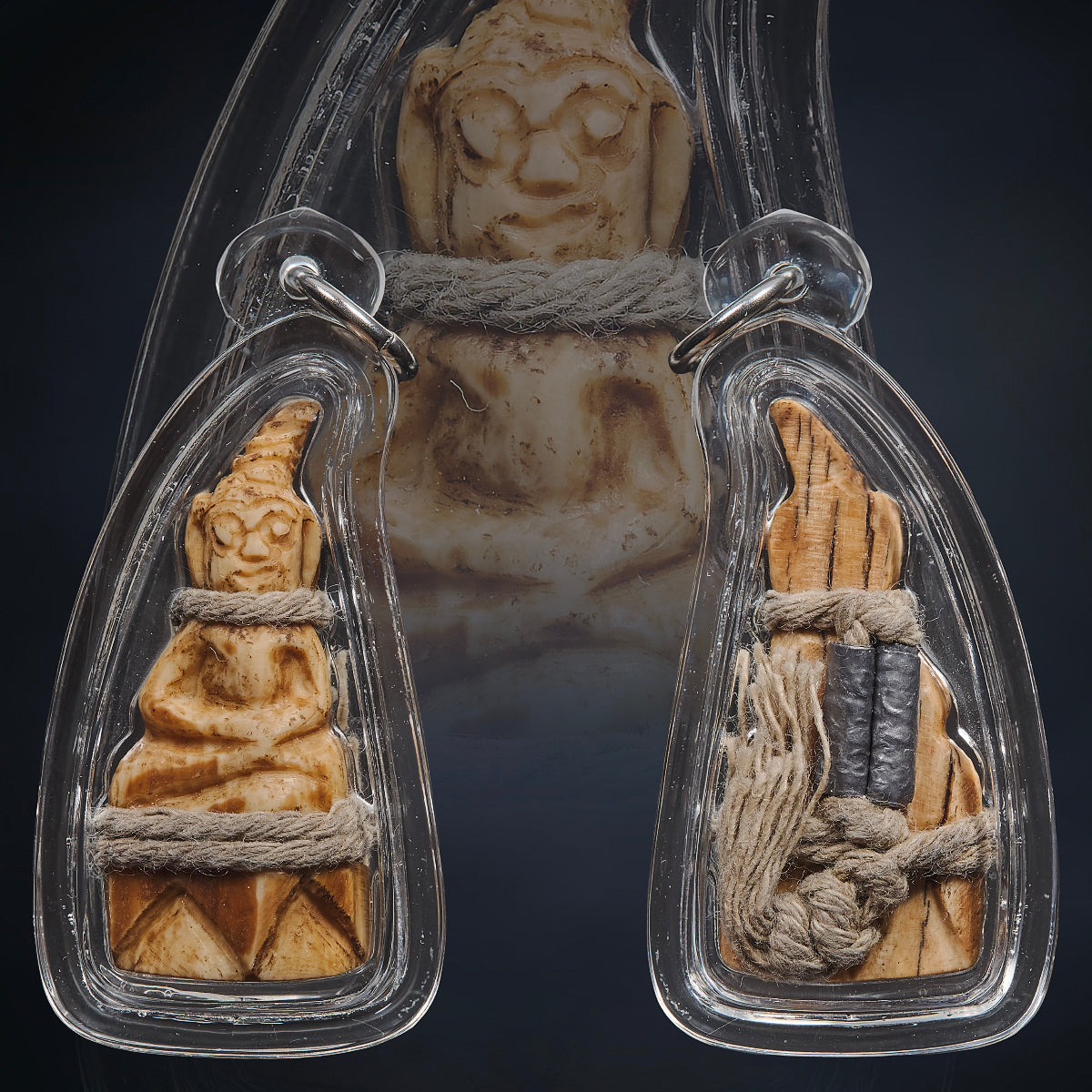
Por Sala Tan first carved the Phra Ngan directly into the elephant relic.
The completed figure was then combined with two takruts, visible along the reverse. These provide the written ritual component accompanying the carved material.
Sai Sin was used to bind the construction firmly together.
Within Por Sala Tan's broader approach to Phra Ngan, the precise formulation could vary considerably from piece to piece. He was known among his luksits for selecting materials according to their intended character rather than relying upon a single standard recipe.
His Ngan work could therefore emphasise different combinations of metta, saneh, authority, protection, livelihood and influence, depending upon the materials and wiccha prepared for the individual artifact.
Blessings and Effects
Traditionally, this Phra Ngan is associated with:
- Metta Maha Niyom — being received favourably and developing easier relations with others.
- Maha Saneh — personal magnetism, attraction and noticeable presence.
- Business and customer flow — traditionally favoured by merchants and people whose livelihood depends upon dealing with others.
- Opportunity — favourable introductions, contacts and openings.
- Influence and communication — useful symbolism for negotiations, sales and leadership.
- Confidence — greater composure when dealing with unfamiliar or influential people.
- Protection — reinforced by the traditional significance attributed to the old Graduk Chang.
- Livelihood and prosperity — particularly where income depends upon personal relationships and reputation.
The attraction aspect is best understood as personal presence and favourable interaction, rather than control over another person's will.
Modern Application
This form of Phra Ngan is particularly relevant to occupations where people themselves are central to success.
Salespeople, business owners, teachers, agents, managers and those working with customers may appreciate its traditional emphasis upon approachability combined with presence.
The distinction is important.
Authority alone can create distance. Metta alone can make someone agreeable without necessarily commanding attention. Phra Ngan traditionally occupies the space between the two — being noticed while still being favourably received.
For business, this translates naturally into customer relations, negotiation, networking and creating opportunities through people.
Physical Details
The front shows a seated Phra Ngan carved directly from pale, naturally aged Graduk Chang.
Its most striking feature is the face. Large rounded eyes, a broad nose and a restrained smile create the unusual expression characteristic of the form. The pointed upper section follows the natural outline of the original relic.
The figure sits cross-legged upon a simple base, with carving kept relatively shallow so that much of the original elephant material remains intact.
The reverse is deliberately functional rather than decorative.
Two dark metal takruts are positioned vertically against the relic, accompanied by aged Sai Sin. Cord bindings secure the upper body and lower section before the entire artifact is protected within its clear casing.
Recommended Pairing
For business use, this Phra Ngan can be paired with a wealth or Salika artifact.
Phra Ngan provides the traditional themes of presence, metta and interpersonal influence, while Salika complements communication and persuasive speech. A dedicated wealth piece can further support the livelihood aspect.
For those who prefer balance, pairing it with a mainstream Buddha or monk amulet creates a straightforward combination of daily Buddhist devotion alongside the specialised folk wiccha of the Phra Ngan.
Personal Notes
This piece helps explain why I became particularly interested in Por Sala Tan's Phra Ngan rather than collecting the form purely by appearance.
For me, the important point was always his relationship with materials.
The Graduk Chang was not simply chosen because elephant relic looks unusual. According to its provenance, it came from an old animal that had completed its natural life, was encountered through the rural community and eventually passed into the hands of a practitioner capable of transforming it into an artifact.
Por Sala Tan then carved the Ngan himself, added the takruts and bound everything together with Sai Sin.
My connection with his work also goes back to the period when I was rebuilding my own business. I saw how his pieces became part of the daily lives of customers who subsequently returned for more, and several of those early customers eventually became long-term collectors.
That history is why I continue to regard Por Sala Tan's Ngan work as an important part of his legacy.
The Graduk Chang provides the foundation; the takruts carry the intended wiccha; but it is Por Sala Tan's understanding of how those materials should work together that gives the piece its individual identity.
-
Free Shipping for Singapore| $15 Worldwide | $100 USA All products