
OOBThaiAmulets
Por Sala Tan
Por Sala Tan
Couldn't load pickup availability
PST06
Phra Pidta
Por Sala Tan
1.5 Inches
Barang Artifact
Individual Craftsmanship
As each artifact was carved and assembled individually from natural sacred materials, variations in shape, markings, texture and binding are intrinsic to the piece.
Personal Experiences Shared by Luksits
Por Sala Tan's Pidta wiccha is traditionally spoken of in terms of quiet protection rather than confrontation.
Luksits describe carrying such pieces when they wish to stay away from unnecessary trouble, remain composed around difficult people, or pass through uncertain situations without attracting unwanted attention.
Business users also associate Pidta with a different form of wealth practice: not simply bringing money in, but preventing opportunities, customers and accumulated resources from continually slipping away.
For meditation and personal practice, the symbolism becomes even more direct. The covered eyes serve as a reminder to withdraw from distraction, remain silent when speech serves no purpose, and concentrate upon what actually matters.
Summary
This is one of Por Sala Tan's more contemplative relic artifacts.
According to the history preserved with the piece, Por Sala Tan encountered the remains of an old ascetic during one of his journeys through the remote northern mountains.
The ascetic had practised within a secluded cave and was believed to have died while in deep samadhi. His remains had remained largely undisturbed within that environment.
Por Sala Tan recovered material from the hip relic and later carved it into Phra Pidta.
The choice of form was deliberate.
The ascetic had withdrawn from ordinary life into the silence of the cave. Phra Pidta similarly represents closing the senses, withdrawing from disturbance and directing awareness inward.
Relic and image therefore carry the same underlying theme.
Historical Background
Phra Pidta — literally the Buddha or sacred figure "closing the eyes" — is among the most recognisable forms in Thai amulet tradition.
The hands covering the face symbolise withdrawal from external distraction and the guarding of the senses. In certain forms this idea develops into Maha Ut, the complete closing or sealing of the bodily openings.
Within traditional amulet culture, these meditative ideas gradually became associated with practical protective meanings: closing the way to danger, preventing hostile influences from entering and keeping unwanted matters away from the owner.
Another interpretation concerns livelihood.
Just as Pidta symbolically closes what should remain closed, wealth-oriented Pidta wiccha may be understood as preventing money and resources from continually flowing out.
Por Sala Tan's use of an ascetic relic gives these ideas an especially appropriate foundation. The source material itself came from a life associated with solitude, restraint and meditation.
Origins of the Materials
During his northern journeys, Por Sala Tan regularly entered remote mountain areas and caves associated with older practitioners.
On one such journey he encountered the remains of an ascetic who had lived in seclusion within a cave.
According to the account surrounding the artifact, the practitioner had died there while deeply absorbed in meditation. His remains subsequently stayed within the cave for years.
Por Sala Tan carefully recovered part of the hip relic.
He also retained earth from the cave itself.
The two materials were later reunited in the finished artifact: the ascetic's relic forming the Pidta on the front, and the earth from his place of practice incorporated behind it.
This connection between person, place and final sacred form is central to the construction of the piece.
Ritual
Por Sala Tan carved the Pidta directly upon the hip relic before preparing the reverse with several complementary materials.
Cave soil reconnects the artifact with the ascetic's original place of meditation.
Wahn Maha Larp was incorporated for the traditional wiccha of fortune and favourable opportunities.
Yaa Lek was added as another wealth and attraction substance within Por Sala Tan's formula, particularly associated in this piece with drawing attention, opportunity and livelihood.
A takrut was inserted to direct and strengthen the intended wiccha, while another fragment of relic was retained within the reverse.
The completed assembly was finally bound with cord, physically securing the different ritual components together.
Blessings and Effects
Within the tradition surrounding this piece, its principal associations are:
- Pidta & Maha Ut — closing the way to danger and unwanted influences.
- Klaew Klad — avoidance of accidents, conflict and unfavourable situations.
- Meditative composure — maintaining concentration when circumstances become uncertain.
- Concealment — avoiding unnecessary attention, hostility and interference.
- Maha Larp — favourable opportunities and unexpected fortune.
- Wealth retention — protecting accumulated resources rather than allowing them to disappear unnecessarily.
- Business stability — smoother negotiations, preservation of customers and greater care around agreements.
- Baramee of the ascetic — traditionally understood as carrying the spiritual weight associated with disciplined practice and withdrawal.
This makes the piece unusual in that protection and wealth are both expressed through the principle of restraint.
Modern Application
For business owners, the Pidta principle is particularly suitable where success depends upon discretion, patience and knowing when not to react.
It may be carried during negotiations, important meetings or periods when the owner wishes to avoid unnecessary conflict while protecting existing interests.
For travellers, the traditional emphasis is Klaew Klad — passing safely through uncertain circumstances and avoiding situations before they become serious.
For meditation, the meaning becomes simpler still: close the external noise and return attention inward.
This is not an artifact whose symbolism encourages force. Its strength lies in stillness.
Physical Details
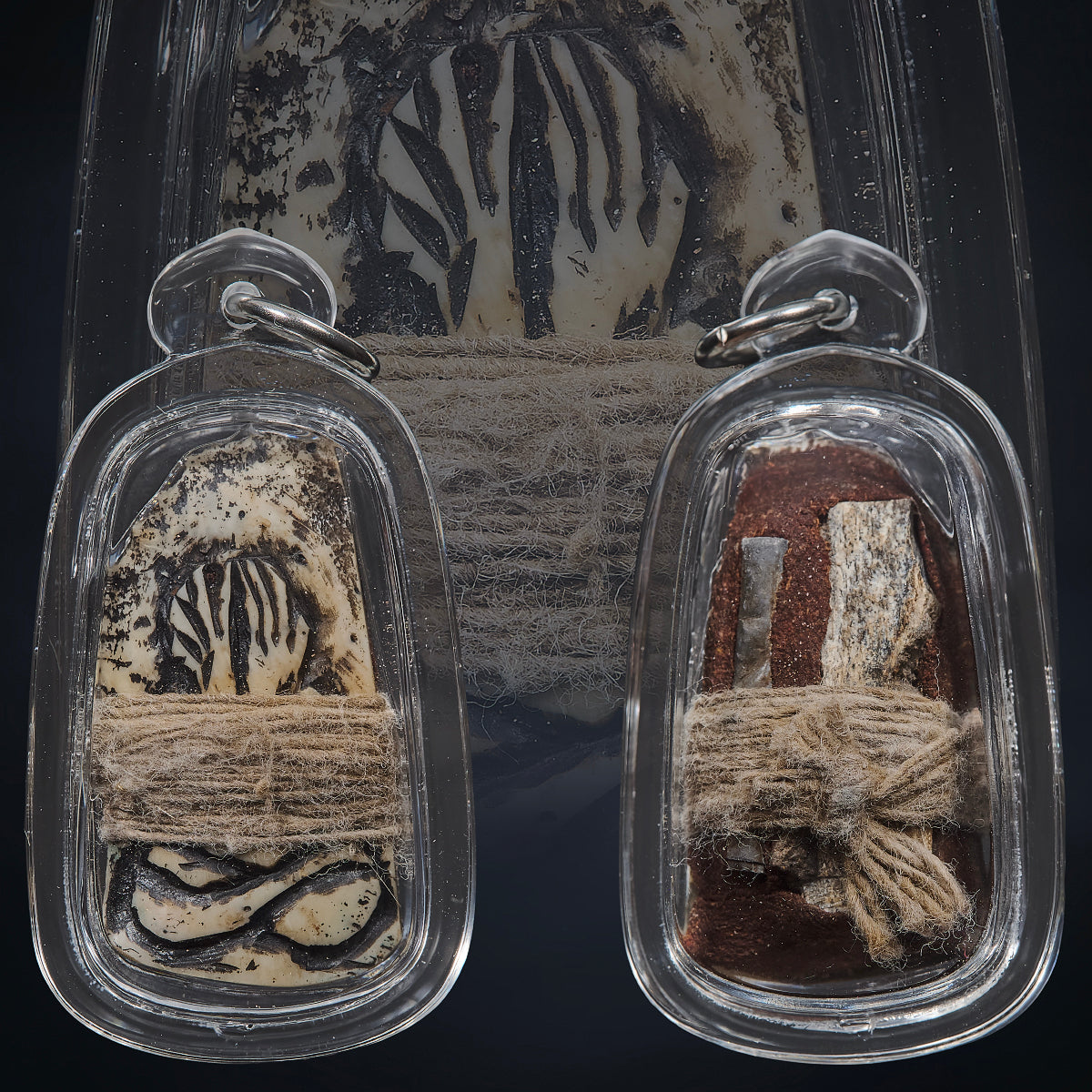
The front retains the natural pale colour and irregular surface of the original relic. A compact Phra Pidta has been carved into the centre, with the figure's raised hands covering the face.
Darkened carving lines emphasise the otherwise restrained image.
The reverse reveals the more complex ritual construction. A bed of reddish-brown sacred material contains the cave-associated components, with a rolled metal takrut and separate pale relic fragment remaining clearly visible.
Traditional natural cord is wrapped firmly around the centre of the piece before the artifact is enclosed within its clear protective casing.
Recommended Pairing
This Phra Pidta already combines protection, concentration and wealth-oriented materials, making it particularly suitable as a principal daily piece.
For stronger business application, it can be paired with a metta or wealth artifact to encourage customer movement and opportunity. The complementary piece attracts; the Pidta helps retain and protect.
For protection, it may also accompany Tao Wessuwan or another guardian artifact, while allowing the Pidta itself to remain focused upon concealment, avoidance and inner stability.
Personal Notes
What I appreciate about this piece is the consistency of its entire construction.
An ascetic withdrew into a mountain cave for practice. His hip relic was later carved into Phra Pidta — an image whose very meaning concerns withdrawal from the senses and external disturbance. Soil from that same cave was then returned to the artifact, while Wahn Maha Larp, Yaa Lek and the takrut extended the wiccha towards livelihood and fortune.
Nothing about the construction feels arbitrary.
The relic represents the practitioner, the cave soil preserves the place of practice, and Phra Pidta preserves the principle of that practice: stillness, restraint and knowing what should remain outside.
-
Free Shipping for Singapore| $15 Worldwide | $60 USA For Items Below $350