
OOBThaiAmulets
Por Sala Tan
Por Sala Tan
Couldn't load pickup availability
PST06
Graduk Moo Graden
Por Sala Tan
2 Inches length
Mainstream Artifact
Individual Craftsmanship
The original form of the relic was deliberately retained. Its natural curvature determines the posture and proportions of the animal, while the hand carving and yantric inscriptions give each piece an individual character.
Personal Experiences Shared by Luksits
Wild-boar pieces within Por Sala Tan’s lineage are generally spoken of differently from softer metta or saneh artifacts.
Luksits commonly associate them with standing one’s ground, greater confidence and being less easily pressured by others. In business, this may be interpreted as remaining firm during negotiations, protecting one’s position and having the courage to pursue an opportunity without becoming intimidated by stronger competitors.
Others keep such pieces for protection during travel, outdoor work or situations where they feel they need greater courage and awareness.
The additional wealth takruts give this particular piece another dimension. Rather than authority alone, its wicha combines strength with the ability to protect and build one’s livelihood.
Summary
The story behind this Graduk Moo Graden centres upon an old alpha wild boar that lived largely alone in the jungle.
According to the account preserved with the piece, other male wild boars rarely approached its territory. It moved independently and was regarded as the dominant animal of that part of the forest.
For Por Sala Tan, these characteristics made the relic particularly suitable for an authority-based artifact.
The wild boar was therefore carved directly upon its own relic, hand-yanted and strengthened with takruts for fortune.
Its traditional themes are straightforward: authority, courage, protection, resilience and prosperity.
Historical Background
The wild boar occupies an interesting place within Southeast Asian forest belief.
Unlike the tiger, whose symbolism often centres upon command and predatory presence, the wild boar represents a different type of strength: determination, territorial confidence and the willingness to continue forward when challenged.
A mature wild boar is heavily built and capable of defending itself when threatened. In folk interpretation, these natural characteristics became symbols of resilience and fearlessness.
Relics associated with an unusually dominant animal could therefore acquire particular significance within forest wicha. The history of the individual animal mattered because practitioners regarded its natural qualities as part of the character of the material.
In this case, the solitary alpha animal became the foundation of the artifact’s symbolism.
Origins of the Materials
The Graduk Moo Graden came from an old wild boar known around the neighbouring jungle.
It was remembered as a solitary and dominant animal. Other mature males generally kept their distance, leaving it effectively in command of its territory.
After obtaining the relic, Por Sala Tan recognised its suitability for a protective and authority-oriented piece.
Rather than reducing the material into powder, he retained the solid relic and worked directly upon it.
This is important to the character of the artifact: the image of the wild boar was carved upon material originating from the animal itself.
Ritual
Por Sala Tan first shaped the Graduk Moo Graden into the recognisable form of the wild boar.
The surface was then individually inscribed with yantric characters. As visible on the reverse, the inscriptions follow the natural shape of the relic rather than a mechanically repeated pattern.
Takruts were incorporated alongside the carving. These were prepared particularly to strengthen the fortune and wealth aspect, complementing the naturally protective and authoritative symbolism attributed to the wild boar.
The piece was finally secured using traditional cord binding, bringing the relic, yantra and takruts together as one working artifact.
Blessings and Effects
Within Por Sala Tan’s tradition, Graduk Moo Graden pieces are associated with:
- Authority and presence — standing firmly without being easily dominated.
- Courage — greater confidence when facing difficult people or uncertain circumstances.
- Protection — particularly against confrontation, danger and hostile environments.
- Resilience — continuing through obstacles rather than withdrawing at the first resistance.
- Territorial protection — traditionally suitable for the owner, home, business or property.
- Fortune and wealth — reinforced in this piece through the additional takruts.
- Business strength — protecting one’s position while competing for customers, contracts or opportunities.
- Leadership — carrying oneself with greater decisiveness and self-command.
The combination is therefore not simply aggressive strength. It is strength used to hold position, protect resources and move forward.
Modern Application
This is particularly suitable for business owners, managers, salespeople, contractors and anyone working within a competitive environment.
The alpha-boar symbolism translates naturally into situations where the owner must negotiate firmly, defend a business position or remain composed when dealing with stronger personalities.
The wealth takruts make it equally relevant for livelihood. Here, prosperity is connected with the ability to secure what has already been built while continuing to seek new opportunities.
It may be carried personally or kept within a workplace where authority and protection of business interests are important.
Physical Details
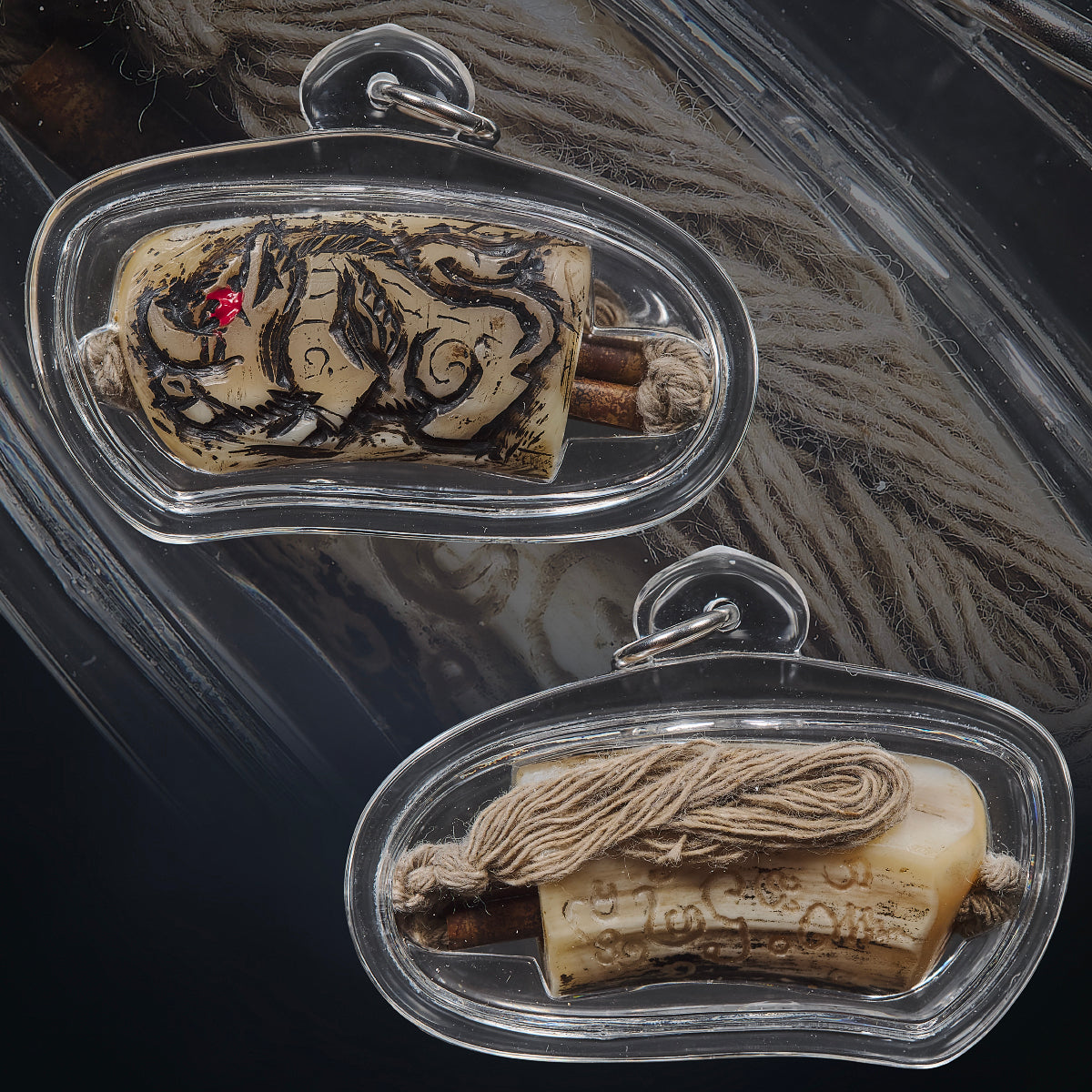
The front shows a hand-carved wild boar in profile, its body following the natural curve of the Graduk Moo Graden. The head is lowered slightly, with the tusk, ear, legs and powerful body picked out through dark hand-cut detailing.
Small red accents emphasise the eye and selected areas of the carving.
The reverse retains the natural pale surface of the relic and carries extensive hand-inscribed yantric markings.
Takruts sit alongside the relic beneath the cord binding, making the construction of the artifact clearly visible through its transparent protective casing.
Recommended Pairing
For business use, this piece pairs naturally with a wealth or metta artifact. The complementary piece may encourage customers, relationships and opportunity, while the Graduk Moo Graden represents the strength to hold one’s position and protect what has been gained.
For stronger guardian emphasis, it may also be paired with Tao Wessuwan or another established protection piece.
Personal Notes
What makes this piece particularly appealing is the relationship between the animal, material and carving.
Por Sala Tan did not merely carve an arbitrary wild-boar image onto an unrelated sacred material. The animal remembered for its solitary dominance became the material from which its own image was subsequently carved.
The additional hand-written yantra and fortune takruts then extend that original symbolism beyond physical strength.
For me, it is a particularly nice example of Por Sala Tan’s forest work: the authority comes from the story of the animal, the protection from the Graduk Moo Graden, and the wealth aspect from the wicha added by the master.
-
Free Shipping for Singapore| $15 Worldwide | $60 USA For Items Below $350