
OOBThaiAmulets
Por Sala Tan
Por Sala Tan
Couldn't load pickup availability
PST06
Yant Saneh Mae Graduk Pii
Por Sala Tan
2 Inches
Barang Artifact
Individual Craftsmanship
Because the Paneang, relics, yantra and ritual materials were individually prepared by hand, every surviving example naturally differs in its markings, texture and arrangement.
Personal Experiences Shared by Luksits
Only a limited number of these pieces were said to have been completed, largely because the principal Mae material was scarce.
Among the accounts shared by luksits, one particularly remembered case concerned a woman working in nightlife entertainment.
After she began carrying the artifact, she described becoming noticeably more popular with customers. Regulars increasingly requested her, some returned specifically because she was working, and she found that people were more willing to support and spend with her.
She personally attributed the change to the Maha Saneh and Maha Niyom qualities of the piece.
Other owners have spoken less about romantic attraction and more about increased luck, smoother interactions and improved movement of income.
For this reason, the artifact developed a reputation among luksits not simply for attraction, but for attraction that could translate into customers, support, opportunity and livelihood.
Summary
Yant Saneh Mae Graduk Pii is one of Por Sala Tan's more specialised Mae-based attraction artifacts.
Its construction combines three principal elements.
The handwritten Paneang yantra directs the work towards Maha Saneh.
The Mae relic establishes the spiritual connection at the centre of the artifact.
The reverse materials—including cemetery soil, Sankasat takruts and Ploi Sek—complete and stabilise the ritual structure.
According to the account preserved with these pieces, Por Sala Tan communicated with the Mae before completing the work. The spirit was invited to assist future owners who treated the artifact faithfully and respectfully, with the clear understanding that its wiccha should not be abused.
Its character is therefore centred upon attraction, goodwill, opportunity and the movement of fortune through other people.
Historical Background
Mae and Graduk Pii Wiccha
Within certain Thai, Lao and border-region occult traditions, Graduk Pii and other relic-based materials may be incorporated into spirit-associated artifacts after appropriate ritual preparation.
A female spirit incorporated into such practice may be respectfully referred to as Mae.
The precise purpose depends entirely upon the practitioner and the spirit narrative attached to the material. In this case, Por Sala Tan interpreted the presence as particularly strong in Saneh, and therefore constructed the artifact around attraction rather than aggressive or protective wiccha.
This is an important distinction.
The intended current is not primarily one of intimidation or suppression. It concerns drawing people closer and encouraging favourable human response.
Maha Saneh
Maha Saneh is broadly understood within Thai occult practice as strong personal attraction or magnetism.
It is closely related to Metta Maha Niyom, but the emphasis differs slightly.
Metta Maha Niyom concerns being liked, welcomed and treated favourably.
Maha Saneh carries a stronger element of personal attraction, fascination and attention.
For merchants, entertainers and people whose livelihood depends upon customers, these traditions naturally developed a commercial dimension: attraction brings attention, attention creates interaction, and interaction may create opportunity.
Origins of the Materials
The principal relic material reached Por Sala Tan through a hunter who frequently travelled through remote jungle areas trapping animals.
The hunter occasionally encountered unusual natural or ritual materials during these journeys and would bring selected items to Por Sala Tan for use in sacred artifacts.
On one occasion he discovered what appeared to be graves that had been disturbed and dug open, probably by wild animals scavenging for food.
Among the exposed earth were relic fragments and several other objects.
Selected materials were subsequently brought to Por Sala Tan.
When Por Sala Tan handled one particular piece of Graduk, he felt what he described as an immense spiritual presence.
His impression was immediate:
the Mae was strong.
This became the foundation for the Yant Saneh Mae Graduk Pii.
Ritual
Por Sala Tan began with a piece of Paneang and personally inscribed the Maha Saneh yantra he had learnt during his travels in Laos.
The writing required its accompanying chants to be recited during the inscription process.
The reverse was then layered with cemetery soil associated with the provenance of the material.
Sankasat takruts were added together with Ploi Sek — ritually blessed gemstone fragments.
Relic material was incorporated into the preparation, including a specific fragment associated with the Mae.
Importantly, each principal relic was individually bound with sacred scrolls, forming a ritual containment structure around the Mae material.
Por Sala Tan then performed the invocation and invited the Mae's presence into the prepared relic.
According to the account preserved with the artifact, the Mae agreed to assist those who respectfully kept the piece, provided that the relationship and its attraction wiccha were not deliberately abused.
Finally, the artifact was secured with red Sai Sin belonging to the Mae, completing the connection between the handwritten yantra, relic and ritual materials.
Blessings and Effects
Traditionally, this artifact is associated with:
- Maha Saneh — strong personal magnetism and attraction.
- Metta Maha Niyom — popularity and favourable treatment.
- Opposite-sex attraction — particularly where personal chemistry and attention are important.
- Customer attraction — drawing interest towards the owner's work or business.
- Returning customers — encouraging stronger personal affinity and repeat interaction.
- Support from others — being treated generously or receiving assistance more readily.
- Business movement — creating opportunities through human interaction.
- Income and wealth — particularly where earnings depend upon customers, commission or personal popularity.
- Social confidence — greater ease when meeting and communicating with people.
The traditional belief surrounding the artifact concerns attraction and favourable interaction; it should not be interpreted as granting control over another person's consent or decisions.
Modern Application
The Yant Saneh Mae Graduk Pii is particularly suited to professions where the individual themselves is an important part of what customers return for.
Sales, hospitality, entertainment, nightlife, beauty services, property, livestream commerce and other client-facing industries fit naturally with this form of wiccha.
Its wealth symbolism is therefore different from a conventional wealth amulet.
The artifact does not simply represent money appearing independently.
Its traditional logic is:
people create movement;
movement creates opportunity;
opportunity creates income.
This helps explain why reports surrounding the piece often concern increased attention, customers returning, introductions and people becoming unexpectedly supportive.
Physical Details
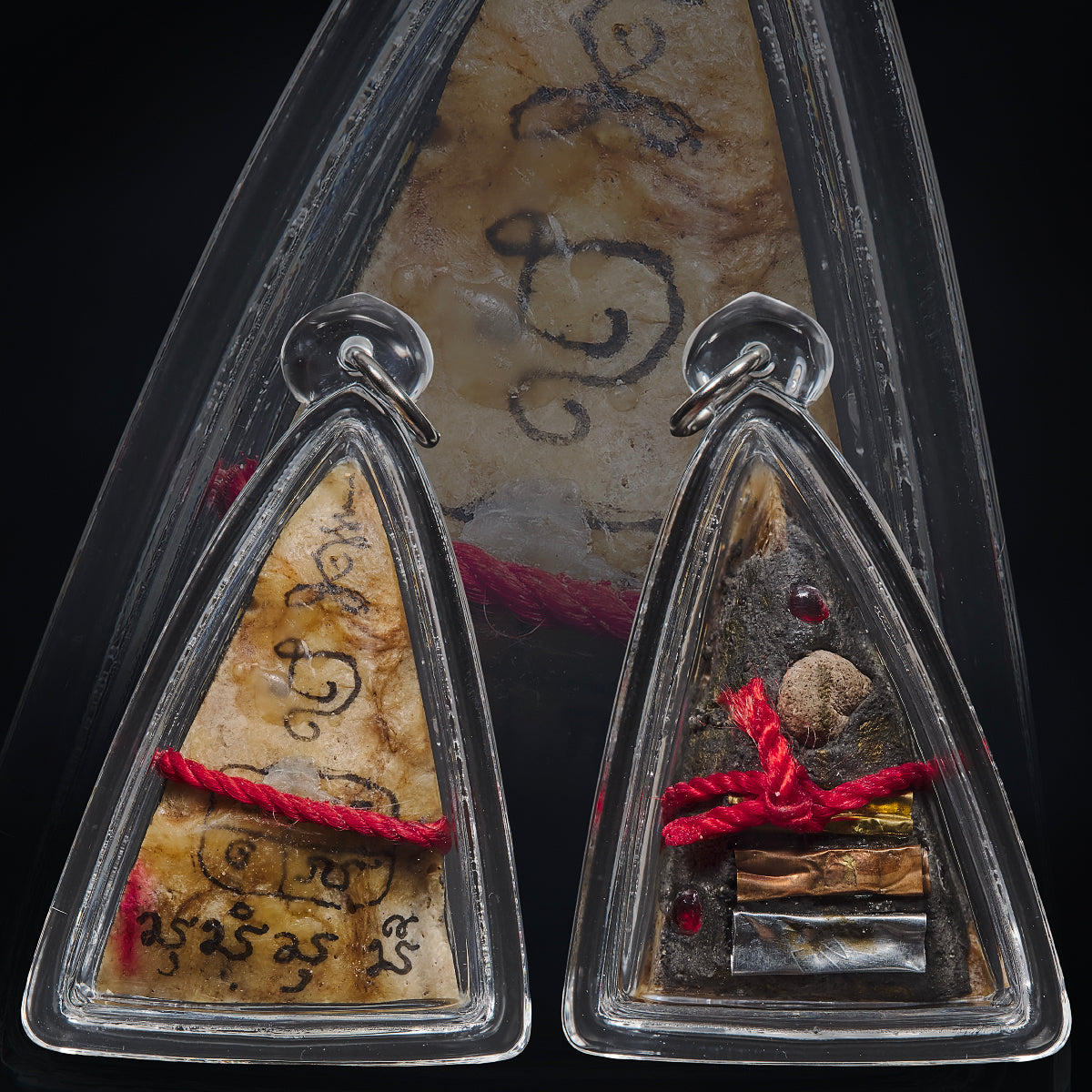
The artifact is constructed in a distinctive triangular form and preserved within a clear acrylic casing.
The front exposes the natural cream-coloured Paneang surface, upon which Por Sala Tan's handwritten yantra remains clearly visible. The irregular texture of the material gives the inscriptions a distinctly handmade appearance.
A length of red Sai Sin crosses the lower portion.
The reverse reveals the considerably more complex ritual construction.
Dark sacred material and cemetery soil form the background. Several Sankasat takruts in different metals are arranged towards the lower section, while Ploi Sek and relic materials are embedded above them.
The red cord passes directly across the ritual chamber, visually binding the two sides of the artifact together.
Recommended Pairing
Because this is already a concentrated Maha Saneh piece, it does not necessarily benefit from pairing with another strong attraction artifact.
For commercial use, a Phra Sivali or wealth-oriented Phra Pidta provides a more balanced combination: Mae Graduk Pii supports customer attraction and human affinity, while the companion amulet represents stable livelihood and retention of wealth.
A Buddha or respected monk amulet associated with baramee and mindfulness also provides a balanced everyday pairing.
Personal Notes
What stands out about this artifact is the way every part of its construction follows the original character Por Sala Tan perceived in the Mae.
He did not simply obtain unusual relic material and build a generic spirit artifact around it.
He felt that the Mae carried exceptionally strong Saneh, and the entire construction followed that direction.
The Paneang received a Maha Saneh yantra.
The relic was individually bound.
The reverse received cemetery soil, Sankasat takruts and Ploi Sek.
The Mae was ritually invited into the prepared relic.
Finally, her own red Sai Sin was used to secure the artifact.
Only limited pieces could be completed from the available material, and positive accounts from luksits meant that examples were seldom released once they entered private collections.
For me, the most interesting aspect is that the reported wealth effect is closely tied to the human side of fortune—customers, attention, support, introductions and people choosing to return.
That is very much the character of this piece:
Saneh first draws the person; Maha Niyom encourages them to stay; opportunity follows from the relationship.
-
Free Shipping for Singapore| $15 Worldwide | $60 USA For Items Below $350