
OOBThaiAmulets
Por Sala Tan
Por Sala Tan
Couldn't load pickup availability
PST06
Palakit
Por Sala Tan
2.5 Inches
Mainstream Artifact
Individual Craftsmanship
Each element was prepared and tied by hand, so natural differences in the yantra, binding and final arrangement form part of the individual craftsmanship.
Personal Experiences Shared by Luksits
The provenance of this Palakit is particularly interesting because it came through a luksit who maintained a close relationship with Por Sala Tan despite living in Bangkok.
He would travel north regularly to visit him, bringing several personal amulets along on different occasions.
This Palakit was among them.
Rather than replacing the original piece, Por Sala Tan worked upon the existing Palakit, preparing a dedicated takrut according to what he felt was suitable for its female imagery and attraction-oriented character.
The emphasis was not solely romantic attraction.
The luksit understood the yantra as being directed towards bringing people closer, improving interpersonal relations and encouraging relationships to develop more smoothly.
Summary
This is an unusual Palakit because its significance lies in the meeting of an existing sacred object with Por Sala Tan's personal handwritten wiccha.
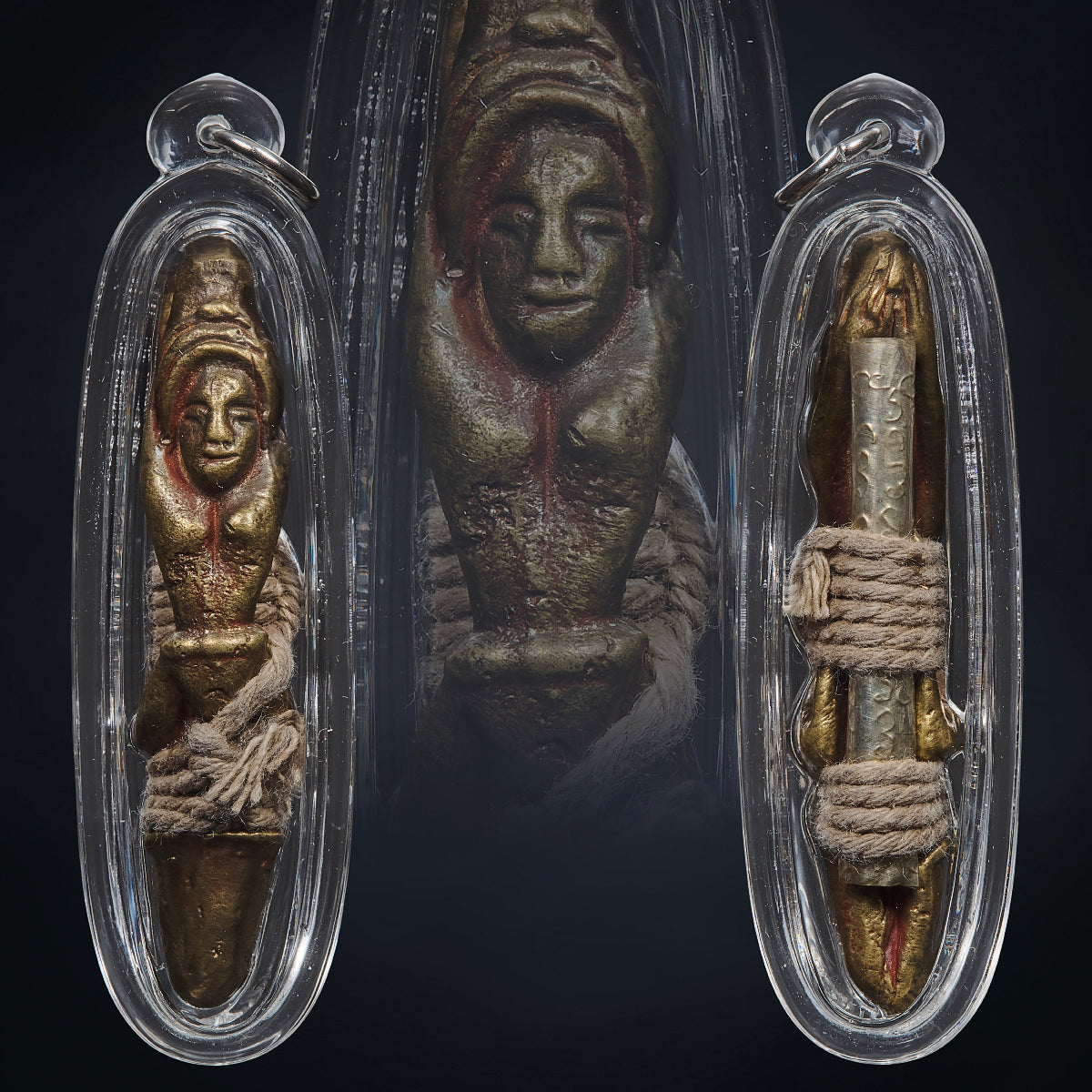
The front carries a prominent female figure incorporated into the Palakit form.
Por Sala Tan subsequently added a hand-written and hand-rolled takrut to the reverse, containing yantras for:
Maha Saneh · Metta Maha Niyom · interpersonal attraction · relationship building
The takrut was then bound directly onto the Palakit with Sai Sin.
Rather than functioning only as a conventional attraction charm, the piece was therefore directed towards the broader movement of human relationships—meeting people, creating affinity and maintaining favourable connections.
Historical Background
Palakit belong to a long-established category of Thai folk talismans associated with fertility, vitality, protection, charisma and prosperity.
Different masters adapted the form according to their own wiccha. Some Palakit were strongly protective, while others became specialised towards commerce, metta or Maha Saneh.
The inclusion of a female figure shifts the symbolism towards the relationship between masculine and feminine principles.
Within folk occult interpretation, such imagery may be understood through the complementary symbolism of the Palakit and Yoni—creation, attraction and the meeting of two forces.
For attraction-oriented practitioners, this developed naturally into wiccha concerned with Saneh and human affinity.
The objective is therefore broader than simply finding a romantic partner. Metta Maha Niyom concerns being welcomed, remembered and treated favourably, qualities equally relevant to friendship, work and business.
Origins of the Materials
Unlike many Por Sala Tan artifacts where he personally sourced the principal relic or material, this Palakit was brought to him by his Bangkok luksit.
This distinction forms an important part of its provenance.
Por Sala Tan's contribution was the ritual modification.
After examining the Palakit, he prepared a metal sheet and inscribed it himself with yantras selected for the purpose of Maha Saneh and relationship building.
The sheet was then rolled into the long takrut now visible along the reverse.
In this way, the original Palakit became the vessel while Por Sala Tan's handwritten takrut became the principal wiccha added to it.
Ritual
The preparation was straightforward but personal.
Por Sala Tan first wrote the required yantras onto the metal sheet by hand.
The inscriptions were directed towards attraction, goodwill and the formation of favourable relationships.
Once completed, the sheet was rolled tightly into a takrut.
It was positioned lengthwise against the reverse of the Palakit and bound firmly with Sai Sin cord, integrating the takrut with the existing sacred object.
The binding serves both a physical and ritual purpose: the added wiccha is not carried separately but becomes part of the Palakit itself.
Blessings and Effects
Within traditional belief, this particular combination is associated with:
- Maha Saneh — personal attraction and magnetism.
- Metta Maha Niyom — goodwill, popularity and favourable treatment.
- Relationship building — encouraging connections to develop more naturally.
- Opposite-sex attraction — strengthened by the female imagery.
- Reconciliation and harmony — supporting smoother communication between people.
- Business relationships — useful where trust and personal rapport matter.
- Customer affinity — encouraging people to feel comfortable approaching or returning.
- Social confidence — helping the owner present themselves with greater warmth and assurance.
The traditional intention is attraction and affinity rather than control over another person's decisions.
Modern Application
The relationship aspect makes this Palakit particularly relevant to people whose opportunities depend upon connections with others.
Salespeople, business owners, agents and those working in customer-facing environments may appreciate its Maha Niyom character.
It is equally suited to professional environments where maintaining good relationships with colleagues, clients and people in authority can influence how smoothly work progresses.
For personal relationships, its symbolism is best understood as supporting attraction, communication and closenessrather than forcing affection.
This makes the piece considerably more versatile than a Palakit intended purely for romantic Saneh.
Physical Details
The Palakit has a long, slender form protected within a clear acrylic casing.
The front displays a female figure carved prominently into the upper body, with traces of gold and red ritual finishing still visible across the surface.
The reverse reveals Por Sala Tan's principal addition: a long rolled metal takrut, visibly inscribed before rolling and positioned directly against the Palakit.
Traditional Sai Sin has been wrapped around the central and lower sections to secure the takrut firmly in place.
The construction remains visibly handmade, with the aged cord and exposed handwritten metal preserving the character of the original ritual work.
Recommended Pairing
Because this piece already concentrates strongly on Maha Saneh and relationships, it pairs well with a calmer baramee or wealth-oriented amulet.
For business, a Phra Sivali or Phra Pidta can complement it well: the Palakit supports people, rapport and returning customers, while the companion piece represents livelihood and financial stability.
For everyday wear, a respected Buddha or monk amulet provides a balanced pairing centred on mindfulness, protection and baramee.
Personal Notes
What makes this Palakit interesting is that it was not originally created from beginning to end by Por Sala Tan.
It belonged to one of his close Bangkok luksits, who regularly travelled to visit him and brought several of his own amulets for Por Sala Tan to work upon.
Por Sala Tan recognised the character of this particular Palakit and personally added something very specific: a handwritten Maha Saneh and relationship-building takrut.
That distinction is important to preserve.
It is therefore not simply another Por Sala Tan Palakit. It is a personal luksit piece that was individually worked upon and strengthened by Por Sala Tan for its owner.
The female imagery, handwritten takrut and original Sai Sin binding remain together today, preserving the story of that relationship between master, luksit and personal sacred object.
-
Free Shipping for Singapore| $15 Worldwide | $60 USA For Items Below $350