
OOBThaiAmulets
Por Sala Tan
Por Sala Tan
Couldn't load pickup availability
PST06
Palakit Yin Tong
Por Sala Tan
3 Inches
Mainstream Artifact
Individual Craftsmanship
Only a handful were said to have been made. Each was individually carved and tied by hand, so differences in the Graduk Chang, carving, surface texture and cord placement are part of the character of each surviving example.
Personal Experiences Shared by Luksits
This particular piece came from the personal collection of one of Por Sala Tan’s close luksits whom I met in Chiang Mai.
He was a low-profile practitioner who, in his earlier years, had learnt directly from Por Sala Tan and frequently travelled with him through the northern regions.
I first saw this Palakit being worn personally by him, tied at his waist.
It was clearly not a piece he had kept merely as a collectible.
When I asked about it, he explained that Por Sala Tan had made only a small number and that many of the people who received them were reluctant to let them go.
After speaking with him and asking repeatedly, I eventually had the opportunity to obtain his own personal piece.
According to him, wearers commonly valued the Palakit for strong opposite-sex attraction, Maha Niyom and being received favourably in social and working environments.
He particularly mentioned office workers, where confidence, popularity and interpersonal acceptance could make a noticeable difference in everyday life.
Summary
This Palakit Yin Tong combines three closely related forms of traditional attraction wiccha:
Graduk Chang, selected for its perceived natural saneh;
Yin Tong, carved directly into the relic to intensify attraction and interpersonal magnetism;
and Naman Saneh, absorbed into the traditional rope binding.
According to the provenance passed with this piece, Por Sala Tan obtained the Graduk Chang during travels through northern forest areas where elephant herds were commonly encountered.
After coming across the remains of a fallen elephant, he regarded the material as possessing unusually strong saneh qualities and collected selected relics for ritual work.
He subsequently carved a very limited number into Palakit forms, incorporating Yin Tong imagery to direct the natural material towards Maha Saneh and Maha Niyom.
Historical Background
Palakit
The Palakit belongs to one of the oldest and most recognisable categories of Thai folk talismans.
Its form is traditionally associated with fertility, vitality, protection, confidence and attraction.
Over time, different masters developed highly specialised Palakit lineages, combining the basic form with yantra, sacred woods, animal relics, herbs, oils, takruts and spirit-based materials.
Some were created primarily for protection.
Others emphasised business and livelihood.
A particularly important branch of Palakit practice concerns Maha Saneh and Maha Niyom—the ability to be noticed, liked and received favourably by others.
This piece belongs clearly to that attraction-oriented tradition.
Yin Tong
Yin Tong is traditionally associated with paired male-female attraction symbolism.
Within Thai occult practice, the image is used in wiccha connected with romantic magnetism, charm, social attraction and the drawing together of people.
When incorporated into a Palakit, the two traditions reinforce one another.
The Palakit provides the underlying vitality and attraction current.
Yin Tong gives that current a more specific direction towards human relationships and opposite-sex attraction.
Origins of the Materials
The principal material is Graduk Chang gathered during one of Por Sala Tan’s journeys through the northern forests.
According to the luksit who originally owned this piece, Por Sala Tan frequently travelled through areas where herds of elephants were still encountered.
On one such journey, they came across the remains of a fallen elephant.
Por Sala Tan felt that the material carried an unusually strong saneh quality and selected portions of the relic for sacred work.
Rather than treating all elephant relic material simply as strength or baramee, he interpreted this particular material through the attraction side of his practice.
The relic was therefore carved into a Palakit Yin Tong, deliberately directing the material towards social magnetism and Maha Saneh.
Ritual
The Graduk Chang was first carved by hand into the Palakit form.
Por Sala Tan then carved the Yin Tong image directly onto the relic, creating a permanent part of the object rather than adding a separate insert.
The cord binding was prepared in the traditional manner.
According to the original luksit, the rope was soaked and coated with Nam Man Saneh before being tied around the piece.
This creates a simple but coherent ritual structure:
the relic provides the natural material;
Yin Tong directs the attraction current;
the Nam Man Saneh binding reinforces the metta and saneh aspect.
Because only a small number were made, each was handled and completed individually rather than produced as a large batch.
Blessings and Effects
Traditionally, this Palakit Yin Tong is associated with:
- Maha Saneh — stronger personal magnetism and attraction.
- Maha Niyom — being liked, welcomed and received favourably.
- Opposite-sex attraction — the principal Yin Tong emphasis.
- Confidence — particularly in social situations.
- Metta — smoother interaction and warmer reception from others.
- Workplace popularity — maintaining better relations with colleagues and people in authority.
- Sales and customer interaction — encouraging approachability and rapport.
- Social opportunity — being noticed and included rather than overlooked.
The attraction aspect should be understood as strengthening one’s own presence and social reception, not overriding another person’s free will.
Modern Application
This is particularly suitable for people whose daily life depends upon human interaction.
Office workers, salespeople, agents, service professionals and those in client-facing roles may find the symbolism especially relevant.
In an office environment, being competent is important—but so is being approachable, remembered and easy to work with.
The Palakit Yin Tong therefore fits situations where the wearer wants to combine confidence with likability.
For those using it in relationship contexts, the more balanced interpretation is to support personal presence, warmth and openness rather than expecting the artifact to control another person’s feelings.
Physical Details
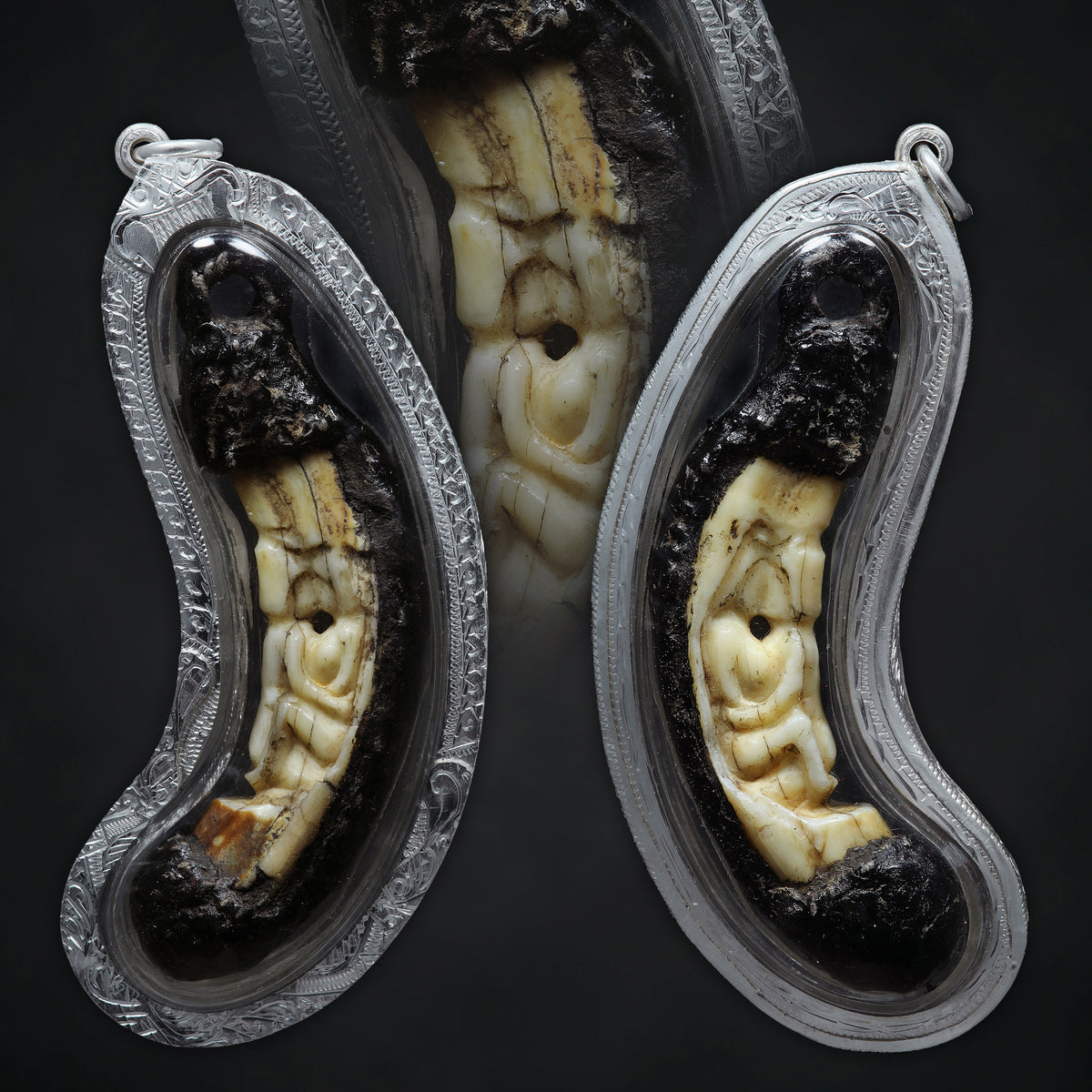
The artifact is carved from a long section of Graduk Chang, retaining the natural cream and ivory-like colouring of the material.
The Palakit form curves strongly through the centre, giving the piece its distinctive profile.
A Yin Tong image is carved directly into the relic, visible along the inner surface.
Dark ritual material remains around the upper and lower portions, while aged rope binding is still attached to the original piece.
The artifact is preserved within a large custom silver casing, allowing the natural relic, carving and original bindings to remain visible.
The survival of the old cord is particularly important because it preserves part of the original ritual construction rather than presenting the piece as a newly restored object.
Recommended Pairing
This Palakit already has a strong focus on saneh and social attraction, so it pairs best with something that adds balance rather than more intensity.
A traditional Buddha or respected monk amulet associated with baramee and protection would give a strong everyday pairing.
For business, it can also be worn with a wealth-oriented piece such as Phra Sivali or Phra Pidta, allowing the Palakit to support people and relationships while the companion piece concentrates on livelihood and financial continuity.
Personal Notes
This is one of the pieces where the previous owner matters as much as the construction.
The Palakit had been kept and personally worn by a close Por Sala Tan luksit whom I met in Chiang Mai.
He had travelled with Por Sala Tan in earlier years, knew the history of the material, and still wore this piece tied at his waist when I first saw it.
That gave the artifact a very different feeling from encountering one anonymously in the market.
I could see that it had actually been used.
I could speak directly with someone connected to Por Sala Tan’s travels.
And I could hear from him why so few owners were willing to release these pieces.
After much persuasion, he eventually allowed me to have his.
For me, that provenance is what makes this Palakit Yin Tong especially meaningful.
It is not merely a rare Graduk Chang Palakit. It is a personal piece that remained with one of Por Sala Tan’s own travelling luksits before eventually entering my collection.
-
Free Shipping for Singapore| $15 Worldwide | $60 USA For Items Below $350