
OOBThaiAmulets
Por Sala Tan
Por Sala Tan
Couldn't load pickup availability
PST06
Na Hua Chamut
Por Sala Tan
2 Inches
Mainstream Artifact
Individual Craftsmanship
Every example is individually assembled from natural relics and hand-prepared sacred materials. Differences in form, surface, gold foil and ritual inserts are therefore part of the character of each artifact.
Personal Experiences Shared by Luksits
What I find particularly interesting about Northern wealth pieces such as Na Hua Chamut is that experiences attributed to them often appear through people and movement rather than sudden windfalls.
Luksits commonly speak of increased enquiries, returning customers, unexpected introductions and conversations that gradually develop into useful opportunities.
For those involved in sales or business, the pattern may be a customer returning after a long absence, negotiations becoming smoother, or someone unexpectedly introducing a new contact.
Others describe quieter periods beginning to move again, with more conversations eventually translating into transactions.
This suits the philosophy behind Na Hua Chamut very well.
The old wiccha is not simply concerned with receiving wealth. It is concerned with finding the pathway through which wealth can arrive.
Summary
Na Hua Chamut belongs to an old body of Northern-Burmese mountain wealth wiccha traditionally associated with trade, resource gathering, side income and the discovery of opportunities.
Its symbolism developed around the instinctive qualities attributed to the Chamut: movement through difficult terrain, locating resources and finding what others may overlook.
Por Sala Tan's construction brings several wealth traditions together within one artifact.
The Chamut represents searching and gathering. The Ploi Mai Thong represents direction and illuminated opportunity. Prosperous farm soil represents productive abundance, while Lersi Serming Pai provides the ascetic and ritual authority through which these elements are brought together.
It is therefore a particularly complete expression of mountain-style wealth wiccha.
Historical Background
Na Hua Chamut is best understood as a cross-border folk-occult tradition, rather than a conventional mainstream Thai Buddhist amulet.
According to older practitioner accounts, related traditions circulated through the mountainous trade routes connecting Burma, Northeast India, Yunnan and the Lanna regions of northern Thailand.
These were environments where livelihood depended upon movement.
Traders travelled between settlements. Farmers depended upon changing seasons and productive land. Merchants needed to recognise where goods were required, while those travelling through mountainous terrain depended upon instinct and knowledge of hidden routes.
The Chamut consequently became associated with movement, searching, resource gathering and survival.
As these ideas entered wealth-oriented wiccha, the natural ability to locate resources became a metaphor for locating financial opportunity.
By the early to mid B.E. 2500s, related Hua Chamut traditions had become known among some northern traders, plantation owners and practitioners working around the Thai-Burmese border regions.
Related Hua Chamut methods were also adopted by certain Thai masters, with the tradition eventually appearing in forms such as Palakit Hua Chamut.
Origins of the Materials
Chamut materials used for pieces of this type were traditionally associated with remote northern plantation and coffee-growing areas where civet populations lived naturally.
When remains were encountered within forest or plantation terrain, they could be preserved and later passed to village ritual specialists.
Por Sala Tan was known among villagers and plantation workers for accepting unusual natural materials and preparing them through the appropriate rites.
For this particular construction, however, the wealth symbolism extends beyond the Chamut itself.
The Lersi Serming Pai roop lor on the reverse was filled with soil obtained from prosperous farms known for producing strong harvests.
Within agricultural folk belief, such earth carries a straightforward symbolism: land that repeatedly produces abundance represents the ability to generate, sustain and replenish resources.
Rather than using ordinary earth merely as filling material, prosperous soil gives the artifact a direct physical connection with successful cultivation and harvest.
Ritual
The preparation follows a wealth tradition associated with Lersi Serming Pai, whose mountain lineage is remembered in this wiccha for commerce and prosperity rites.
Fire plays an important role within the traditional preparation.
It represents activation and transformation—taking natural materials with their own histories and bringing them together under a defined ritual purpose.
The Chamut was prepared with Burmese wax before being finished with gold foil. Wealth-related substances and takruts were incorporated, while the Lersi Serming Pai roop lor was prepared with the prosperous farm soil.
Chanting, fire offerings and takrut empowerment are traditionally used to direct the completed working towards commerce, opportunity, productive livelihood and baramee.
The principle is not simply attraction.
It is direction—giving the various materials a common purpose.
Blessings and Effects
Na Hua Chamut is traditionally associated with wealth through movement: side income and additional sources of revenue; customer attraction and repeat business; smoother buying, selling and negotiation; profitable introductions and useful contacts; discovering overlooked opportunities; stronger commercial momentum; successful harvest and productive livelihood; gathering and retaining resources; and opportunities arriving through unexpected channels.
The addition of Lersi Serming Pai and prosperous farm soil strengthens an important distinction within this particular piece.
The intention is not merely to attract a single fortunate event. The agricultural symbolism points towards continued production—something that can grow, replenish itself and provide another harvest.
Modern Application
Na Hua Chamut remains particularly relevant for people whose income depends upon continuous movement.
This includes business owners, traders, salespeople, property agents, livestream sellers, retailers and those working on commission.
Traditionally, pieces of this nature might be kept near trading areas or carried during journeys and negotiations. In a modern environment, the equivalent might be an office desk, sales counter, cash register or meeting place.
The piece can also be carried when meeting clients or pursuing new opportunities.
Its practical symbolism is particularly appropriate for entrepreneurship: remain alert, keep moving and recognise opportunities that others overlook.
Physical Details
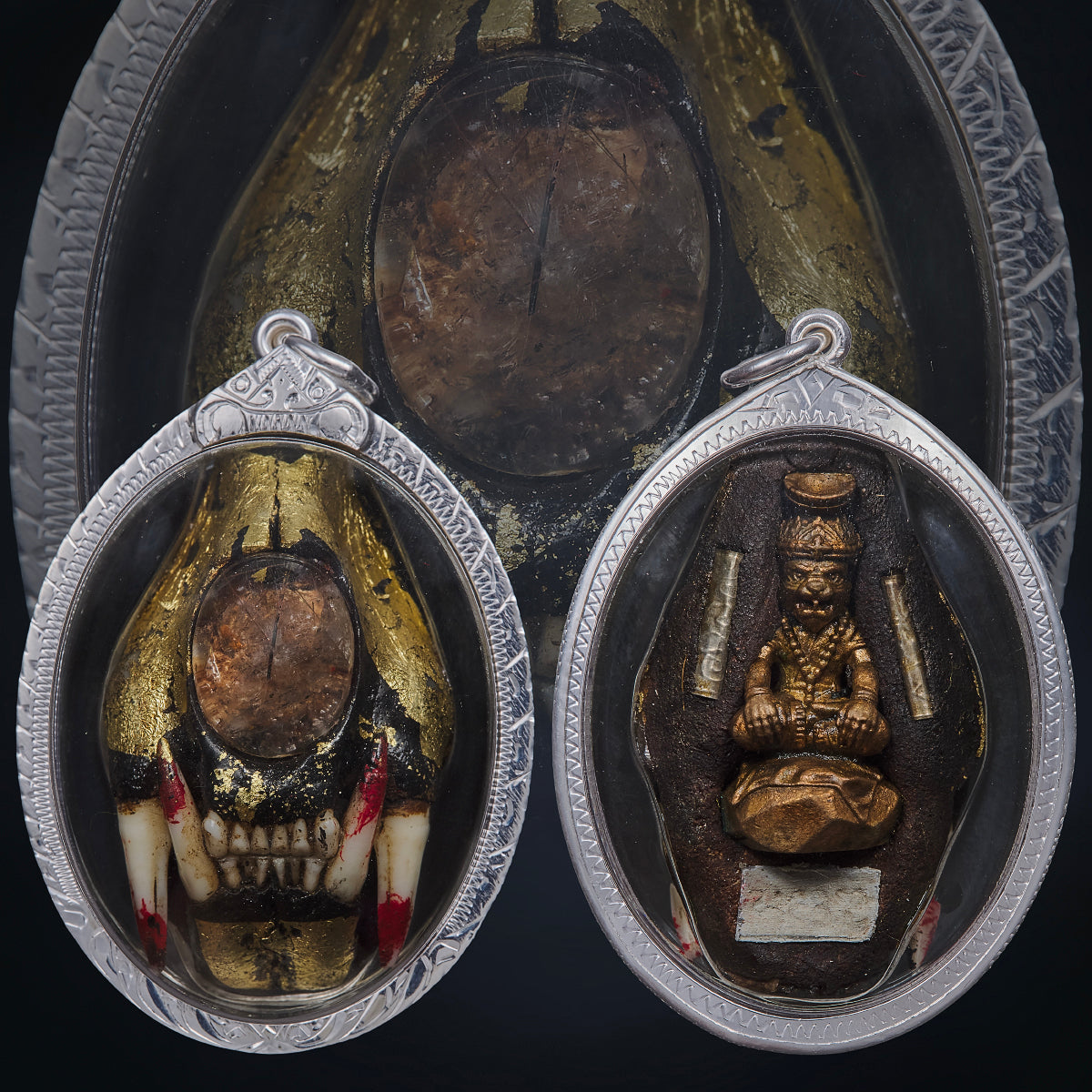
The front retains the natural Chamut form and has been finished with Burmese wax and gold foil.
At the centre of the forehead sits the oval Ploi Mai Thong rutilated quartz. The natural inclusions remain clearly visible within the stone, creating the appearance of fine dark and golden threads beneath its surface.
The reverse presents an entirely different composition.
A small seated Lersi Serming Pai roop lor occupies the centre, surrounded by the dark prepared sacred base. Two takruts flank the Lersi, visually reinforcing the symmetrical construction.
The Lersi itself contains prosperous soil from abundant-harvest farmland.
Together, the front and reverse create two distinct aspects of the same wealth working: the Chamut seeks the pathway; Lersi Serming Pai directs and stabilises it.
Recommended Pairing
For commercial use, this piece pairs naturally with a metta or saneh artifact, particularly for occupations where customers, communication and personal relationships determine income.
A wealth-oriented Phra Pidta can complement Na Hua Chamut by introducing the symbolism of retaining and protecting accumulated wealth.
For business owners seeking greater authority alongside commercial movement, a strong baramee-oriented Buddha or monk amulet provides a balanced pairing of opportunity, respect and stability.
Personal Notes
This particular Na Hua Chamut stands apart from simpler examples because its construction tells a complete story from front to back.
The Ploi Mai Thong represents pathways and direction.
The Chamut represents the instinct to search, move and gather.
The prosperous farm soil represents land capable of producing abundance repeatedly.
And Lersi Serming Pai represents the ritual knowledge that gives these elements direction.
For me, that combination captures the older mountain understanding of prosperity particularly well. Wealth was never simply something one waited to receive. Farmers cultivated it, traders travelled for it, and merchants had to recognise where the next opportunity might appear.
In that sense, the meaning of this artifact can be reduced to a simple principle:
Find the pathway, create movement, and turn opportunity into a continuing harvest.
-
Free Shipping for Singapore| $15 Worldwide | $60 USA For Items Below $350