
OOBThaiAmulets
Por Sala Tan
Por Sala Tan
Couldn't load pickup availability
PST06
Na Hua Chamut
Por Sala Tan
2 Inches
Mainstream Artifact
Individual Craftsmanship
As each piece depends upon naturally occurring relic material and individually prepared inserts, variations in form, surface, gemstone and construction are expected. Every artifact therefore retains its own individual character.
Personal Experiences Shared by Luksits
Northern wealth artifacts of this category are particularly interesting because experiences attributed to them are not always described as sudden windfalls.
More commonly, luksits speak of movement beginning around their livelihood.
A quiet period may be followed by new enquiries. An old customer returns unexpectedly. Someone makes an introduction that develops into useful business. Negotiations become easier, or an opportunity appears from a direction that had not previously been considered.
Among people working in sales and commission-based industries, the recurring theme is often continuity—customers coming back, conversations developing into transactions and opportunities continuing to circulate.
This reflects the traditional character of Na Hua Chamut particularly well. Its wealth symbolism is less about money appearing without cause and more about finding pathways through which income can move towards the owner.
Summary
Na Hua Chamut belongs to an older body of Northern-Burmese mountain wiccha associated with trade, side income, resource gathering and the discovery of opportunity.
The tradition is connected through oral accounts to the historic mountain routes linking Burma, Northeast India, Yunnan and the Lanna regions of northern Thailand. Along these routes, commerce, migration and local ritual practices naturally crossed cultural boundaries.
The Chamut became valued symbolically for its instinctive ability to move through difficult terrain and locate resources. Within wealth wiccha, these qualities were transformed into the idea of finding hidden pathways towards livelihood and opportunity.
Por Sala Tan's piece retains this older mountain character while adding his own wealth takruts, sacred materials and ritual preparation.
Historical Background
Na Hua Chamut is best understood as a cross-border folk-occult tradition rather than a mainstream Buddhist amulet form.
Older accounts connect related practices with village shamans and ritual specialists living throughout the mountainous regions separating northern Thailand, Myanmar, southern China and Northeast India.
In these environments, successful livelihood historically depended heavily upon movement: finding fertile ground, locating food and water, transporting goods, identifying safe routes and knowing where another trading opportunity might exist.
The Chamut consequently became associated with instinct, searching and resource gathering.
As the tradition entered northern Thai occult practice, these characteristics developed into wealth symbolism. Traders and travelling merchants sought the wiccha for commerce, while farmers associated it with productive land and the successful movement of their produce.
Related Hua Chamut concepts later appeared in the practices of certain Thai masters, including forms incorporated into Palakit Hua Chamut.
The lineage nevertheless retains a distinctly mountain character—practical, portable and closely connected with livelihood.
Origins of the Materials
The Chamut materials associated with pieces of this kind traditionally came from remote agricultural and coffee-growing regions in the northern mountains.
Where remains were encountered naturally within plantation or forest terrain, they could be preserved and eventually passed to local ritual practitioners.
Por Sala Tan became known among certain villagers and plantation workers as someone willing to receive unusual materials and prepare them through the appropriate rites.
In some cases, artifacts were subsequently prepared for the farming families themselves, particularly where the intention concerned crop prosperity, trade, wealth fetching or improvement of livelihood.
For this piece, the natural Chamut relic became the principal foundation.
The Ploi Mai Thong placed prominently at the front adds another visual layer to the wealth symbolism—the fine golden inclusions appearing almost like threads or routes running through the gemstone.
Ritual
The preparation follows a mountain-style wealth tradition associated with teachings surrounding Lersi Serming Pai.
Fire forms an important element within this practice. Rather than functioning simply as destruction, it represents activation, transformation and transition.
During preparation, chanting is performed alongside fire offerings and the empowerment of the accompanying takruts. The purpose within the tradition is to redirect the natural qualities represented by the material towards constructive livelihood and prosperity.
Wealth takruts and additional sacred substances are incorporated to give the working a defined direction towards business, income and baramee.
The principle is therefore not simply to invoke a spirit force.
It is to give that force direction.
Blessings and Effects
Na Hua Chamut is traditionally associated with wealth movement rather than passive wealth.
Its principal applications concern side income and additional revenue; attracting customers and repeat business; identifying profitable opportunities; smoother trade and negotiation; unexpected introductions and useful contacts; maintaining momentum during quieter business periods; encouraging movement in commission-based work; and strengthening baramee within commercial environments.
Older practitioners also associated the Chamut with the ability to seek rather than wait.
This is why the artifact historically appealed to traders and travelling merchants. Its symbolism concerns finding the road that leads towards opportunity—even when that road is not immediately obvious.
Modern Application
The traditional principles translate particularly well into modern commercial life.
Na Hua Chamut is suited to business owners, salespeople, traders, property agents, dealers, livestream sellers and anyone whose income depends upon transactions, customers and continuous human interaction.
It may be carried during negotiations and meetings or kept near a sales counter, office desk or other place where business is conducted.
For modern users, perhaps the most useful interpretation is commercial momentum: keeping conversations moving, maintaining customer relationships and remaining alert to opportunities outside one's usual channels.
Physical Details
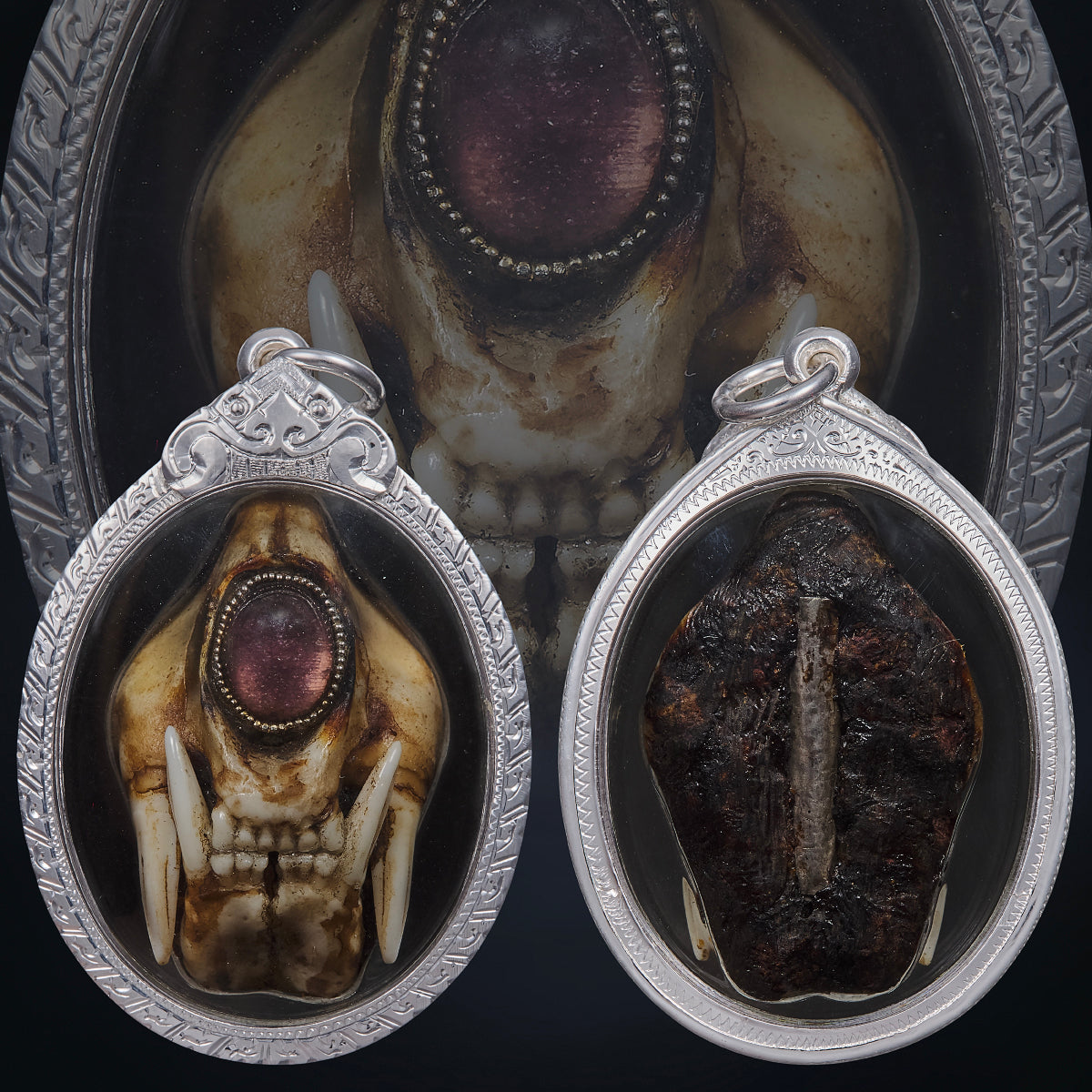
The artifact retains the striking natural anatomical form of the Chamut relic, giving it an appearance quite unlike conventional temple amulets.
A large oval Ploi Mai Thong rutilated quartz is mounted prominently at the front. Its translucent reddish tone and internal inclusions create the central visual focus of the piece.
The reverse exposes the prepared ritual materials rather than concealing them. A takrut runs vertically through the centre of the dark mixture, allowing the construction of the artifact to remain visible.
The entire piece is protected within a custom engraved silver casing while retaining the irregularity and character of the original material.
Recommended Pairing
For business use, Na Hua Chamut pairs naturally with metta-oriented artifacts, particularly where income depends upon communication, customer relationships and negotiation.
A wealth-oriented Phra Pidta can complement it where the intention is not only to generate movement but also to retain what has already been earned.
For leadership or higher-value negotiations, a baramee-oriented monk or Buddha amulet can provide a more balanced combination of opportunity, respect and stability.
Personal Notes
What distinguishes Na Hua Chamut from many conventional wealth artifacts is its emphasis upon movement and instinct.
The old mountain trader could not simply wait for prosperity. He had to recognise changing conditions, locate resources, travel unfamiliar routes and understand where the next opportunity might arise.
That underlying idea remains surprisingly relevant today.
For collectors, the piece is also significant as an example of the less documented cross-border traditions that developed between Lanna, Burma and the surrounding mountain cultures. These practices rarely fit neatly into a single national or religious category; they developed through generations of travel, trade and exchange between communities.
The Ploi Mai Thong gives this particular example an especially appropriate visual symbolism: within the stone, countless fine threads appear to travel in different directions.
Much like the old Na Hua Chamut wiccha itself, wealth is not represented as something waiting in one place, but as a pathway that must first be found.
-
Free Shipping for Singapore| $15 Worldwide | $60 USA For Items Below $350