
OOBThaiAmulets
Por Sala Tan
Por Sala Tan
Couldn't load pickup availability
PST06
Mae Prai
Por Sala Tan
2.5 Inches
Barang Artifact
Individual Craftsmanship
The scarcity of the principal materials meant that very few examples were made. Differences in the placement of the relic, herbs, oil and Por Sala Tan's individual handwriting naturally distinguish one surviving piece from another.
Personal Experiences Shared by Luksits
This particular Mae Prai remained with one of Por Sala Tan's own luksits for a considerable period.
It was not a piece that was readily offered for sale or passed casually between collectors. I had known about it and wanted to obtain it, but the owner was reluctant to let it go.
Only after much persuasion did the luksit eventually agree to pass the artifact to me.
For me, that provenance is particularly important. With rare Barang pieces of this nature, the connection to an established luksit and the history of how the artifact was kept can be just as meaningful as the physical materials themselves.
Summary
Mae Prai belongs to the more specialised side of Por Sala Tan's Barang work.
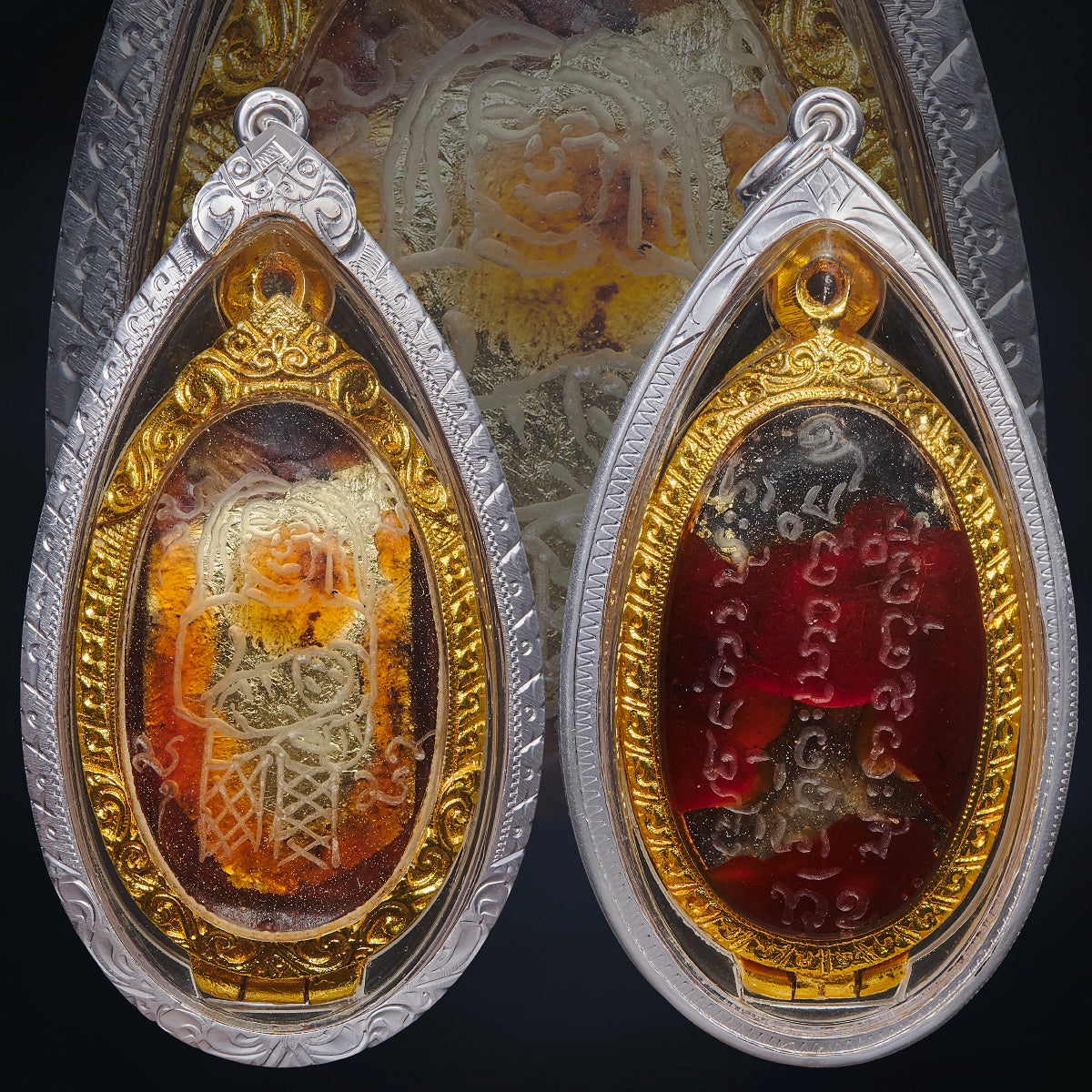
The artifact combines a physical relic, Nam Man Prai and metta herbs, while the outer casing carries Por Sala Tan's own hand-drawn representation of Mae and handwritten yantra.
Within Thai occult tradition, prai refers broadly to spirit-related practices associated with the deceased. Mae Prairepresents the feminine aspect of this tradition and is commonly connected with metta, attraction, livelihood, assistance and protective qualities.
This particular example is especially collectible because of its limited production, scarce materials and direct provenance from one of Por Sala Tan's luksits.
Historical Background
Mae Prai in Thai Occult Tradition
Mae Prai can be translated broadly as “Mother Prai” or a female spirit associated with prai wicha.
Thai folk-occult traditions contain many different classifications of female spirits, and the precise identity of a Mae Prai depends upon the individual lineage and the history attached to the materials used.
Some traditions connect especially powerful female prai with women who died under unusual or tragic circumstances, including the well-known Tai Tang Klom folklore surrounding death during pregnancy or childbirth. However, this should not automatically be assumed for every Mae Prai artifact unless its individual provenance specifically establishes it.
Within amulet practice, Mae Prai developed a reputation particularly around metta, Maha Sanae, livelihood, customer attraction and spiritual assistance.
The maternal aspect also gives Mae a second character: attraction accompanied by guardianship and care for the person under her protection.
Origins of the Materials
The principal ingredients preserved within this artifact are relic material, Nam Man Prai and metta herbs.
The relic provides the physical foundation of the spirit-related construction.
Nam Man Prai belongs to a long-established category of Thai folk-occult preparations traditionally connected with praiwicha. Depending upon the lineage, such oils may be compounded with herbs, waxes, powders and other ritual ingredients.
Here it was combined with metta herbs, directing the character of the piece particularly towards goodwill, attraction, social acceptance and favourable human interaction.
Because these materials were difficult to obtain in the form required by Por Sala Tan, only a small number of Mae Prai pieces are said to have been completed.
Ritual
The inner materials were first assembled around the relic and the prepared Nam Man Prai.
Metta herbs were incorporated to establish the attraction and goodwill aspect of the wicha before the composition was sealed within the casing.
Por Sala Tan then worked directly upon the exterior.
Rather than using a printed image, he hand-drew Mae onto the casing. He subsequently added yantric characters by hand, making the casing itself part of the ritual construction rather than merely a protective enclosure.
This is an important feature of the artifact.
The casing does not simply contain the wicha.
It carries Por Sala Tan's hand upon it.
Blessings and Effects
Within Por Sala Tan's tradition, Mae Prai is associated principally with:
- Metta Maha Niyom — goodwill, favourable treatment and being readily accepted by others.
- Maha Sanae — personal magnetism and attraction.
- Business and customers — encouraging people to approach, return and maintain good relations.
- Negotiation — smoother conversations and greater receptiveness when discussing agreements or opportunities.
- Opportunity and livelihood — traditionally associated with movement of fortune and finding openings for income.
- Personal presence — greater confidence and warmth in social situations.
- Protection and assistance — the maternal character of Mae is traditionally interpreted as watchful and protective towards the keeper.
- Relationship harmony — encouraging closeness and goodwill rather than unnecessary conflict.
These are traditional beliefs surrounding the wicha rather than guaranteed effects. The metta and attraction aspects are best understood as supporting one's own presence and relationships, not overriding another person's choice.
Modern Application
Mae Prai is particularly relevant to people whose livelihood depends heavily upon human relationships.
Salespeople, business owners, agents and those regularly involved in negotiation may appreciate the metta aspect because success often depends not simply upon attracting attention, but upon establishing trust and encouraging people to return.
It can likewise be meaningful for someone whose work requires networking or frequent interaction with unfamiliar people.
The character is therefore different from Por Sala Tan's stronger tiger or guardian pieces.
Those artifacts tend towards authority and defensive presence.
Mae Prai works through approachability, attraction and connection.
Physical Details
The artifact is presented in an elongated oval form within an ornate gold-toned inner frame and custom silver outer casing.
On the front, Por Sala Tan's hand-drawn image of Mae can be seen through the transparent surface. The pale lines depict a seated female figure surrounded by further hand-written sacred characters, with gold-toned material visible beneath.
The reverse exposes the deeper red ritual composition. Handwritten yantric characters cover much of the surface, while darker embedded materials remain visible beneath the casing.
The handmade character is immediately apparent. It does not have the uniform appearance of a commercially printed or moulded piece.
Recommended Pairing
Mae Prai pairs naturally with an established Buddha, Somdej or respected monk amulet to provide a calmer devotional foundation for everyday wear.
For business, it may also be paired with Phra Sivali or another wealth and livelihood piece. The two functions complement one another: Mae Prai emphasises people, goodwill and attraction, while the wealth piece supports opportunity and financial movement.
For someone already carrying a strong Suer, Rahu or guardian artifact, Mae Prai can provide a useful counterbalance of metta and social warmth.
Personal Notes
This is one of those pieces where how I obtained it matters greatly to me.
It came from one of Por Sala Tan's own luksits, who had kept the Mae Prai rather than readily allowing it to circulate. I had to persuade him several times before he eventually agreed to let me have it.
That reluctance made the piece even more memorable.
Very few were said to have been created because the required materials were scarce, and this example combines those materials with something that cannot simply be reproduced later: Por Sala Tan's own hand-drawn Mae and handwritten yantra on the casing.
For me, it is therefore more than a Mae Prai distinguished by its ingredients.
It preserves the materials, Por Sala Tan's individual handwork, and the history of the luksit who kept it before it entered my collection.
-
Free Shipping for Singapore| $15 Worldwide | $60 USA For Items Below $350