
OOBThaiAmulets
Por Sala Tan
Por Sala Tan
Couldn't load pickup availability
PST06
Phra Rahu
Por Sala Tan
3 Inches
Barang Artifact
Individual Craftsmanship
Because the coconut shell and relic were individually selected and carved by hand, natural differences in material, texture, carving depth and ritual finishing make every surviving piece distinct.
Personal Experiences Shared by Luksits
Luksits who carried this combination commonly spoke about obstacles gradually becoming easier to manage.
Rather than describing dramatic overnight changes, several accounts concerned practical matters: work becoming smoother, delayed matters beginning to move, difficult situations resolving more easily and everyday life seeming to encounter fewer unnecessary obstructions.
Others associated the Jinn side with unexpected luck and opportunity — useful introductions, assistance arriving at the right moment, or circumstances unexpectedly turning in their favour.
Within the lineage, the two sides therefore came to be understood quite simply:
Rahu clears what is blocking the road.
The Jinn helps seek what may be found beyond it.
These remain personal experiences and traditional interpretations shared by luksits rather than guaranteed effects.
Summary
This artifact represents a seldom-seen combination within Por Sala Tan's work.
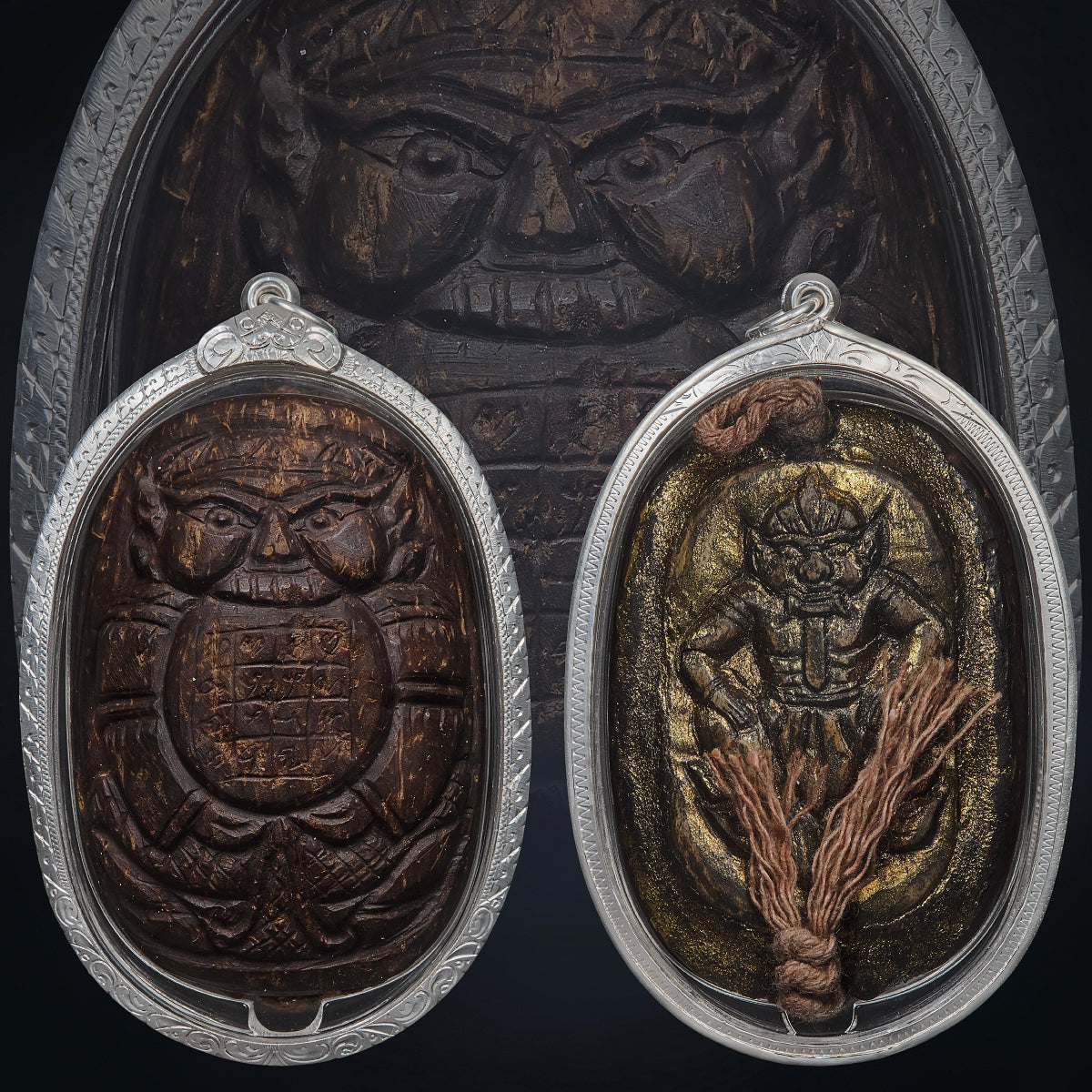
On one side is Phra Rahu, hand-carved from Kala Ta Diao.
On the other is a consecrated Jinn relic.
Por Sala Tan had been given several unusual relics which, according to their accompanying account, were connected with a Jinn. He subsequently carved some of these materials into Jinn images and consecrated them according to his own wicha.
For this particular construction, however, he went further.
Rather than creating another standalone Jinn artifact, he combined the Jinn with a hand-carved Rahu, creating an artifact centred upon reversal, removal of obstacles, protection and the opening of new opportunities.
Historical Background
Phra Rahu — The Eclipse and Reversal of Fortune
Phra Rahu originates from the Indian Rahu tradition and became deeply incorporated into Thai astrology, Brahmanic practice and amulet culture.
Rahu is associated with the eclipse — the celestial shadow that temporarily consumes the Sun or Moon.
For this reason, Thai devotees developed an important interpretation of Rahu as a force capable of consuming misfortune.
The familiar expression is:
Klap Rai Klai Pen Di — turning what is bad towards what is good.
Rahu is therefore commonly approached during periods of uncertainty, repeated obstacles, financial difficulty, conflict or sudden changes in fortune.
One of Thailand's most respected traditional materials for Rahu carving is Kala Ta Diao, the one-eyed coconut shell. Its natural rarity and dark appearance made it especially appropriate for the eclipse deity, and hand-carved Kala Ta Diao Rahu pieces became an important form within Thai amulet culture.
Origins of the Materials
Two very different sacred materials form the foundation of this artifact.
The first is Kala Ta Diao.
Rather than using ordinary coconut shell, Por Sala Tan selected the rare one-eyed form traditionally favoured for Rahu wicha. The material was then individually carved into the imposing Rahu image seen on the front.
The second material came through a separate lineage.
Por Sala Tan had received several relics said to have an association with a Jinn. After working with these materials, he carved a number of them into representations of the Jinn and performed the appropriate consecration.
One of these Jinn relics was selected for this particular Rahu.
The significance therefore lies not only in the materials themselves, but in Por Sala Tan's decision to bring the two together rather than keeping them as separate artifacts.
Ritual
The Kala Ta Diao was first hand-carved into the form of Rahu.
Its central celestial disc carries individually cut sacred characters, while further inscriptions and symbolic details cover the surrounding body.
The Jinn relic was separately prepared and consecrated.
Por Sala Tan then joined the two components into a single construction. The Jinn side was finished with sacred material and Sai Sin, visibly tied across the figure as part of the ritual binding.
The result is effectively two complementary wicha contained within one artifact.
Rahu performs the symbolic work of consuming and reversing obstruction.
The Jinn represents movement, assistance, opportunity and watchfulness.
Blessings and Effects
Traditionally, this combination is associated with:
- Reversal of difficult fortune — Rahu's classic Klap Rai Klai Pen Di principle.
- Removal of obstacles — particularly repeated delays or circumstances that seem persistently blocked.
- Protection from hidden problems — including jealousy, hostile intentions and unseen complications.
- Opportunity and luck — the Jinn aspect is traditionally associated with finding openings that may otherwise be overlooked.
- Business movement — smoother negotiations, customer flow and progress in stalled matters.
- Timely assistance — meeting helpful people or receiving support when circumstances become difficult.
- Baramee and authority — maintaining presence when dealing with competitive or uncertain environments.
- Adaptability during change — particularly when moving between jobs, businesses, countries or important stages of life.
The character of this piece is therefore not simply about attracting fortune.
It is about changing the conditions around fortune — clearing what obstructs progress and then recognising the opportunities that become available.
Modern Application
This combination is particularly suited to periods when life feels stagnant rather than completely unsuccessful.
A business may still be operating, but progress has slowed. A career may remain secure, but advancement repeatedly fails to materialise. Agreements may be delayed. Customers may disappear unexpectedly. Plans may continually encounter small but costly obstacles.
The symbolism of Rahu is appropriate to these transitional periods because darkness is understood as temporary rather than permanent.
The Jinn introduces the second element: once conditions begin changing, one must be alert enough to recognise the new path.
For collectors involved in business, sales, negotiation or competitive environments, this creates a particularly interesting pairing of obstacle removal and opportunity seeking.
Physical Details
The front presents a strongly carved Phra Rahu in dark Kala Ta Diao.
His face is broad and commanding, with large eyes, pronounced teeth and an elaborate headdress. The central celestial body is positioned prominently across the torso and covered with hand-carved sacred characters.
The reverse is visually very different.
A Jinn figure occupies the centre, its body highlighted with a gold-toned sacred coating against the darker surrounding material. Sai Sin passes vertically across the figure, with aged knots visible at the upper and lower edges.
The contrast is particularly striking: the dark, heavily carved Rahu on one side and the gold-highlighted Jinn on the other.
Both are preserved within a custom engraved silver casing, allowing the two sides to remain visible.
Recommended Pairing
This artifact already combines two comparatively strong traditions, so it does not require another aggressive protective piece to complete it.
For everyday wear, it pairs particularly well with a respected Buddha, Somdej or monk amulet associated with metta, mindfulness and stable baramee.
A Phra Sivali can complement the opportunity and livelihood aspect, while a traditional Somdej gives the overall combination a calmer devotional foundation.
The intention is balance: Rahu clears, the Jinn assists, while the Buddhist piece provides steadiness and direction.
Personal Notes
What makes this artifact particularly interesting to me is that Por Sala Tan could easily have treated these as two separate pieces.
Kala Ta Diao Rahu already has a complete identity of its own.
The Jinn relic likewise already carried its own provenance and wicha.
Yet Por Sala Tan deliberately brought them together.
That decision gives the artifact a very clear philosophy.
There are periods when obtaining more luck is not the first problem. Something has to be cleared first.
Old obstacles, repeated setbacks, difficult people or simply an unfavourable period may need to pass before new opportunities can be properly used.
That is where the two sides meet:
Rahu consumes what obstructs the path.
The Jinn searches beyond the obstruction.
For me, this seldom-seen combination is what gives the piece its distinctive place among Por Sala Tan's Barang artifacts.
-
Free Shipping for Singapore| $15 Worldwide | $60 USA For Items Below $350