
OOBThaiAmulets
Por Sala Tan
Por Sala Tan
Couldn't load pickup availability
PST06
Ngu Kin Hang — Buang Nakabat
Por Sala Tan
2.5 Inches
Mainstream Artifact
Sacred Craftsmanship
Each piece was hand-prepared and consecrated individually, so differences in the lead surface, yantra, soil mixture and placement of the embedded materials are natural features of the artifact.
Personal Experiences Shared by Luksits
Pieces carrying the Ngu Kin Hang symbolism are commonly approached for one central idea: continuity.
Luksits often describe this less as sudden wealth and more as having work continue to come, customers returning, money circulating rather than stopping, and opportunities appearing before existing ones have completely ended.
Those in sales and business particularly value the concept of “Mi Kin Mai Mi Ot” — having enough and not going without.
Other accounts focus on the binding character of the Buang Nakabat: keeping customers, holding contracts, maintaining useful relationships and preventing accumulated wealth from dispersing too quickly.
For this reason, the artifact is especially meaningful to people whose livelihood depends upon cash flow, recurring customers, trade and continuing opportunity.
Summary
Ngu Kin Hang literally means “snake eating its tail.”
Within Thai and Lanna occult tradition, the form is closely associated with Buang Nakabat, the sacred Naga loop or binding circle.
Its central symbolism is simple but powerful.
A serpent forms a closed circle, creating something without a clear beginning or end. The image therefore represents:
continuity · protection · provision · retention · prosperity
Por Sala Tan strengthened this traditional symbolism through materials connected with prosperity, sacred places and Naga-related ritual work.
The reverse further incorporates Buang Nak Giaw, the form of two Nagas entwined together, reinforcing the qualities of binding, continuity and accumulated fortune.
Historical Background
Ngu Kin Hang
In Thai, Ngu Kin Hang means “snake eating its tail”.
The image belongs to a wider family of circular serpent symbols, but in Thai and Lanna traditions it developed its own identity through Naga belief, folk magic and protective yantra practice.
The closed serpent is traditionally associated with the phrase:
Mi Kin Mai Mi Ot
“There is always enough; one does not go hungry.”
The concept is not merely abundance.
It concerns resources continuing to return into the cycle.
Money is earned, spent and earned again.
Customers leave and return.
Opportunities close and new ones open.
The circle remains unbroken.
Origins of the Materials
For this work, Por Sala Tan prepared the metal from old lead artifacts and older donated lead, including material given by prosperous individuals.
These sources were deliberately selected before being melted together and recast.
Por Sala Tan then travelled to the Mekong River, to an area where forest hermits had long spoken of Naga encounters and where Naga-associated relics were said to have been found.
There, beside the river, he performed ritual work upon the lead.
Each piece was then personally hand-carved, hand-yanted and consecrated by Por Sala Tan at the riverbank.
The choice of the Mekong was important.
Within Thai and Lao belief, the river is one of the great landscapes associated with Phaya Nak, water, fertility, guardianship and abundance.
Ritual
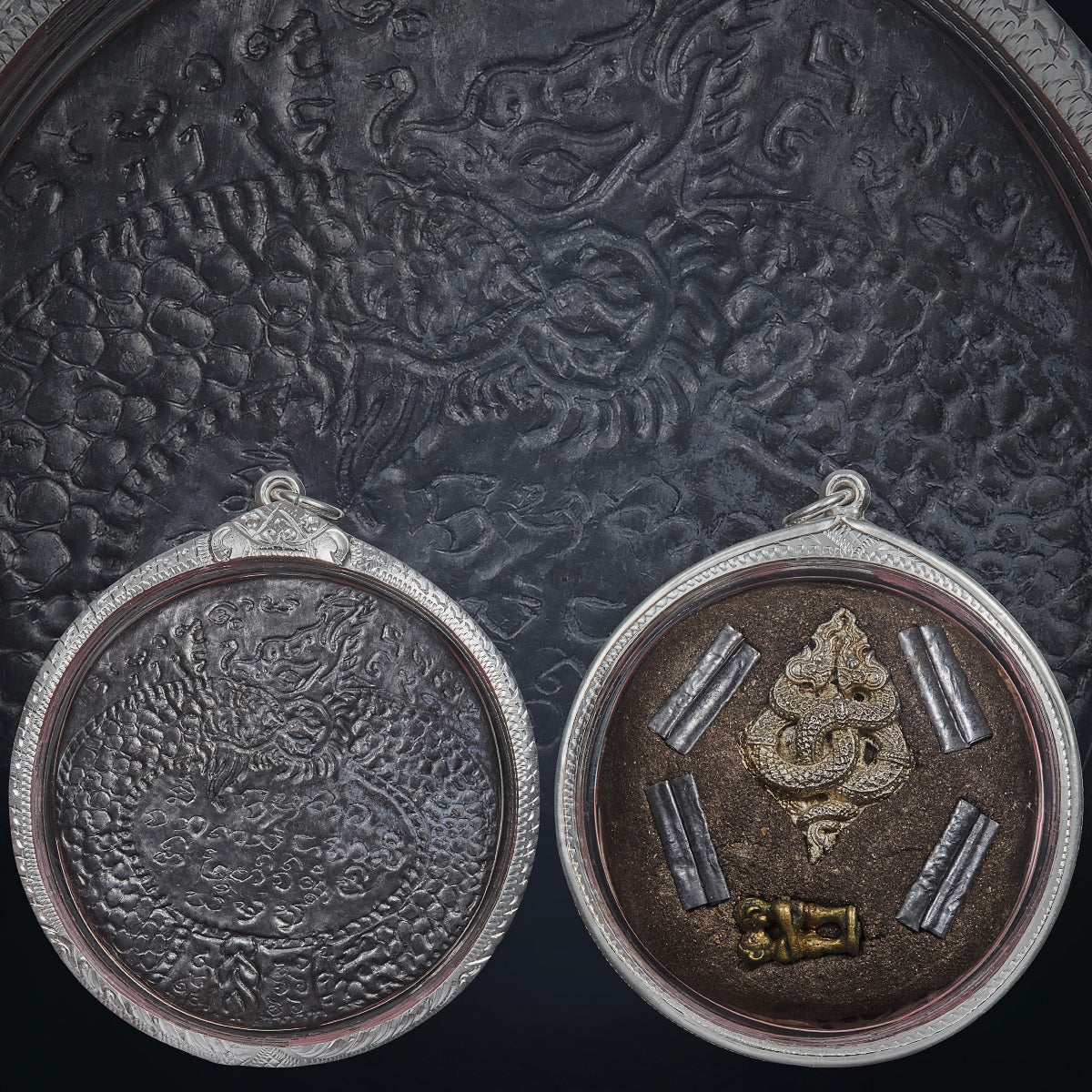
After preparing the sacred lead, Por Sala Tan inscribed each piece individually with the Ngu Kin Hang / Buang Nakabat form and surrounding yantric characters.
The circular serpent acts as the central structure.
In the traditional interpretation, the loop performs several functions at once.
It contains, preventing prosperity from escaping.
It binds, helping favourable conditions remain connected to the owner.
It circulates, expressing the continued movement of livelihood and opportunity.
It also forms a protective enclosure.
The reverse was then covered with soil gathered from prosperous places in Thailand and Laos, together with soil from temples and sacred locations.
Wealth takruts were added to strengthen the financial intention.
Finally, a Buang Nak Giaw, depicting two Nagas entwined together, was embedded into the backing.
Blessings and Effects
The traditional qualities of this artifact centre upon wealth continuity and preservation.
It is associated with:
- steady livelihood and sufficient resources;
- continuing money flow;
- repeat customers and recurring business;
- attraction of commercial opportunity;
- holding onto accumulated wealth;
- stronger negotiations and agreements;
- metta and favourable human relationships;
- protection from financial disruption;
- avoidance of danger and harmful influences;
- Naga baramee and support connected with water and abundance.
The phrase Mi Kin Mai Mi Ot captures its character particularly well.
It does not necessarily promise sudden riches.
Its deeper meaning is continuity — always having enough to continue moving forward.
Modern Application
Ngu Kin Hang is particularly suitable for people whose income depends upon circulation.
Retailers need customers to return.
Salespeople need one agreement to lead towards the next.
Business owners need cash to move continuously through expenses, stock and revenue.
Property agents, brokers and independent professionals similarly depend upon a steady sequence of opportunities.
The closed-circle symbolism therefore translates naturally into modern business life.
It may be approached not simply with the wish to “become rich”, but with a more practical intention:
May work continue.
May income circulate.
May customers return.
May what has been earned remain secure.
Physical Details
The front consists of a round, darkened lead disc, personally worked by Por Sala Tan.
At its centre is the hand-drawn Ngu Kin Hang / Buang Nakabat, surrounded by numerous yantric inscriptions.
The surface retains the irregularities and aged character of the sacred lead mixture.
The reverse is covered with a dark brown sacred compound prepared from prosperity soil and temple earth.
At the centre sits the ornate Buang Nak Giaw, showing two Nagas entwined together.
Several lead takruts are arranged around it, strengthening the wealth and binding functions of the work.
A smaller sacred component is positioned beneath the central Naga motif.
The entire artifact is finished in a custom engraved silver casing.
Recommended Pairing
Because this piece already combines wealth attraction, retention, metta and protection, it works very well by itself for business use.
For those who want stronger personal authority, it may be paired with a Buddha or monk artifact associated with baramee and leadership.
For shop owners or traders, it also pairs naturally with a metta-oriented piece focused upon customer attraction and persuasive speech.
A protective guardian such as Wua Thanu may complement it where the owner wants one artifact focused on keeping prosperity circulating and another focused upon guarding physical property and accumulated wealth.
Personal Notes
What distinguishes this piece is the consistency of its construction.
Every major element supports the same idea.
The old lead contributes continuity from earlier sacred artifacts.
Lead donated by prosperous people introduces a worldly connection with successful livelihood.
The consecration beside the Mekong River connects the work with Naga tradition, water and abundance.
The soil comes from prosperous and sacred locations in both Thailand and Laos.
The wealth takruts reinforce the financial intention.
And finally, the Buang Nak Giaw at the reverse repeats the same symbolism in another form — two Nagas intertwined and bound together.
Por Sala Tan therefore did not simply draw a serpent symbol and label it a wealth yantra.
He constructed the entire artifact around one principle:
what comes in should continue to circulate, what is valuable should remain, and the flow of livelihood should not be broken.
-
Free Shipping for Singapore| $15 Worldwide | $100 USA All products