
OOBThaiAmulets
Por Sala Tan
Por Sala Tan
Couldn't load pickup availability
PST06
Four Armed Wealth Yantra
Por Sala Tan
2.5 Inches
Barang Artifact
Sacred Craftsmanship
Each piece was individually hand-yanted, filled and assembled. Natural differences in the relic, inscriptions, sacred powders and placement of the embedded materials make every artifact distinct.
Personal Experiences Shared by Luksits
I collected this piece from one of Por Sala Tan’s close luksits in Bangkok.
He shared that artifacts carrying this particular yantra were made only in small numbers and were seldom seen outside the circle of people who had received them directly.
According to him, many of the pieces ended up with people working in sales, business development and commission-based work, where success depended heavily upon persuasion, opportunity and the ability to secure agreement from different directions.
The yantra was especially valued by those who wanted not only customer attraction, but also money movement, luck in negotiation, repeat business and success from multiple sources at the same time.
Summary
This artifact is centred upon a rare Cambodian-derived yantra that Por Sala Tan learnt from Ta Eisey, the Cambodian counterpart of the Thai Lersi or Ruesi.
Its design resembles a central body with four arms reaching outward, representing either the four directions or the four elemental forces of earth, water, fire and wind.
The “head” is intentionally absent.
The form was explained not as a human figure, but as a universal force extending equally in all directions.
Por Sala Tan later adapted this older yantric knowledge towards wealth, luck, prosperity and success, giving the four arms a practical symbolic meaning:
four hands reaching out to gather four forms of prosperity.
Historical Background
Ta Eisey
The Cambodian term Ta Eisey derives from Sanskrit ṛṣi and Pali isi, referring to a seer, sage or hermit.
In cultural terms, Ta Eisey are closely related to the Thai Lersi or Ruesi, Lao Lusi and Indian Rishi traditions.
Within Cambodian belief, they are remembered as ancient ascetics associated with forests, healing, ritual knowledge, sacred arts and the preservation of esoteric teachings.
Por Sala Tan encountered several Ta Eisey during his travels in Cambodia in his earlier years.
It was through these meetings that he learnt this uncommon yantra.
The design was said to be rarely used, even among practitioners familiar with older Khmer and border-region wicha.
Origins of the Materials
The base itself was carved from a relic connected with a wealthy businessman.
This was important to the composition because the material already carried a direct association with prosperity and successful worldly life.
Por Sala Tan then incorporated:
Phong Plai Guman, used within the centre;
three wealth takruts, placed within the relic;
prosperity soil from auspicious Cambodian sacred sites, used on the reverse;
and an embedded Phra Ngan, traditionally associated in this context with attraction, opportunity, influence and movement of fortune.
The entire construction was therefore directed towards one coherent purpose rather than being assembled from unrelated sacred substances.
Ritual
The most important element is the hand-written yantra itself.
Its structure extends outward in four directions.
The Ta Eisey explained the form as reflecting either the four cardinal directions or the balancing of the four primary elements:
earth · water · fire · wind
The absent head reinforces the idea that this is not a portrait of a being.
It represents a force that is non-personal, universal and active in every direction.
Por Sala Tan then adapted the yantra with his own knowledge of wealth and prosperity wicha.
The four arms became four active hands:
one gathering opportunity,
one drawing wealth,
one securing favourable relationships,
and one supporting success.
The central cavity containing Phong Plai Guman and wealth takruts became the energetic core of the piece, while the Cambodian prosperity soil formed its backing.
Blessings and Effects
The main qualities of this artifact are traditionally associated with:
- wealth attraction;
- success in sales and negotiation;
- stronger customer response;
- prosperity from multiple directions;
- luck in business opportunities;
- repeat customers and continuing income;
- influence and persuasive communication;
- favourable agreements and contracts;
- metta and attraction;
- movement through financial or professional stagnation.
The four-armed structure is especially meaningful for those whose livelihood depends upon many different people, channels or sources of income.
Rather than concentrating prosperity in only one direction, the yantra symbolically reaches outward and gathers from all sides.
Modern Application
This piece is particularly suitable for people involved in sales, trading, property, insurance, brokerage, entrepreneurship and client-facing business.
Someone whose income depends upon commissions or multiple clients may find the four-direction symbolism especially relevant.
It can also be understood more broadly.
One “hand” may represent customers.
Another may represent influential people.
Another may represent contracts or opportunities.
The last may represent the ability to retain and grow what has already been earned.
This gives the artifact a particularly practical modern meaning while remaining faithful to the older yantric idea of gathering prosperity from every direction.
Physical Details
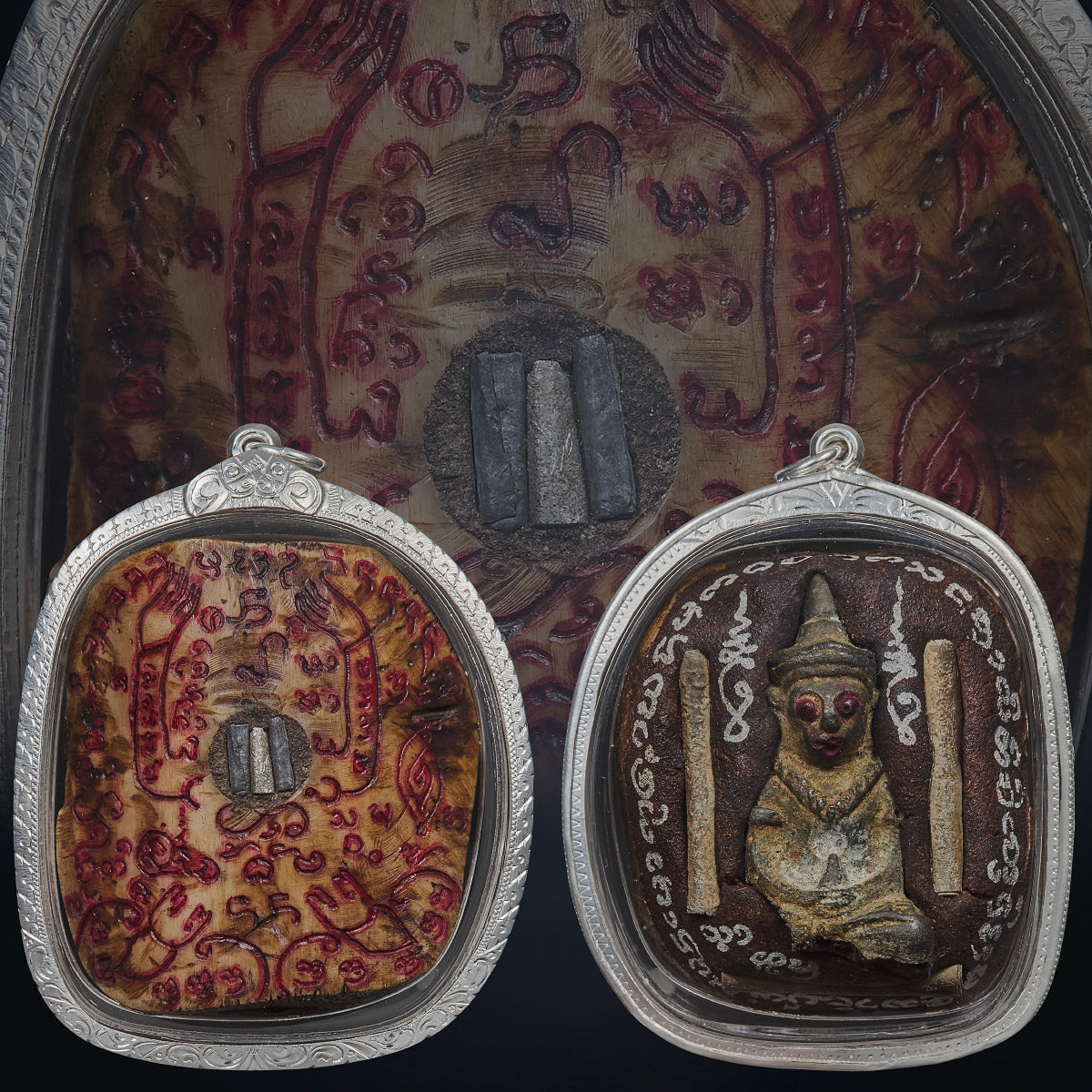
The front shows Por Sala Tan’s hand-inscribed yantra directly upon the Paneang surface.
The unusual design resembles a central body with four extended arms, surrounded by additional characters and inscriptions in red and dark pigment.
At the centre is a circular sacred filling containing three embedded takruts.
The reverse is built around a dark sacred compound prepared with prosperity soil and other ritual substances.
A small Phra Ngan image sits prominently in the centre, flanked by two larger takruts.
Further inscriptions surround the composition.
The complete artifact is protected within a custom engraved silver casing, allowing both sides of the work to remain visible.
Recommended Pairing
This artifact already carries a strong emphasis on wealth, sales, attraction and opportunity, so it works well on its own for business use.
For someone who wants a more balanced combination, it may be paired with a Buddha or monk amulet associated with baramee, stability or protection.
Those working in highly competitive environments may also pair it with a protective piece such as Tao Wessuwan or Wua Thanu, allowing this yantra to remain focused on gathering opportunity and prosperity.
Personal Notes
What makes this piece especially important to me is its provenance.
I did not obtain it casually from the market. I collected it from one of Por Sala Tan’s close luksits in Bangkok, who shared the background of how Por Sala Tan had learnt this yantra during his travels in Cambodia.
The design itself is rarely encountered.
Its meaning is simple but powerful: four hands reaching into four directions, gathering the conditions required for prosperity.
Por Sala Tan then strengthened that foundation with materials chosen specifically for the same purpose — a relic connected with a wealthy businessman, Phong Plai Guman, wealth takruts, prosperity soil from Cambodia and Phra Ngan.
For collectors of Por Sala Tan’s work, this is therefore more than a visually unusual hand-yanted piece.
It represents a small surviving example of the Cambodian Ta Eisey knowledge he carried back and later adapted into his own wealth wicha.
-
Free Shipping for Singapore| $15 Worldwide | $100 USA All products