
OOBThaiAmulets
Por Sala Tan
Por Sala Tan
Couldn't load pickup availability
PST06
Mae Kali
Por Sala Tan
2.5 Inches
Barang Artifact
Personal Note
I was introduced to Kali through Mae Pim while studying a book on the avatars and manifestations of Goddess Parvati, the consort of Lord Shiva. As I researched further, I began to see meaningful connections to Kali and was eventually led to her former shrine at Lim Chu Kang Hindu Cemetery, Path 2. Although the shrine has since been removed by the authorities, I visited it several times.
Over time, I came to understand Kali beyond her fierce appearance. To me, she represents the protective love of a mother for her children and followers. Her image holding the demon’s head reflects her victory over harmful forces and her determination to defend those under her care. She is also revered as a force that clears obstacles, cuts through negativity, and helps one move forward with greater resolve.
Personally, when I venerate Kali, I find that obstacles seem to be resolved one by one, allowing me to focus more clearly and work towards my goals with greater speed and confidence.
Por Sala Tan is widely known for his seneh and metta creations, but his amulets for wealth, progress, and success should not be overlooked. This piece carries that same intention of overcoming limitations and moving ahead in life.
As always, I recommend pairing specialised pieces like this with mainstream Buddha amulets. Building one’s baramee through a balanced collection provides a stronger foundation, allowing the wearer to benefit more fully from the focused purpose of a particular amulet.
Sacred Craftsmanship
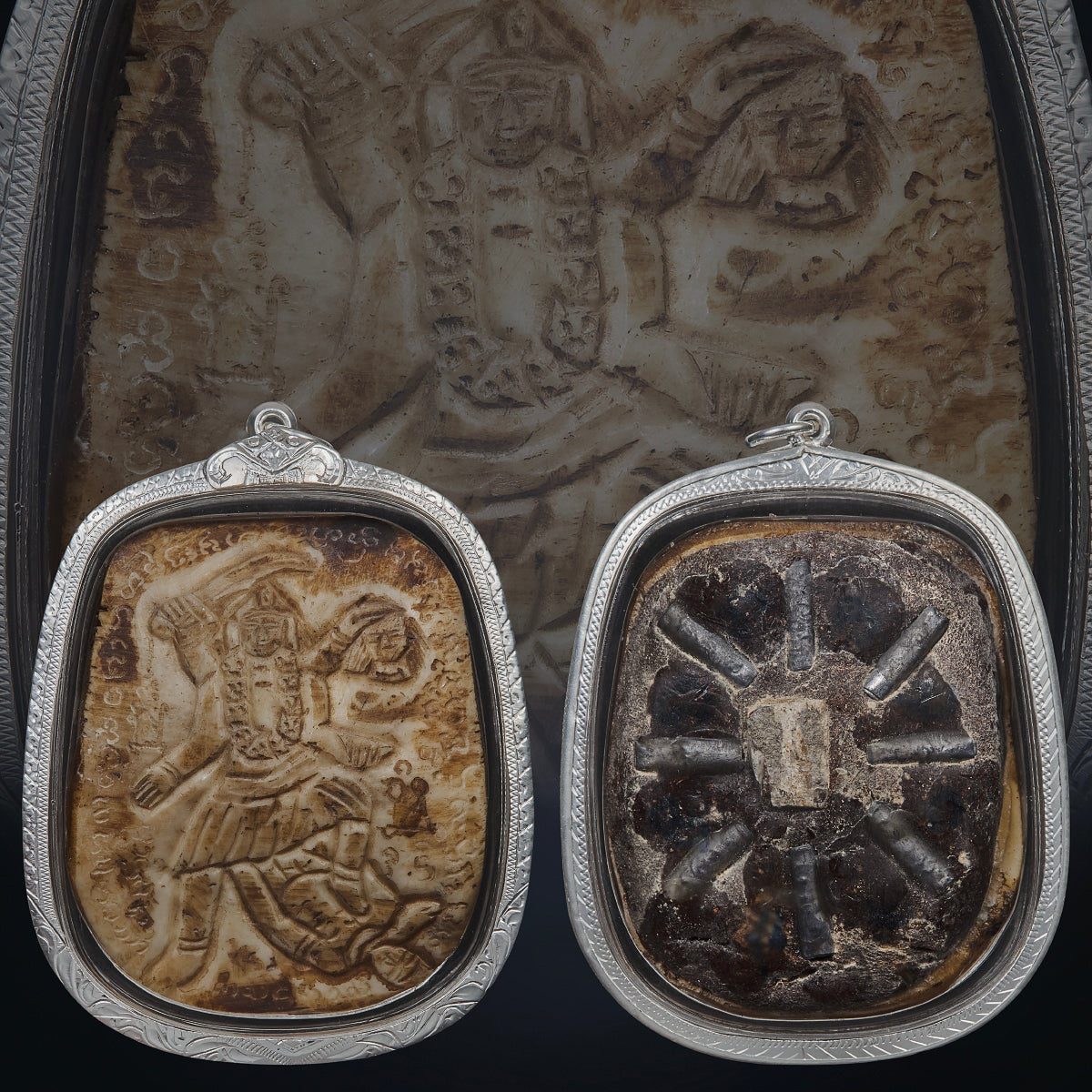
This Mae Kali was individually carved from Paneang, its surface worked into the fierce image of Mother Kali standing upon Shiva.
The reverse carries the deeper ritual construction. Por Sala Tan prepared it with Nam Man Prai, Tid Jai, relic fragments, earth from the original burial site and soil brought from the woman's home village in Burma. Multiple takruts were arranged around the backing, while a larger relic fragment was sealed at its centre.
The materials were deliberately assembled around the provenance of one particular spirit rather than gathered as unrelated ingredients.
Each artifact was carved, filled and completed by hand. Variations in the Paneang, relic fragments, sacred substances and placement of the takruts are therefore natural characteristics of the work.
Personal Experiences Shared by Luksits
Pieces of this nature are generally approached differently from ordinary metta or wealth amulets.
Luksits who work with Mae Kali commonly speak first about strength during difficult periods — particularly when facing hostile environments, complicated relationships, uncertainty or situations where they feel repeatedly obstructed.
Some describe becoming calmer and more decisive rather than simply more aggressive. Situations that previously created fear or hesitation became easier to confront, while difficult people appeared to exert less influence over their decisions.
Others associate the piece with warnings: an uncomfortable feeling before entering a situation, sudden hesitation over an agreement, or information emerging at an important moment.
For this particular artifact, such experiences fit closely with its construction. The spirit associated with the materials was described from the beginning as strong, unsettled and difficult to contain. Por Sala Tan therefore did not leave that force without structure; Mae Kali and the surrounding takruts were deliberately used to place it under control.
Summary
This is one of Por Sala Tan's more unusual spirit-bound Paneang artifacts.
Its history begins not with the carving of Mae Kali, but with a Burmese woman who was said to have passed on violently while travelling in Northern Thailand.
According to the village shaman, her spirit remained near the place where her remains had been buried. Unable to return to her family in Burma, she became increasingly resentful and disturbances were reported around the area.
Por Sala Tan was asked to intervene.
What followed involved locating her burial place, communicating with the spirit, ritually binding her presence to the remains, travelling with those materials back to her home village in Burma, and finally returning them to Thailand.
Por Sala Tan subsequently chose Mae Kali as the form through which the spirit would be contained.
The result is an artifact concerned principally with fierce protection, control of hostile forces, courage, transformation and overcoming difficult circumstances.
Historical Background
Mae Kali
Kali, is one of the great goddesses of Hindu Shakta tradition.
Her appearance is deliberately fierce.
She is commonly represented with dark skin, wild hair and an extended red tongue. Around her neck may appear a garland of severed heads, while a skirt of severed arms surrounds her waist.
In her familiar four-armed form, one hand carries a sword or khadga, while another holds a severed head. Her remaining hands may express gestures of fearlessness and blessing.
These images are not simply representations of violence.
Kali represents time, death, transformation and the destruction of forces that prevent liberation. Her sword cuts through ignorance and attachment; her frightening appearance confronts fear rather than avoiding it.
This duality is important to understanding why Por Sala Tan selected her for this particular work.
She can be fierce enough to confront a destructive force while simultaneously functioning as its governing authority.
Origins of the Materials
The history preserved with this artifact begins in a mountainous Northern village close to the Thai–Burmese region.
A local shaman approached Por Sala Tan concerning recurring disturbances attributed to a wandering female spirit.
The woman was believed to have been Burmese and to have travelled regularly between Burma and Thailand during her lifetime.
She eventually died in Thailand under violent and unnatural circumstances.
Her remains were buried near the village, close to a cave.
According to the shaman, however, her attachment to her family and homeland remained unresolved.
Her spirit continued to linger.
Over time, grief and attachment were understood to have developed into resentment, with disturbances occurring around people who entered the area.
Ritual
Por Sala Tan travelled to the area and attempted to communicate with the presence.
According to the account preserved with the piece, the spirit revealed the location of her remains and expressed a strong desire to return to her family in Burma.
Por Sala Tan agreed to help.
There was, however, an important condition. The spirit could be brought home for a final ritual connection with her family and homeland, but could not simply remain there as an uncontrolled wandering presence.
Por Sala Tan initially asked her to enter and remain with her own relic material.
She refused.
Together with the village shaman, Por Sala Tan therefore performed an extended rite using chanting and binding methods to bring the unsettled presence under control and connect it with the recovered remains.
The process was described as difficult and requiring considerable effort.
Por Sala Tan then honoured the promise he had made.
The materials were physically taken across the border into Burma and returned to the woman's home village, where another ceremony was conducted. In this way, the spirit was given the opportunity to return symbolically to her homeland and family.
After the ceremony, the ritual materials were brought back to Thailand.
Blessings and Effects
Por Sala Tan subsequently chose to carve the Paneang into Mae Kali because he considered Kali's fierce protective force appropriate for controlling the character of the spirit attached to the materials.
The choice carries considerable symbolism.
Kali is not merely destructive. Within her religious iconography, destruction exists alongside fearlessness, blessing and liberation.
The image therefore expresses control over a dangerous condition rather than uncontrolled aggression.
Traditional qualities associated with this particular work include:
- fierce personal protection;
- resistance to hostile spiritual influences;
- courage when confronting difficult circumstances;
- warning and heightened awareness of danger;
- cutting through persistent obstacles;
- protection against malicious intentions;
- greater firmness when dealing with difficult people;
- transformation of adverse circumstances;
- strengthening personal presence and resolve.
The central principle is control.
The spirit is not presented as something simply released to act according to its anger. Its force is contained within the authority represented by Mae Kali and further restricted through the takruts placed across the reverse.
Modern Application
Mae Kali is particularly meaningful during periods requiring courage, decisive change and strong personal boundaries.
Someone facing persistent workplace opposition may approach her for steadiness and protection.
A business owner dealing with aggressive competition may value the combination of awareness and firm personal presence.
Others may keep the artifact during major transitions — ending an unhealthy situation, moving through prolonged uncertainty, or confronting circumstances they have previously been afraid to address.
The symbolism is particularly appropriate here.
Kali does not promise that every difficulty disappears. Her traditional image instead represents the courage to face what cannot be ignored, remove what must end and continue forward without remaining trapped by fear.
Physical Details
The front is carved directly upon Paneang.
Mae Kali appears with multiple arms, wild hair and the characteristic extended tongue. She stands above the reclining figure of Shiva, whose still posture provides a striking contrast to Kali's movement and intensity.
This relationship carries an important traditional meaning: dynamic Shakti above still consciousness — tremendous power brought into awareness and balance.
The reverse reveals an unusually substantial ritual construction.
A dark circular compound contains Nam Man Prai, Tid Jai, soil from the Thai burial site, soil from the woman's Burmese village and relic fragments.
Multiple takruts radiate around the composition, forming an enclosing arrangement.
At the centre sits a larger relic fragment, physically anchoring the history of the spirit to the artifact.
The complete piece is protected within a custom silver casing while leaving both the carved image and its ritual backing visible.
Recommended Pairing
Because this is already a forceful and complex artifact, it does not require another Barang piece to strengthen it.
For everyday wearing, a traditional Buddha or respected monk amulet provides the most natural pairing, introducing a calmer Buddhist devotional element alongside Mae Kali's fierce guardian symbolism.
A strong metta amulet may also complement the piece for someone who needs protection and authority professionally while maintaining approachable relationships with customers, colleagues or clients.
For collectors who prefer to keep spirit-related artifacts individually, Mae Kali is equally suitable as a standalone piece.
Personal Notes
What gives this artifact its particular significance is the journey of its materials.
The story begins at the woman's burial place in Thailand.
The remains were recovered there and ritually connected with the wandering spirit. Por Sala Tan then physically carried those materials back across the border to the woman's village in Burma, fulfilling his promise to allow her a final return to her homeland.
Earth from that village was collected and subsequently brought back together with the materials to Thailand.
The finished artifact therefore contains soil from both sides of her story — the place where she died and was buried, and the homeland to which she wished to return.
Por Sala Tan's choice of Mae Kali is equally deliberate.
Rather than allowing a resentful presence to remain without restraint, he selected a deity whose iconography represents fierce power brought towards destruction of harmful forces, transformation and eventual release. The surrounding takruts were then incorporated specifically to seal and control the spirit's rage.
For collectors of Por Sala Tan's work, this makes the piece particularly characteristic of his approach: the image was not chosen first and ingredients added afterwards.
The history of the spirit determined the materials, the journey determined the ritual, and the nature of the spirit determined the final sacred form.
-
Free Shipping for Singapore| $15 Worldwide | $100 USA All products