
OOBThaiAmulets
Por Sala Tan
Por Sala Tan
Couldn't load pickup availability
PST06
Wua Thanu
Por Sala Tan
1.5 Inches
Mainstream Artifact
Sacred Craftsmanship
Each artifact was individually carved, inscribed and assembled by hand. Natural differences in the horn, sacred mixture, skin and placement of the takruts make every piece unique.
Personal Experiences Shared by Luksits
Some of the earliest feedback came from villagers living around the area where the buffalo had once wandered.
Those who kept the Wua Thanu around farms or livestock areas spoke particularly about protection of animals and property.
Several villagers said their livestock seemed less vulnerable to wild animals and theft after keeping the artifact nearby.
More unusually, some described seeing what appeared to be the shadow of a buffalo moving around the livestock, particularly at night or when the animals appeared unsettled.
A few interpreted this as the old buffalo continuing to act as a guardian, guiding livestock back towards safer areas or alerting the household when something was wrong.
Whether viewed literally or as part of village spiritual experience, these reports are consistent with the traditional role of Wua Thanu as a guardian of land, animals, property and livelihood.
Summary
Wua Thanu is one of the better-known guardian forms within Thai and Lanna occult tradition.
Historically, the buffalo was central to rural life. It represented strength, endurance, farming, food security and family livelihood.
This particular piece carries an additional layer of significance because it was carved from the horn of a lightning-struck water buffalo whose presence was reportedly still perceived around the surrounding fields after its death.
Por Sala Tan subsequently located the remains with the help of local villagers and used selected materials to create protective artifacts.
Its traditional purposes centre upon protection, property guarding, livestock protection, preservation of wealth and resistance to hostile influences.
Historical Background
Wua Thanu in Thai Tradition
Wua Thanu refers to the magical bull or buffalo guardian found in several branches of Thai folk ritual practice.
Related forms are also known as Khwai Thanu, particularly when the effigy takes the form of a water buffalo.
The tradition emerged naturally within agrarian communities where cattle and buffalo were among a family's most important assets. They cultivated rice fields, transported goods and represented both working power and household wealth.
It is therefore unsurprising that the buffalo became associated with guarding:
farmland · livestock · houses · stores · family property · wealth
Within older occult practice, Wua Thanu was often understood as a form of animated guardian effigy, related in principle to hoon phayon traditions.
Rather than functioning as a simple symbol, the completed figure was ritually given the duty of guarding a specific person or place.
Origins of the Materials
The story of this piece begins with a solitary alpha water buffalo known to villagers in the surrounding area.
It regularly wandered alone across the open fields.
During the monsoon season, the buffalo was struck and killed by lightning.
Afterwards, villagers began reporting something unusual.
Although the buffalo had died, some continued to see what appeared to be its shadow or outline wandering through the fields in the same manner as before.
The repeated accounts eventually reached Por Sala Tan.
Interested in the unusual circumstances surrounding the animal, he asked villagers to bring him to the burial place.
Selected remains were then collected for sacred work.
The horn became the principal material for the Wua Thanu carving.
Por Sala Tan also collected soil from two significant locations:
the buffalo’s grave, and the paddy field where the lightning strike occurred.
These materials preserved the physical connection between the finished artifact and the place where the original event took place.
Ritual
After carving the buffalo image from the horn, Por Sala Tan prepared a separate lead backing.
He personally wrote yantra across the front and reverse of the lead sheet, directing the work towards protection of:
the owner · personal safety · accumulated wealth · home · land · property
The collected grave and paddy-field earth was then combined with Por Sala Tan’s own sacred wealth powder.
This compound was applied directly over the yantric lead sheet.
Two takruts were embedded into the sacred mixture, reinforcing the protective and wealth-preserving intention.
A remaining piece of the buffalo's skin was positioned between them, preserving another direct physical connection with the original animal.
The resulting artifact therefore combines both yantric wicha and relic-based construction.
Blessings and Effects
The primary role of Wua Thanu is guardianship.
Its traditional qualities are particularly relevant where wealth is held in tangible forms — land, livestock, property, stock, machinery or a business premises.
Commonly associated purposes include:
- protecting the owner and household;
- guarding livestock and agricultural property;
- discouraging theft and intrusion;
- preservation of accumulated wealth;
- protection from hostile or unseen influences;
- alertness when danger approaches;
- safeguarding shops, warehouses and workplaces;
- strengthening courage and resilience.
The wealth aspect of this piece is important.
Its function is not simply to attract money. Much of its wicha is directed towards protecting what has already been earned.
For someone whose livelihood depends upon assets, livestock, inventory or property, this distinction is particularly meaningful.
Modern Application
Although Wua Thanu comes from an agricultural world, its guardian principle adapts easily to modern life.
A farmer may still keep such a piece for land and livestock.
A business owner may instead approach it for protection of a shop, warehouse, office, vehicles or inventory.
Those who travel frequently may carry it for personal protection and awareness.
It may also be kept near a home entrance or working area as a traditional guardian of the household.
For business use, the combination of protection and preservation of wealth makes this piece especially relevant to people who have already built something valuable and wish to safeguard it.
Physical Details
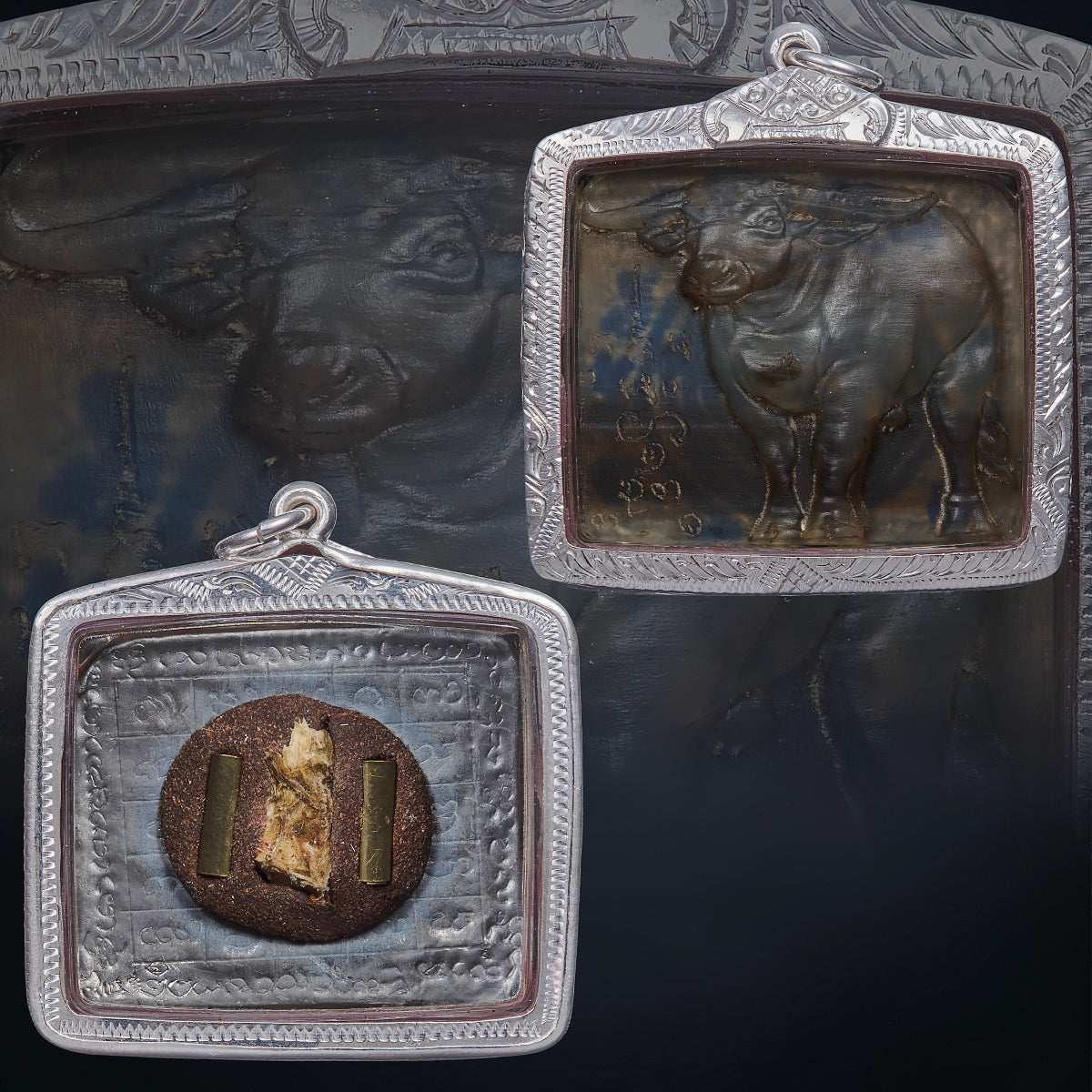
The front is carved directly from Kao Kwai Fapar, forming the three-dimensional image of a powerful standing water buffalo.
The natural dark tone and structure of the horn remain visible beneath the carving.
The reverse is particularly elaborate.
A rectangular lead plate covered with handwritten yantra forms the foundation.
Above it sits a circular layer of sacred compound containing earth from the grave and paddy field, blended with Por Sala Tan’s wealth powder.
Two metal takruts are positioned vertically on either side.
Between them is a preserved section of buffalo skin.
The entire piece is protected within a custom silver casing while keeping both the carved buffalo and the ritual construction visible.
Recommended Pairing
Wua Thanu is already a complete guardian artifact and can be carried on its own.
For business owners, it pairs naturally with amulets associated with wealth flow, metta or customer attraction, allowing one piece to support incoming opportunity while Wua Thanu focuses upon protection and preservation.
It may also be paired with Tao Wessuwan or a strong protective Buddha image where greater emphasis on personal safety is desired.
For agricultural or property-related use, however, there is little need to complicate the combination. Wua Thanu’s traditional identity is already closely aligned with land, animals, livelihood and boundaries.
Personal Notes
This piece is especially interesting because nearly every major component can be traced back to the same event.
The horn came from the lightning-struck buffalo itself.
The skin came from the same animal.
The soil came from its grave and from the field where it died.
Por Sala Tan then connected these materials through his own handwritten yantra, wealth powder and takruts.
That gives the piece a degree of continuity rarely seen in ordinary Wua Thanu work.
Rather than assembling unrelated sacred ingredients around the image of a buffalo, the entire artifact was constructed around the history of one particular animal and one particular place.
The village accounts of its shadow continuing to wander the fields add another layer to that provenance and help explain why Por Sala Tan chose to preserve the buffalo's material within a guardian form.
For collectors of Por Sala Tan's relic-based work, this is therefore not simply a Wua Thanu carved from horn. It is an artifact whose story, material and intended function remain closely connected from beginning to end.
-
Free Shipping for Singapore| $15 Worldwide | $100 USA All products