
OOBThaiAmulets
Por Sala Tan
Por Sala Tan
Couldn't load pickup availability
PST06
Lersi Narod Suer Fao Lang
Por Sala Tan
4cm
Barang Artifact
Sacred Craftsmanship
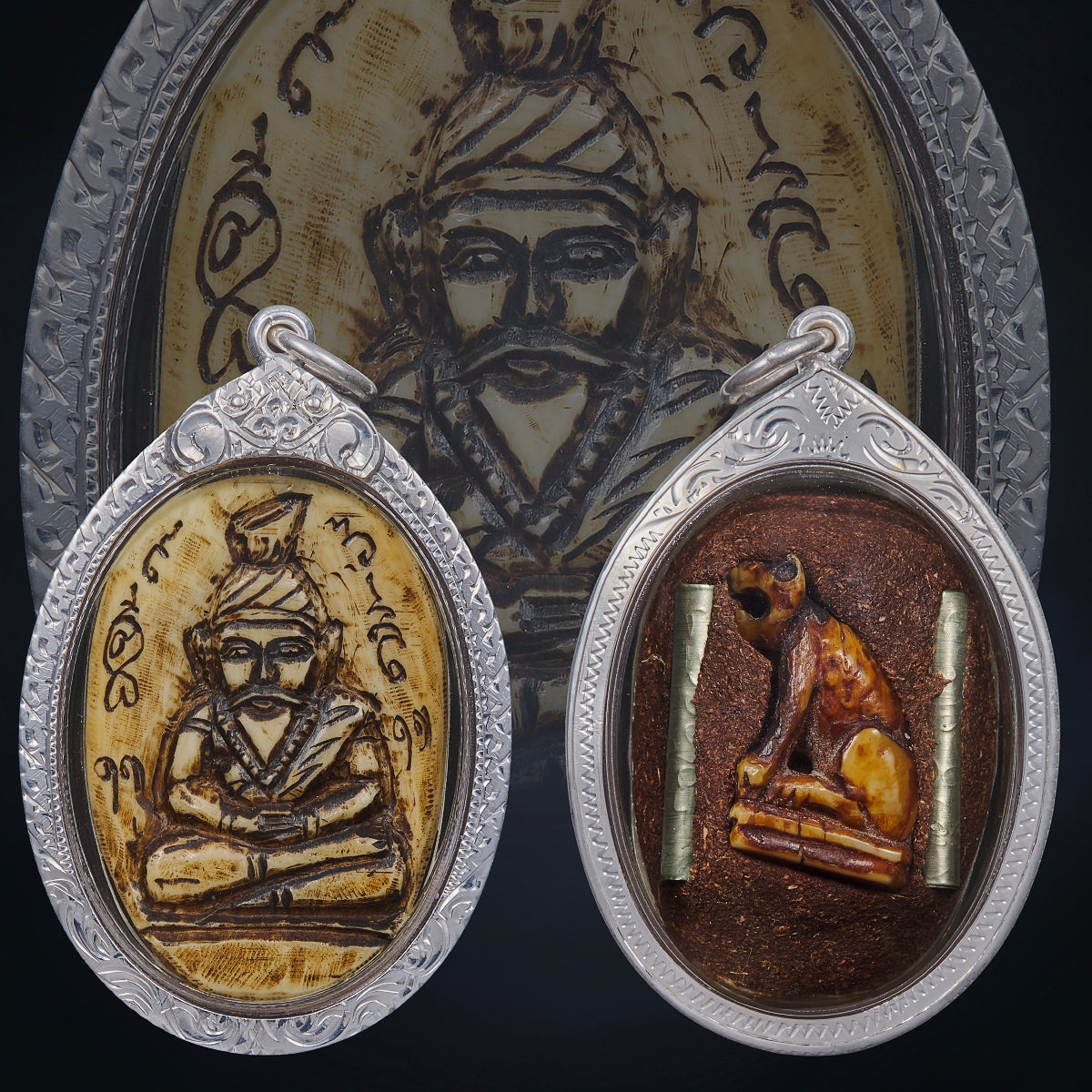
Rather than being produced from a mould, the principal image was individually carved according to the natural form of the relic. Its irregular surface, hand-cut inscriptions and separately assembled reverse make the artifact unique.
Personal Experiences Shared by Luksits
Followers familiar with this piece describe its character principally in terms of protection, confidence and the feeling of having strong spiritual backing.
The arrangement is particularly meaningful: Lersi Narod occupies the principal position while the tiger remains concealed behind him. Among Por Sala Tan's luksits, this is understood as Suer Fao Lang — the tiger watching or guarding from behind.
Users have described becoming more composed when dealing with difficult people or uncertain circumstances. Rather than feeling pressured into immediate reactions, they speak of being more willing to observe, assess the situation and act only when necessary.
Others associate the piece with greater confidence when travelling, conducting business or entering unfamiliar environments. The tiger is not regarded simply as an aggressive force, but as a silent guardian positioned where the wearer cannot see.
Summary
Lersi Narod Suer Fao Lang combines two important strands within Por Sala Tan's wicha: the wisdom and authority of the Lersi lineage together with the vigilance and protective force represented by the tiger.
The front depicts Lersi Narod, carved directly from an old relic believed to have belonged to a deceased Lersi.
Hidden behind him is a small tiger Roop Lor, accompanied by two takruts. These elements were subsequently sealed beneath 108 sacred herbs, creating a layered artifact in which much of its ritual construction remains concealed.
Its symbolism can therefore be understood quite literally:
Lersi Narod guides from the front; the tiger guards from behind.
Historical Background
Lersi are ascetic teachers within Thai and wider Southeast Asian sacred traditions. They represent disciplined learning, meditation, herbal knowledge, ritual practice and the transmission of specialised wicha from teacher to student.
Lersi Narod occupies an especially elevated position in modern Thai Lersi traditions. He is commonly honoured as a great teacher of the hermit lineage and is associated with sacred knowledge, mantra, meditation and ritual authority.
He is also connected with the arts and music through the broader tradition surrounding Narada, the divine sage and musician.
For practitioners, however, the significance of Lersi Narod extends beyond any single domain. His image represents Baramee Kru — the accumulated authority and blessing of the teacher.
This makes Lersi imagery particularly important to practitioners such as Por Sala Tan, whose wicha is understood through relationships between teachers, lineages and transmitted knowledge.
Origins of the Materials
During one of Por Sala Tan's journeys to visit a forest monk, he passed through an area containing old ruins.
Among the remains he encountered several aged relics. Through his traditional method of spiritual communication, Por Sala Tan understood that some of these materials had belonged to an old Lersi who had already passed away.
The material was therefore treated differently from an ordinary piece of bone or found object.
Por Sala Tan retained the relic and subsequently selected a suitable portion for carving into Lersi Narod, preserving the connection between the physical material and the Lersi lineage it was believed to represent.
This provenance became the foundation upon which the remainder of the artifact was constructed.
Ritual
After carving the Lersi Narod image, Por Sala Tan prepared the reverse as a concealed protective assembly.
A small tiger Roop Lor was placed directly behind the Lersi. Two individually prepared takruts were positioned on either side, creating a balanced arrangement around the tiger.
The entire reverse was then covered with a preparation containing 108 sacred herbs.
The use of 108 materials carries particular significance within Thai sacred traditions. The number is repeatedly associated with completeness and the gathering together of multiple auspicious properties within a single ritual composition.
Once sealed, the tiger effectively disappeared beneath the herbal layer.
This concealed construction reinforces the meaning of Suer Fao Lang: the guardian does not need to be visibly displayed in order to remain present.
Blessings and Effects
The artifact combines the traditional qualities of Lersi Narod with tiger symbolism and the specialised takruts placed behind the image.
It is principally associated with:
- Baramee Kru — authority and support of the teacher lineage.
- Protection — particularly against unseen or unexpected difficulties.
- Klaew Klad — avoidance of danger and harmful situations.
- Wisdom and judgement — remaining composed before making important decisions.
- Authority and confidence — maintaining presence without unnecessary aggression.
- Spiritual vigilance — awareness of circumstances developing beyond one's immediate view.
- Learning and wicha — supporting disciplined study, meditation and sacred practice.
- Career and livelihood — overcoming obstacles through patience, judgement and steady action.
The tiger contributes an important distinction. In this composition it is not presented as a force that constantly attacks or dominates. Its position behind the Lersi expresses controlled strength: alert, watchful and ready when required.
Modern Application
Lersi Narod Suer Fao Lang is particularly appropriate for people carrying significant responsibility or regularly entering situations where circumstances cannot be completely controlled.
Business owners, managers and professionals may relate to its combination of judgement, authority and unseen protection.
Those who travel frequently may appreciate the symbolism of the tiger watching behind them, while practitioners and students of traditional wicha may place greater importance on the Lersi Narod component and its connection with teacher lineage.
For artists, musicians and performers, Lersi Narod also retains his traditional connection with knowledge and the arts.
Above all, the artifact represents the principle that strength does not always need to be displayed. Wisdom leads; power remains in reserve.
Physical Details
The front consists of an oval section of old relic carved with the seated image of Lersi Narod. His robes, facial features and headdress are individually incised into the pale natural surface, with sacred inscriptions surrounding the figure.
The reverse contains a separately made tiger Roop Lor positioned centrally between two metal takruts.
These components are embedded within a dense reddish-brown preparation of 108 sacred herbs, leaving the tiger visible while securing the ritual assembly behind the principal Lersi image.
The artifact is presently protected within a custom silver-toned casing.
Recommended Pairing
This piece already contains a particularly complete protective arrangement and does not require a complicated pairing.
For stronger emphasis upon guardianship, it may be worn with Tao Wessuwan, complementing the tiger's watchful character with a recognised guardian figure.
A Phra Pikanet may be paired when the intention concerns work, new undertakings or overcoming obstacles, while a traditional Buddhist amulet may provide a calmer devotional balance to the more specialised Lersi and tiger symbolism.
Personal Notes
The most distinctive aspect of this artifact is easily overlooked when viewing only its front.
It is not simply a Lersi Narod carved from an unusual old relic.
Por Sala Tan deliberately constructed a second layer of meaning behind the Lersi — placing the tiger Roop Lor there together with two takruts before sealing the arrangement with 108 sacred herbs.
The name Suer Fao Lang therefore describes the physical construction as much as its spiritual purpose.
The Lersi remains visible, representing the teacher, wisdom and direction. The tiger occupies the concealed position behind him, representing vigilance and controlled protective strength.
It is a particularly clear expression of an idea found repeatedly in Por Sala Tan's work: the strongest protection is not necessarily the force displayed in front, but the force quietly watching from behind.
-
Free Shipping for Singapore| $15 Worldwide | $100 USA All products