
OOBThaiAmulets
Por Sala Tan
Por Sala Tan
Couldn't load pickup availability
PST06
Yin Tong
Por Sala Tan
2 Inches
Mainstream Artifact
Sacred Craftsmanship
Each of these early preparations was individually assembled from hand-prepared materials, so differences in surface, texture, colour and the degree of remaining Si Peng are natural characteristics of the artifact.
Personal Experiences Shared by Luksits
One of the most frequently repeated observations from users of Por Sala Tan's older metta and saneh preparations concerns returning customers.
Salespeople who carried pieces of this nature have described customers returning specifically to look for them rather than simply dealing with whichever salesperson happened to be available. Some spoke of customers remembering them after an earlier encounter, requesting their assistance again and becoming regular clients over time.
Within the traditional understanding of Metta Maha Niyom, this is regarded as particularly significant. The emphasis is not merely on attracting attention at the first meeting, but on leaving a favourable impression that encourages people to remember, trust and willingly return.
For those working in sales, service, negotiation or businesses dependent upon repeat customers, this became one of the qualities most closely associated with these older preparations.
Summary
This is an unusual early Yin Tong by Por Sala Tan, distinguished by having spent many years embedded within his Si Peng rather than existing simply as an independent powder artifact.
The Yin Tong itself was made from Phoong Metta Saneh, while the surrounding Si Peng contained Wahn Dok Thong and other sacred herbs associated with Por Sala Tan's travels through Burma. Together, the preparation was directed principally towards metta, maha niyom, saneh, persuasive communication and commercial attraction.
Although the Si Peng has dried considerably with age, the condition records how the object was originally prepared and kept. For followers of this tradition, drying does not signify the disappearance of its consecrated purpose. The Yin Tong itself has remained in prolonged contact with the preparation and is regarded as having absorbed its qualities over the years.
Historical Background
Yin Tong belongs to the broader family of paired male-and-female imagery encountered in Thai and regional charm traditions. Such imagery is traditionally associated with interpersonal attraction, affection, harmony and the drawing together of people.
In Por Sala Tan's work, these forms were frequently combined with specialised powders, herbs, oils and older regional formulas rather than relying upon imagery alone.
The surrounding Si Peng is equally important. Si Peng, more commonly transliterated See Phueng is a consecrated wax or balm traditionally prepared for Metta Maha Niyom and Maha Saneh. Depending upon lineage, it may incorporate beeswax, botanical oils, pollen, aromatic plants and specialised wahn.
Traditionally, small quantities were used before social encounters, negotiations or business dealings, particularly where favourable reception and persuasive speech were desired.
Origins of the Materials
At the centre of this artifact is Por Sala Tan's Phoong Metta Saneh.
This was not described as a single herb or standard powder. It was a composite preparation accumulated from sacred materials gathered by Por Sala Tan from numerous locations across Thailand and Burma, reflecting the travelling and material-collecting aspect of his practice.
Among the principal ingredients associated with the surrounding Si Peng was Wahn Dok Thong, literally the "golden-flower wahn."
Within Thai folk belief, Wahn Dok Thong has long carried a particularly strong reputation for Maha Saneh. Its roots, flowers or botanical preparations appear in charm oils, powders and Si Peng intended for attraction and social magnetism.
Por Sala Tan additionally incorporated sacred herbs gathered during his journeys into Burma, including materials traditionally selected for metta, goodwill and popularity.
The importance of this particular example therefore lies in the combination of the Yin Tong powder body, Wahn Dok Thong, Burmese herbal materials and the aged Si Peng in which the artifact remained for years.
Ritual
After the Yin Tong was formed from Phoong Metta Saneh, it was placed directly into Por Sala Tan's prepared Si Peng.
This allowed the artifact to remain continuously surrounded by the herbal and wax preparation rather than merely receiving a superficial application.
Over the years, the volatile oils gradually diminished and the Si Peng hardened and dried. What remains today is therefore an aged ritual preparation rather than a fresh cosmetic balm.
The prolonged contact is an important characteristic of the piece. In the traditional understanding of its preparation, the Yin Tong has effectively soaked in and absorbed the Si Peng over many years.
Blessings and Effects
The combined Yin Tong and Si Peng preparation is traditionally associated primarily with:
- Metta — goodwill, kindness and favourable treatment.
- Maha Niyom — popularity and being readily accepted by others.
- Maha Saneh — personal attraction and social magnetism.
- Jerajaa — smoother speech, persuasion and negotiation.
- Kha Khai — support for trade, sales and customer relations.
- Returning customers — being remembered positively and sought out again.
- Relationship harmony — encouraging warmth and easier interpersonal interaction.
The presence of Wahn Dok Thong places a particularly strong emphasis on attraction and memorable personal presence, while the broader Phoong Metta Saneh formula extends its traditional purpose into business and everyday social relationships.
Modern Application
This type of artifact is particularly suited to people whose livelihood depends heavily upon personal interaction and reputation.
Sales professionals, business owners, agents, consultants, performers and those regularly meeting clients may appreciate its traditional emphasis on being approachable, remembered and favourably received.
Its purpose can also be understood beyond commerce. In contemporary use, metta-oriented artifacts are often carried before interviews, negotiations, presentations, networking events or important meetings where calm communication and a positive first impression matter.
The dried condition of the Si Peng means there is no necessity to treat it as a balm. The complete artifact can simply be carried or worn in its present preserved form.
Physical Details
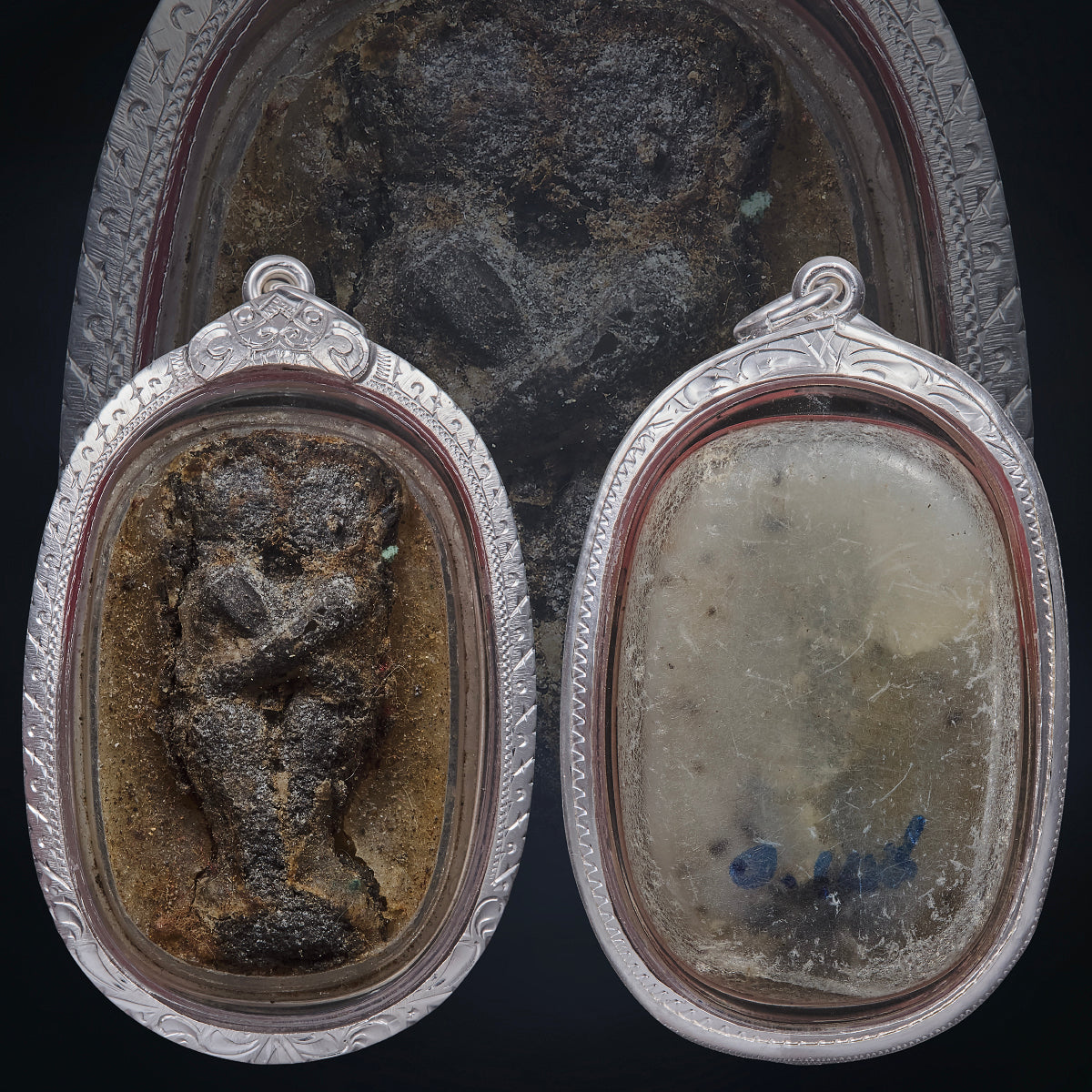
The Yin Tong is an aged powder artifact originally immersed within Por Sala Tan's Si Peng preparation.
Much of the Si Peng has naturally dried and contracted over time, leaving an aged, irregular surface around the central form. Traces of the original herbal and wax preparation remain visible throughout.
The reverse is comparatively plain and shows the aged material and casing. The present silver casing protects what has become a fragile early preparation.
Its weathered appearance should therefore be understood as part of the object's history rather than as a newly finished surface.
Recommended Pairing
Because this Yin Tong already carries a concentrated metta–maha niyom–saneh character, it pairs naturally with an artifact of a different emphasis.
A Phra Pikanet may complement it for removing obstacles and supporting successful completion of work, while a Lersi artifact may add qualities traditionally associated with wisdom, discipline, authority and guidance.
For business use, such a pairing creates a traditional balance between being favourably received by people and having the clarity and opportunity to act upon that goodwill.
Personal Notes
This is particularly interesting as an example of Por Sala Tan's earlier work.
Its importance is not found in a pristine appearance. Much of its character comes from precisely the opposite: the Si Peng has visibly aged and dried after many years, while the Yin Tong remained inside it throughout that period.
Por Sala Tan was able to draw upon sacred herbs and powders gathered across Thailand and Burma, and this piece preserves that older approach particularly well. The combination of Phoong Metta Saneh, Wahn Dok Thong, Burmese herbs and prolonged immersion in Si Peng makes it an uncommon surviving example of his early metta and saneh preparations.
For me, the dried Si Peng is therefore part of the provenance of the artifact. It records how the Yin Tong was originally kept and prepared, while the Yin Tong itself has spent years absorbing the surrounding preparation.
-
Free Shipping for Singapore| $15 Worldwide | $100 USA All products