
OOBThaiAmulets
Por Sala Tan
Por Sala Tan
Couldn't load pickup availability
PST06
Phra Pikanet
Por Sala Tan
2 Inches
Mainstream Artifact
Sacred Craftsmanship
The preparation gives this piece a gentler emphasis upon Metta, auspiciousness, smooth dealings and favourable progress, while preserving the central Phra Pikanet character of removing obstacles and supporting successful completion.
Personal Experiences Shared by Luksits
Por Sala Tan regards Phra Pikanet as especially important during consecration and ritual work.
For this reason, whenever he receives sacred material that he considers particularly suitable, he may reserve a portion and carve it into Phra Pikanet.
These pieces are not created as a standard production batch.
According to his luksits, Por Sala Tan values the presence of Phra Pikanet during ceremony because of the traditional association with clearing obstacles, allowing ritual work to proceed smoothly and supporting successful completion.
This is also why examples of his hand-carved Phra Pikanet are relatively difficult to encounter. They appear only when suitable material becomes available and Por Sala Tan decides that a Phra Pikanet should be made from it.
Summary
This Phra Pikanet was carved by Por Sala Tan from old Graduk Chang Graden received from a wandering practitioner who had travelled through Cambodia in search of deeper occult knowledge.
During that journey, the practitioner was directed to travel north and seek Por Sala Tan for further learning. Upon meeting him, he presented the old Graduk Chang Graden as a gesture of respect for Por Sala Tan’s wicha.
Por Sala Tan subsequently divided the material and carved it into several individual sacred forms.
For this particular piece, he chose Phra Pikanet, reflecting the deity’s important place within his ritual work.
The carving was finished with red lacquer and Burmese wax, then soaked in Naman Wan.
Its traditional emphasis therefore centres upon removing obstacles, opening pathways, successful completion, wisdom, Metta, auspicious beginnings and smoother human relationships.
Historical Background
Phra Pikanet is the Thai form of Ganesha, the elephant-headed deity widely associated with wisdom, auspicious beginnings and the removal of obstacles.
Within Thailand, Phra Pikanet occupies an important position in both Brahmanic and Buddhist-influenced ceremonial traditions.
He is commonly invoked before important undertakings because of his traditional role in clearing obstructions before work begins.
This extends naturally into ritual practice.
For a consecration, ceremony or important undertaking to succeed, the process must first proceed without unnecessary interruption, confusion or obstruction.
This is why Por Sala Tan regards Phra Pikanet as an important and essential presence in consecration work.
Rather than treating the image only as a prosperity charm, he places particular importance upon its ritual function: open the path first, then allow the work to reach completion properly.
Origins of the Materials
The foundation of this artifact is an old piece of Graduk Chang Graden.
The material was presented to Por Sala Tan by a wandering practitioner who had travelled into Cambodia seeking higher learning and occult knowledge.
During his journey, he was advised to continue north and find Por Sala Tan.
When they eventually met, the practitioner offered the Graduk Chang Graden as a sign of respect.
Por Sala Tan later used sections of the old material to produce several different sacred artifacts, depending upon the character he considered appropriate for each piece.
This section was selected for Phra Pikanet.
After carving, the surface was treated with red lacquer mixed with Burmese wax.
It was then immersed in Naman Wan, an auspicious herbal preparation rather than a spirit-oriented or attraction-heavy substance.
Ritual
Por Sala Tan’s approach to this piece reflects the ritual role he assigns to Phra Pikanet.
Whenever suitable sacred material is available, he may create a Phra Pikanet specifically because he considers the deity important in consecration ceremonies and the successful completion of ritual work.
The carving was first completed from the Graduk Chang Graden before being treated with red lacquer and Burmese wax.
The artifact was then soaked in Naman Wan.
Naman Wan is traditionally prepared from auspicious herbs, fragrant flowers, pollen and sacred woods, with formulas varying according to lineage.
Its character is generally associated with Metta, goodwill, good fortune and smoother dealings, rather than the stronger Saneh emphasis of Tid Jai.
This makes it especially appropriate for the Phra Pikanet form.
The finished artifact therefore combines obstacle-clearing symbolism with auspicious herbal preparation, giving it a distinctly balanced ritual character.
Blessings and Effects
The principal traditional quality of Phra Pikanet is Khachat Upsak — the removal of obstacles.
He is traditionally approached at the beginning of important work, especially where delays, confusion or repeated complications may prevent progress.
The artifact is also associated with Poet Thang — opening the way, creating better conditions for opportunities and allowing plans to move forward.
The Naman Wan treatment adds further emphasis upon:
Metta and goodwill, encouraging smoother relations with people involved in an undertaking; auspiciousness and good fortune, particularly at the beginning of something new; business rapport, supporting calmer negotiations and favourable interaction; and wisdom and judgement, reflecting Phra Pikanet’s broader association with knowledge and clear thinking.
The overall character of this version is therefore not aggressive.
It is about removing what obstructs progress and creating conditions in which things can proceed smoothly.
Modern Application
This Phra Pikanet is particularly suitable for people beginning something important.
It may be carried before starting a business, launching a project, attending a major meeting, changing jobs, taking examinations or beginning a significant personal undertaking.
Businesspeople may connect strongly with its combination of obstacle-clearing and Naman Wan Metta, especially where progress depends upon cooperation from clients, partners or superiors.
For ritual practitioners, its role is even clearer.
Phra Pikanet may be placed or invoked before consecration as a symbolic request that the ceremony proceeds smoothly, unforeseen obstacles are removed and the work reaches proper completion.
Physical Details
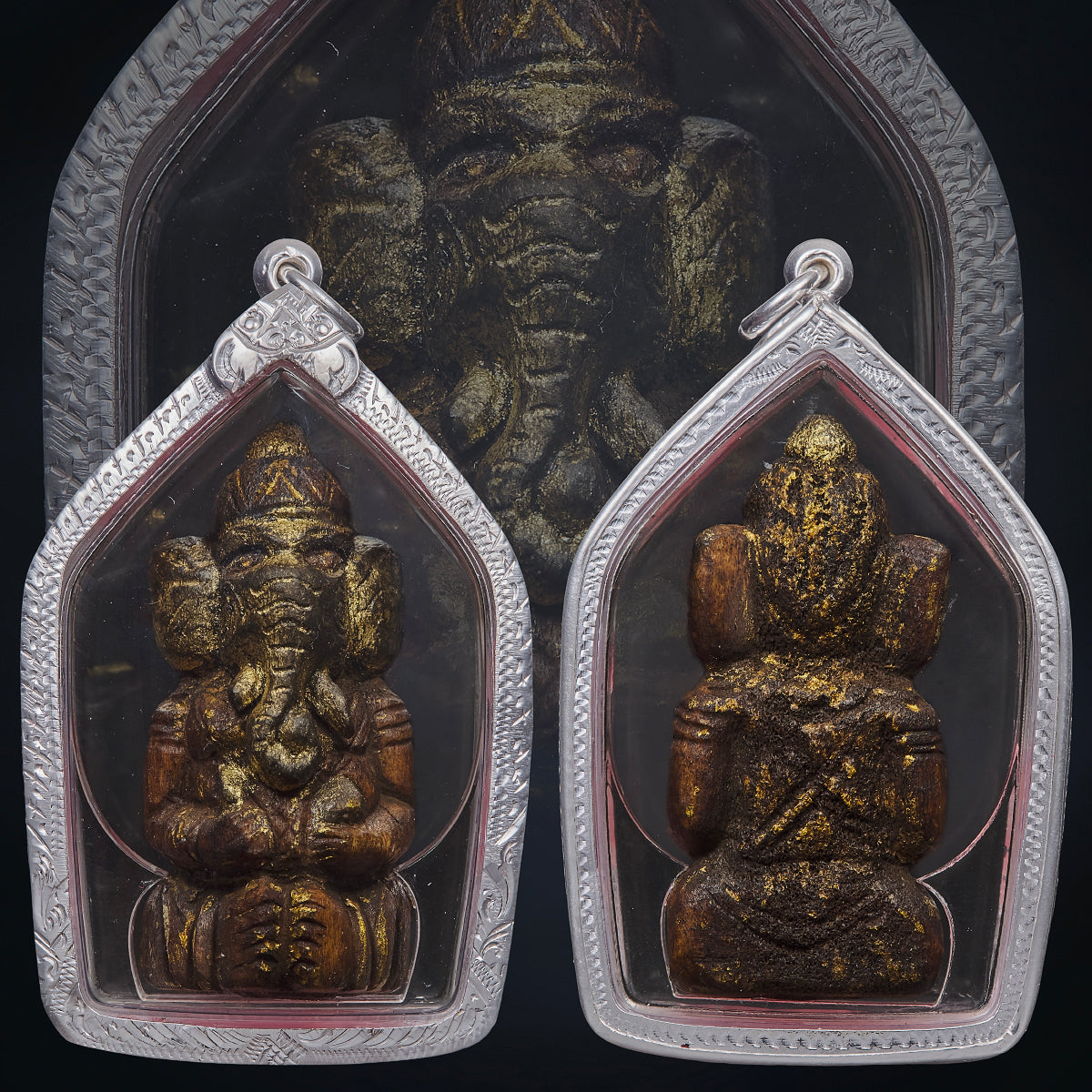
The artifact is a three-dimensional Phra Pikanet carving made from old Graduk Chang Graden.
The front depicts the elephant-headed deity seated in a composed posture, with the trunk descending prominently through the centre of the figure.
The surface carries a deep brown-red tone from the red lacquer and Burmese wax preparation, with aged gold remaining across selected raised areas.
The reverse continues the full carved form.
This particular example was soaked in Naman Wan and was not smeared with Tid Jai, distinguishing it from other Por Sala Tan relic carvings that were prepared more strongly for Saneh.
The artifact is presently protected within a fitted silver casing.
Recommended Pairing
This Phra Pikanet can comfortably be carried alone when the principal intention is smooth progress, auspicious beginnings and removal of obstacles.
For business use, it pairs naturally with a wealth artifact, while a Salika may be added where speech, negotiation and customer relations are particularly important.
It may also be paired with a respected monk image or Buddha amulet for a more devotional arrangement.
Personal Notes
What distinguishes this piece from some of the other Graduk Chang carvings by Por Sala Tan is the absence of Tid Jai.
Por Sala Tan deliberately treated this Phra Pikanet differently.
Rather than preparing it as an attraction-heavy piece, he soaked it in Naman Wan, giving the artifact a softer and more auspicious character centred upon Metta, good fortune and smooth progress.
This fits closely with how Por Sala Tan regards Phra Pikanet within his own ritual practice.
Whenever he has suitable sacred material, he may carve a Phra Pikanet because he considers the deity important to the proper flow of consecration itself.
That is also why these pieces remain relatively uncommon.
For me, the character of this example is especially clear:
Phra Pikanet clears the obstacle, while Naman Wan helps the path ahead unfold with goodwill and smoother circumstances.
-
Free Shipping for Singapore| $15 Worldwide | $60 USA For Items Below $350