
OOBThaiAmulets
Por Sala Tan
Por Sala Tan
Couldn't load pickup availability
PST06
Lersi Serming Pai
Por Sala Tan
2 inches
Barang Artifact
Sacred Craftsmanship
As each component was individually prepared, carved, painted and assembled by hand, natural differences in texture, colour, placement and finishing make every artifact unique.
Personal Experiences Shared by Luksits
There was once a follower grandson who just step out in the work force and was nervous whenever he had to speak to new customers. He rushed his words, promised too much, and went home disappointed when people did not buy. His grandfather gave him a small tiger-headed Lersi amulet and ask him to pray to it faithfully.
Before each meeting, he held the amulet and remembered three things: listen first, speak clearly, and keep his promise.
He did not become famous overnight. But customers began returning because he was calm, honest, and easy to deal with.
Summary
This Lersi Serming Pai by Por Sala Tan is a particularly material-intensive Barang artifact centred upon the lineage of the tiger-associated forest master.
Its foundation is a carved relic connected with a deceased forest hermit, whose final rites were personally undertaken by Por Sala Tan after one of his followers discovered the remains near the Burmese border.
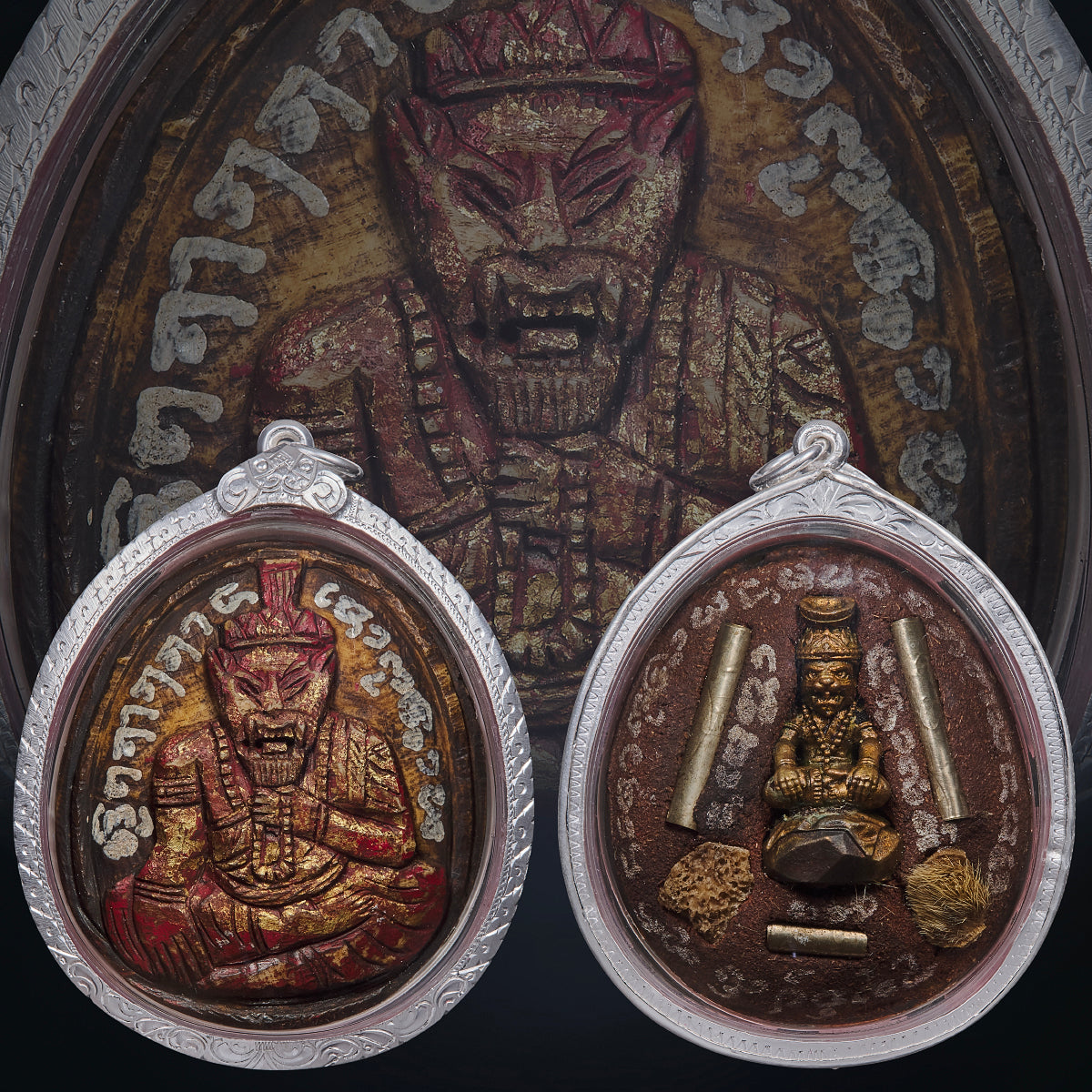
The front presents the fierce seated form of Lersi Serming Pai, finished in red lacquer, Burmese wax and gold. The reverse forms a compact ritual assemblage containing soil, sacred herbs, a Lersi Serming Pai Roop Lor, multiple takruts, Paneang from a Chamut fragment and Chamut fur.
Its traditional emphasis combines Baramee Kru, authority, protection, forest wisdom, courage, controlled strength, Metta and the ability to deal with difficult people or uncertain environments.
Historical Background
Lersi Serming Pai, more commonly connected with Pu Chao Saming Phrai, belongs to the northern Thai tradition of the powerful forest master.
He is particularly associated with the classical northern literary tradition surrounding Lilit Phra Lo, where Pu Chao Saming Phrai appears as a powerful guardian being and ritual adept capable of assuming different forms, including that of a tiger.
This shape-changing character helps explain the later tiger-faced imagery familiar in sacred objects.
The tiger should not be understood simply as aggression.
Within the symbolism of Lersi practice, it represents alertness, survival instinct, courage and command over dangerous surroundings. The Lersi element adds knowledge, discipline and restraint.
Together, the two express an important principle:
strength should be mastered rather than allowed to master the practitioner.
For this reason, Lersi Serming Pai became associated with those requiring authority and courage while still retaining judgement and self-control.
Origins of the Materials
The central material is the relic associated with the deceased forest hermit encountered near the Thai–Burma border.
After the appropriate rites and cremation had been completed, Por Sala Tan retained suitable relic material with permission for future sacred work.
The significance of cremated remains within certain traditional lineages lies partly in continuity. Ash and surviving fragments associated with respected practitioners have historically been retained by disciples and incorporated into later sacred objects as a means of preserving connection with the teacher and lineage.
For this artifact, Por Sala Tan carved the relic itself into Lersi Serming Pai.
The reverse was further prepared with:
- Soil and sacred herbs
- Lersi Serming Pai Roop Lor
- Takruts
- Paneang from a Chamut fragment
- Chamut fur
The carved face was then finished with red lacquer mixed with Burmese wax, reflecting the border-region character of the materials and practice.
Ritual
The ritual history begins before the artifact itself was created.
Por Sala Tan's first responsibility was to provide the deceased hermit with the necessary final rites. Only afterwards were appropriate relics and materials retained.
This distinction is important. The relic was not simply found and immediately carved. It first passed through funerary rites and was subsequently preserved until Por Sala Tan considered it suitable for sacred construction.
When the artifact was eventually created, the relic was carved into the tiger-associated Lersi form and ritually combined with the other materials on the reverse.
The Lersi Serming Pai Roop Lor reinforces the Kru or teacher aspect of the piece, while the takruts provide additional written wicha.
The Chamut materials introduce another layer of animal-associated force and instinct, while the sacred herbs and soil form the ritual foundation binding the different components together.
The completed piece therefore brings together relic, teacher lineage, forest symbolism, animal materials, written wicha and Por Sala Tan's own consecration practice.
Blessings and Effects
Lersi Serming Pai is traditionally approached for a combination of protection, authority, courage and Baramee Kru.
The tiger aspect represents alertness and the ability to remain firm when confronted by pressure. For those working around difficult personalities, competition or unpredictable environments, this symbolism is particularly relevant.
Its traditional associations include Maha Amnaj and Baramee — commanding presence, leadership and the ability to establish firm boundaries without unnecessary confrontation.
The Lersi aspect is associated with knowledge, judgement, learning and spiritual discipline, while the forest aspect concerns awareness of hidden danger and the instinct to recognise when circumstances are changing.
Lersi Serming Pai is also associated in modern practice with Metta Maha Niyom and Maha Saneh, balancing the fiercer protective character with personal charisma and favourable reception from others.
Rather than uncontrolled aggression, the central quality is controlled power: knowing when to remain quiet, when to act and when to stand one's ground.
Modern Application
This artifact is particularly relevant for those whose daily lives involve leadership, negotiation, competition, travel or frequent interaction with unfamiliar people.
Business owners and managers may approach the authority aspect for confidence and presence when making decisions or dealing with difficult situations.
Those travelling frequently or entering unfamiliar environments may connect more strongly with its traditional qualities of alertness, protection and forest instinct.
For practitioners, the Lersi aspect also makes the piece appropriate as a reminder of discipline, respect for teachers and continued development of knowledge.
Its combination of Metta and authority makes it suitable for situations where one must remain approachable while still maintaining strong personal boundaries.
Physical Details
The artifact is an oval carved Lersi Serming Pai relic, depicting the forest master seated in a commanding posture with a fierce, tiger-associated face.
The front is finished with red lacquer mixed with Burmese wax, with gold detailing accentuating the figure. Sacred characters surround the image.
The reverse is densely constructed upon a bed of soil and sacred herbs. At its centre sits a small Lersi Serming Pai Roop Lor, accompanied by several takruts. A Paneang fragment from a Chamut and Chamut fur are also incorporated into the composition.
The artifact is protected within a fitted casing while leaving its complex front and reverse construction visible.
Recommended Pairing
Because this piece already combines Lersi, protective, authority and Metta elements, it is sufficiently complete to be carried on its own.
For a more Buddhist-centred arrangement, it may be paired with an amulet of a respected monk or a Buddha image, providing a devotional foundation alongside the specialised Lersi wicha.
For business or customer-facing work, a dedicated Salika or Metta artifact can complement the stronger authority and protective character of Lersi Serming Pai.
Personal Notes
What distinguishes this piece is not simply the unusual materials on its reverse, but the story that precedes its creation.
The relic originated with a forest hermit discovered after his passing near the Burmese border. Por Sala Tan travelled there specifically to provide the necessary rites after being contacted by his follower.
Only afterwards, and after understanding the hermit's connection with Lersi Serming Pai wicha, did Por Sala Tan seek permission to preserve suitable relics and materials for future sacred work.
He did not rush their use.
The materials were retained until the appropriate opportunity arose, after which some were transformed into these Lersi Serming Pai artifacts and combined with Burmese wax, sacred herbs, takruts, Chamut Paneang and Chamut fur.
For me, this gives the piece its strongest character: it preserves a physical and ritual connection between a departed forest practitioner, his Lersi lineage, and Por Sala Tan's continuing work.
-
Free Shipping for Singapore| $15 Worldwide | $100 USA All products