
OOBThaiAmulets
Por Sala Tan
Por Sala Tan
Couldn't load pickup availability
PST06
Phra Yama
Por Sala Tan
Barang Artifact
1.5 Inches
Sacred Craftsmanship
Each artifact was individually carved and ritually assembled by hand. Natural differences in the Paneang, carving, surface, Sai Sin and sacred materials therefore give every completed piece its own individual character.
Personal Experiences Shared by Luksits
Those who travel frequently, work late at night or regularly enter unfamiliar environments have described carrying Phra Yama as giving them a stronger sense of security and composure.
Some collectors have also spoken of spiritually uncomfortable surroundings becoming noticeably quieter while carrying Phra Yama. Rather than describing dramatic encounters, they often speak about feeling less disturbed, less fearful and more capable of remaining composed in places they consider spiritually heavy.
One collector who regularly wore Phra Yama artifacts by Por Sala Tan described another recurring experience. During periods when his work was beginning to become unusually difficult, he would often develop a heightened sense of alertness before the problem became obvious.
He began treating this feeling as an early warning to slow down and examine what was happening around him. On several occasions, he subsequently discovered obstacles, complications or people creating difficulties that he had not initially noticed.
For him, Phra Yama became associated not simply with protection, but with awareness during changing circumstances — recognising that something was becoming unsettled early enough to prepare rather than being caught completely unaware.
Summary
This Phra Yama is one of Por Sala Tan's cemetery-origin artifacts, carved directly from old Paneang recovered from an exposed grave.
The figure represents Phra Yama — also widely known in Thailand as Phaya Yom or Phaya Yommarat — the ruler and judge associated with death, karma and the ordering of the spirit world.
The underside retains a particularly direct connection with the Paneang's origin. Cemetery soil collected from the same location was mixed with Nam Man Prai and packed beneath the carving, while red Sai Sin was incorporated into the figure.
Within Por Sala Tan's wicha, the artifact was prepared primarily around protection, spiritual authority, awareness, courage and the suppression of disturbing influences.
Historical Background
Phra Yama has a long presence within Buddhist cosmology and Southeast Asian religious culture. In Northern Thai traditions he is commonly referred to as Phaya Yom or Phaya Yommarat.
His fearsome appearance can easily be misunderstood. Phaya Yom is not traditionally regarded simply as an evil or destructive being. His principal role is that of an impartial judge, examining the actions accumulated during a person's life according to karmic law.
This association with judgement also explains his authority over the dead and wandering spirits.
Within Thai and Lanna folk belief, a figure capable of governing the spirit realm naturally became important in protective traditions. His image therefore came to represent order imposed upon disorder, justice over wrongdoing and authority over harmful spiritual influences.
Traditional iconography commonly depicts Yama as a powerful royal figure carrying a staff and sometimes a noose, while his mount is frequently represented as a buffalo.
Origins of the Materials
The principal material is an old piece of Paneang associated with a grave.
According to the history accompanying this artifact, the grave had become exposed while Por Sala Tan was collecting cemetery soil and other materials from the surrounding area. The old Paneang was subsequently recovered and retained for sacred work.
Por Sala Tan recognised the material as particularly appropriate for an image of Phra Yama because of its direct association with death, burial and the cemetery environment.
Importantly, he also retained soil from the same cemetery.
This created a material relationship between the carving and its original surroundings: the Paneang formed the body of Phra Yama, while soil from the place where it had rested was subsequently incorporated into the underside.
Ritual
Por Sala Tan carved the Paneang into the seated form of Phra Yama, giving particular attention to the figure's fierce expression and the staff held across the body.
After the carving was completed, cemetery soil from its place of origin was prepared together with Nam Man Prai and packed beneath the figure.
Red Sai Sin was then tied prominently around the artifact. Within the construction of the piece, the cord serves both as a ritual component and as a visible means of binding the different elements together.
The completed artifact therefore combines three closely related components: the old Paneang itself, cemetery soil connected with its origin, and Por Sala Tan's ritual preparation using Nam Man Prai and Sai Sin.
Blessings and Effects
Phra Yama is traditionally approached for strong protective authority.
Because of his position as ruler and judge within the realm of the dead, devotees commonly associate his image with protection against disturbing spirits, harmful occult influences and spiritually uncomfortable environments.
Another important quality is justice. Phra Yama represents judgement according to one's actions rather than personal favour. For this reason, his image may be carried by those facing disputes, complicated negotiations, workplace politics or situations where deception and unfair treatment are concerns.
Por Sala Tan's Phra Yama artifacts are also associated with alertness and warning. In practical terms, devotees may interpret this as becoming more observant when circumstances begin changing — noticing unusual behaviour, emerging problems or risks before proceeding further.
Courage is equally important. Phra Yama does not represent the absence of danger, but the ability to remain composed when confronted by uncertainty.
Modern Application
This Phra Yama is particularly suited to people who work at night, travel frequently, enter unfamiliar locations or routinely operate in environments where greater awareness is valuable.
Security personnel, drivers, travellers and people working alone may appreciate its traditional protective symbolism. Business owners and professionals may instead connect with Phra Yama's qualities of judgement, fairness and recognising hidden complications.
It can also serve as a reminder of karmic accountability. The figure who judges the actions of others equally reminds the wearer to examine his own conduct — to remain fair, disciplined and conscious of the consequences of his decisions.
In this sense, Phra Yama combines protection with responsibility: remain alert to what surrounds you, but also remain accountable for your own actions.
Physical Details
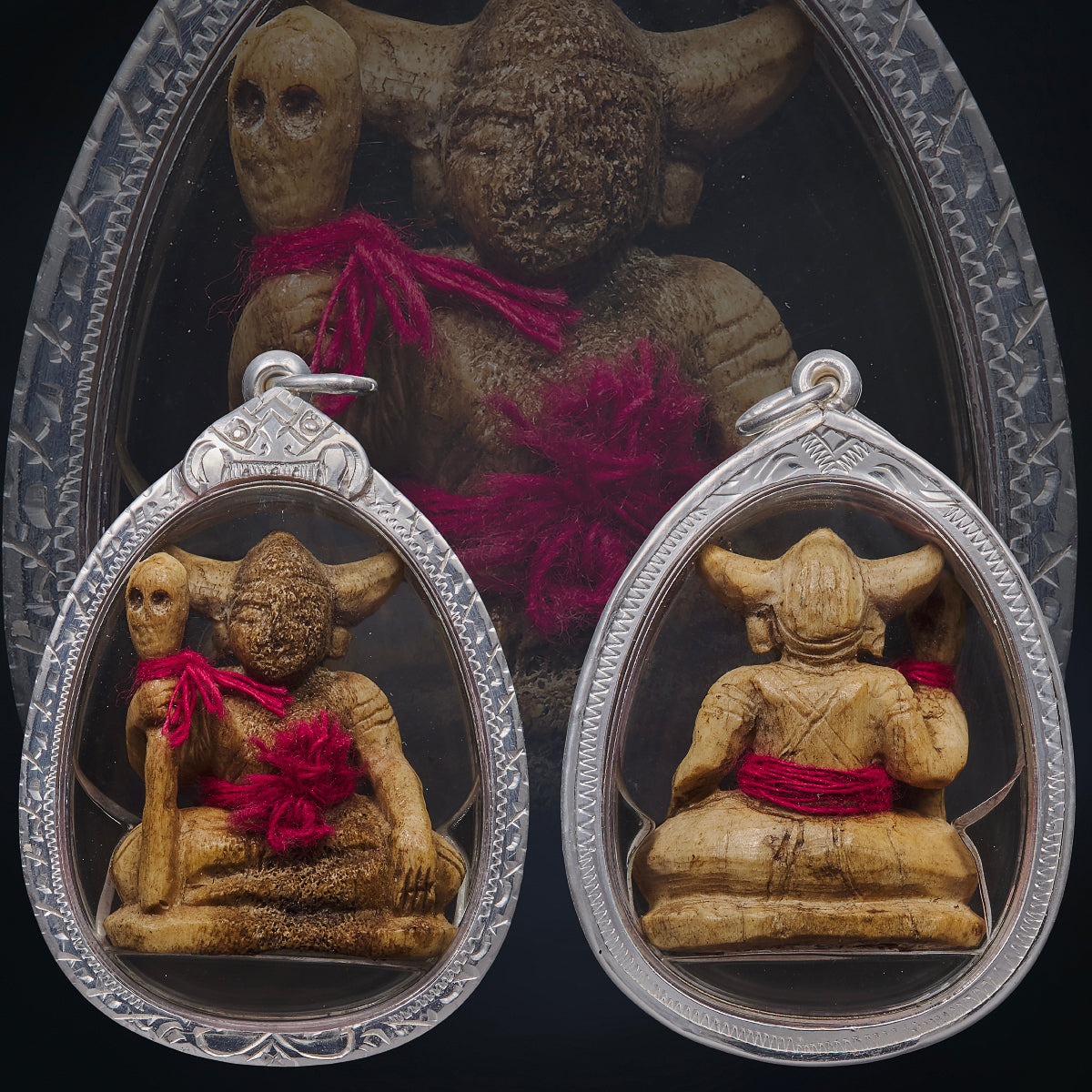
The artifact is carved from an old, naturally aged piece of Paneang, with the material's irregular surface deliberately retained as part of its character. Phra Yama is shown seated in a powerful frontal posture with a fierce face, broad horn-like elements extending behind the head and his distinctive staff held prominently across the body.
A smaller skull-like form appears beside the main figure, reinforcing the carving's association with mortality and the realm governed by Phra Yama. Bright red Sai Sin is tied around the neck, torso and waist, creating a striking contrast against the pale aged material.
The reverse reveals the carving more plainly, including incised markings across the back and the continuation of the red Sai Sin around the body.
Beneath the figure is the concealed ritual filling prepared from cemetery soil and Nam Man Prai, connecting the completed artifact back to the environment from which the Paneang was originally recovered.
The piece is protected within a fitted silver casing while leaving both the front and reverse visible.
Recommended Pairing
Phra Yama pairs naturally with Tao Wessuwan when stronger emphasis is desired on protection, authority and the control of disturbing spiritual influences.
It may also be paired with Phaya Burisat, particularly for those working at night or entering unfamiliar environments, where courage, alertness and commanding protective presence are the principal intentions.
For a more balanced combination, a Lersi artifact can complement Phra Yama's severe protective character with wisdom, judgement and guidance.
Personal Notes
What makes this Phra Yama particularly interesting to me is the direct relationship between the carving and the place from which its materials originated.
The Paneang was not selected simply because it was an old sacred material. It came from an exposed grave, and Por Sala Tan subsequently retained cemetery soil from the same surroundings to complete the artifact.
The combination of Paneang, its original cemetery soil, Nam Man Prai and red Sai Sin gives the piece a very coherent construction. Every principal material supports the same underlying character of Phra Yama — authority over the realm of the dead, protection, judgement and awareness.
Among Por Sala Tan's more unusual carvings, I regard this as a particularly distinctive example because the origin of the material, the figure chosen for the carving and the ritual substances used to complete it all follow the same purpose rather than being assembled without connection.
-
Free Shipping for Singapore| $15 Worldwide | $60 USA For Items Below $350