
OOBThaiAmulets
Por Sala Tan
Por Sala Tan
Couldn't load pickup availability
PST06
Nat
Por Sala Tan
Mainstream Artifact
2 inches
Sacred Craftsmanship
Each figure was individually prepared and carved by hand from naturally irregular old material. Variations in carving, surface, lacquer and the underlying Graduk Chang Graden therefore give every piece its own character.
Personal Experiences Shared by Luksits
For Por Sala Tan, this particular image carried a personal significance beyond the materials used.
The appearance of the Nat was completed from his memory of meeting the elderly Burmese shaman from whom the old Graduk Chang Graden originated. Rather than creating a purely conventional spirit image, Por Sala Tan allowed elements of that encounter to influence the character of the finished figure.
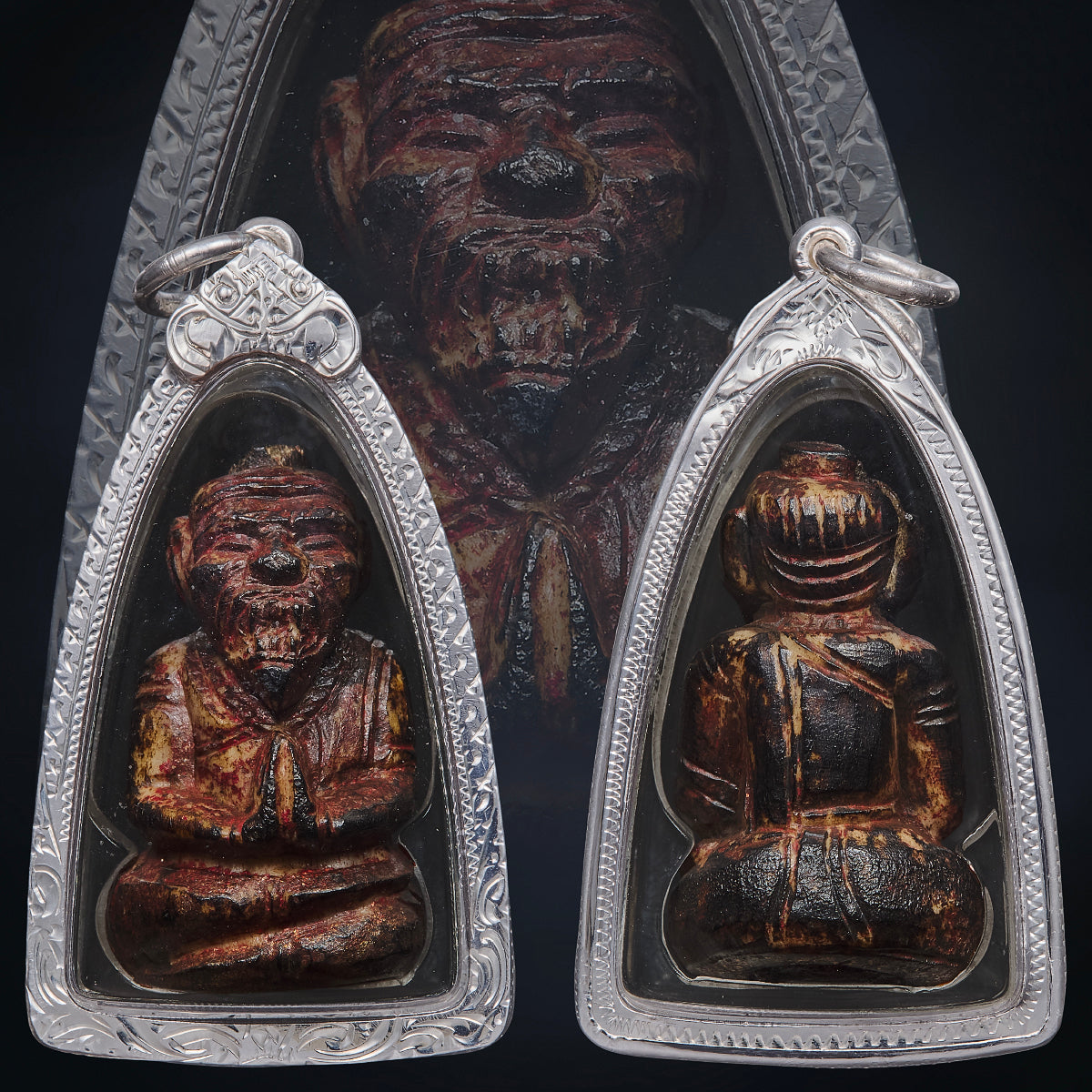
This explains the unusually human appearance of the carving. The aged face, wrapped head, seated posture and hands held together give it the presence of an old practitioner rather than an idealised deity.
Among luksits, artifacts of this nature are generally kept for guidance, protection, awareness and spiritual companionship. Some owners describe becoming more cautious when something does not feel right, while others associate such pieces with remaining composed when travelling or entering unfamiliar places.
The deeper importance of this example, however, remains its connection with the old Burmese practitioner and the long history of the material from which it was carved.
Summary
This Nat by Por Sala Tan combines Burmese spirit tradition with the personal history of an elderly Burmese shaman.
Its body was carved from old Graduk Chang Graden that the shaman had kept and blessed for over twenty years. After the material passed to Por Sala Tan, he prepared it according to his own practice and carved the seated figure, drawing upon his memory of meeting the old practitioner.
Traditional Burmese red lacquer was subsequently applied, while 108 sacred herbs powder was incorporated beneath the carving.
The resulting artifact is therefore closely tied to memory, lineage and material provenance. Its importance comes not simply from representing a Nat, but from the relationship between Por Sala Tan, the elderly Burmese shaman and the old ritual material that passed between them.
Historical Background
Nat is the Burmese term for a broad class of spiritual beings deeply rooted in Myanmar's religious and cultural landscape.
Nat traditions developed alongside Buddhism rather than simply disappearing with its spread. In popular Burmese practice, Nats may be associated with particular places, families, occupations, historical individuals or protective roles. Some traditions recognise the famous Thirty-Seven Nats, although local Nat beliefs extend far beyond that formal group.
A Nat should also be distinguished from a Weizza.
A Weizza is understood as an accomplished practitioner or “knowledge bearer” whose spiritual attainment is cultivated through disciplines such as meditation, sacred formulas and esoteric practices. Bobo Aung, for example, belongs to this broad Weizza tradition.
A Nat, by contrast, is fundamentally a spirit being.
Likewise, a Nat Kadaw is traditionally a human medium associated with Nat worship and spirit communication, rather than being a Nat themselves.
These distinctions are useful when understanding Por Sala Tan's Burmese-influenced artifacts, as his work may draw separately upon Nat, Weizza, Lersi and practitioner traditions.
Origins of the Materials
The principal material is old Graduk Chang Graden obtained through an elderly Burmese shaman.
According to its accompanying history, the shaman had kept the raw material for more than two decades and regularly blessed it during those years. It therefore already possessed a substantial ritual history before reaching Por Sala Tan.
When the material eventually changed hands, Por Sala Tan retained its provenance rather than treating it simply as raw carving stock.
He prepared the Graduk Chang Graden according to his own wicha and divided suitable portions for individually handcrafted sacred artifacts.
For this particular piece, the material was chosen for a Nat image connected with Por Sala Tan's memory of the old Burmese shaman himself.
The use of 108 sacred herbs beneath the carving added another layer to the construction. The number 108 carries widespread sacred associations across Buddhist and regional ritual traditions, while mixtures of selected herbs are frequently encountered in traditional amulet preparation.
Ritual
After selecting the appropriate section of Graduk Chang Graden, Por Sala Tan prepared and carved the figure by hand.
The facial expression was intentionally given an aged and strongly individual character. Rather than producing a polished or symmetrical image, the carving retains deep facial lines, a pronounced mouth, wrapped head covering and the weathered appearance of an elderly practitioner.
Por Sala Tan subsequently coated the figure in traditional Burmese red lacquer. The lacquer settled differently across the raised and recessed areas, leaving a combination of deep red, brown and almost black tones.
Finally, 108 sacred herbs powder was placed beneath the figure before the artifact was completed.
The combination joins together the old shaman's material history, Por Sala Tan's own wicha, the Nat representation and the herbal ritual foundation.
Blessings and Effects
Within folk belief, Nat-oriented artifacts are commonly associated with protection, guidance and awareness of one's surroundings.
For this piece, the emphasis may be understood as support during uncertain circumstances — remaining alert, recognising when caution is necessary and maintaining confidence when travelling or working in unfamiliar surroundings.
The old practitioner's connection also gives the artifact a strong Khru, or teacher-oriented, character. It can therefore represent respect for inherited knowledge, experience and the guidance of those who practised before.
For collectors familiar with Por Sala Tan's work, this is less an artifact centred upon wealth or Saneh than one concerned with presence, guidance, protection and connection to an older Burmese spiritual tradition.
Modern Application
This Nat may be carried by those who frequently travel, work alone, enter unfamiliar environments or make decisions under uncertain conditions.
It can also hold particular meaning for practitioners and collectors interested in Burmese spiritual traditions, especially where the relationship between teacher, practitioner and inherited material is important.
Its aged expression provides an appropriate reminder of experience itself: observe first, remain composed and do not dismiss the instincts developed through knowledge and practice.
Physical Details
The artifact depicts an elderly seated figure carved in full relief from Graduk Chang Graden. The front is particularly expressive, with a wrapped head covering, heavily lined face, prominent nose and an open mouth revealing individually carved teeth. The hands meet at the centre of the chest in a respectful gesture, while the figure sits cross-legged upon a broad base.
Traditional Burmese red lacquer covers the carving, with natural wear and differences in absorption producing shades of dark red, brown, black and traces of the lighter material beneath. These irregularities emphasise its handmade construction and aged character.
The reverse remains fully sculpted rather than flat. Por Sala Tan carved the back of the head covering, shoulders, robes and seated body, allowing the artifact to be viewed as a complete three-dimensional figure. 108 sacred herbs powder is concealed beneath the base.
The piece is presently protected within a fitted silver casing while leaving both its front and reverse visible.
Recommended Pairing
This Nat pairs naturally with Bobo Aung, particularly as both pieces share a Burmese spiritual context while representing different traditions: the Nat as a spirit presence and Bobo Aung as an accomplished Weizza figure.
A Lersi artifact is another appropriate pairing where emphasis is placed upon teachers, knowledge and disciplined practice.
For stronger protective symbolism, it may also be worn alongside Tao Wessuwan, creating a combination centred upon guidance, awareness and guardianship.
-
Free Shipping for Singapore| $15 Worldwide | $60 USA For Items Below $350