
OOBThaiAmulets
Por Sala Taan
Por Sala Taan
Couldn't load pickup availability
PST05
Phra Rahu Gaduk Prai
Por Sala Taan
1.5 Inches
Barang Artifact
Sacred Craftsmanship
Each piece was individually carved and ritually prepared from the available sacred materials. Variations in the Paneang, lacquer, wax, graveyard soil and embedded components naturally make every example unique.
Personal Experiences Shared by Luksits
Among devotees who keep Rahu pieces, experiences are often described during periods when circumstances seem unusually obstructed — business slowing, opportunities repeatedly collapsing, difficult people appearing or several problems developing within a short period.
One luksit carried a Rahu piece during a prolonged period of financial difficulty. Rather than experiencing an immediate windfall, he noticed that the pattern of setbacks gradually changed. An overdue payment was recovered, an old customer returned and a transaction that had repeatedly failed finally went through. He interpreted the experience not as money appearing from nowhere, but as Rahu gradually swallowing the obstacles surrounding his livelihood.
Another user involved in sales described experiencing several months in which competitors repeatedly secured opportunities before him. After beginning to carry Rahu, he reported becoming less affected by rivalry and more selective about which opportunities to pursue. Shortly afterwards, a previously unsuccessful contact returned with a substantial order. To him, the significant change was that an opportunity he believed had already disappeared unexpectedly came back.
Choke Lap is another theme traditionally associated with stronger Prai-based Rahu works. Some devotees have spoken of small unexpected winnings, additional commissions or money arriving from forgotten sources. With this particular construction, the Ngern Bpaag Phii and Prai materials give the fortune aspect greater prominence alongside Rahu's principal role of changing difficult circumstances.
Others value Rahu principally for protection. Users sometimes describe hostile relationships gradually becoming less troublesome, gossip losing its effect or people who had been creating persistent difficulties simply moving away from their immediate environment.
Summary
The Phra Rahu Gaduk Prai combines two particularly strong streams of Por Sala Taan's Barang practice.
The first is Rahu wicha — traditionally associated with eclipses, changing difficult destiny, consuming misfortune and protecting against hidden hostility.
The second is Prai-based fortune wicha, represented here through Nam Man Prai, graveyard soil and the Ngern Bpaag Phii.
The origins of those materials are equally important. They came from cemetery grounds belonging to a mountain village that had been abandoned after severe monsoon flooding made the surrounding area uninhabitable.
Por Sala Taan had originally gone there not to collect materials, but to perform the necessary rites for graves damaged and disturbed by the floods.
Only after communicating with the associated spiritual presences did he collect selected materials for future sacred works.
Historical Background
Phra Rahu occupies a distinctive position in Thai astrological and occult traditions.
Rahu is intimately connected with the eclipse. In traditional cosmology, the dark celestial figure temporarily consumes the sun or moon, creating the visible eclipse before releasing it again.
This act of swallowing became the foundation for much of Rahu's ritual symbolism.
Devotees consequently approach Rahu during periods of bad Chata, repeated misfortune, hidden enemies, sudden reversals or circumstances in which progress appears continually blocked.
The desired principle is transformation: Rahu consumes what is harmful so that circumstances can eventually emerge differently.
This explains why Por Sala Taan waited for a lunar eclipse before completing the consecration. Within traditional occult belief, an eclipse is regarded as an especially significant period for Rahu rites because the celestial event physically mirrors the mythology upon which the wicha is based.
Origins of the Materials
The cemetery materials used in this artefact came from a remote mountainous area close to the Burmese border.
A settlement there had suffered severe monsoon flooding. Water inundated the village and surrounding rice fields, leaving the area increasingly unsuitable for habitation. The surviving villagers eventually relocated to safer ground.
One concern remained: the graves left behind.
Heavy rainfall and continued erosion had damaged portions of the burial area, and the former villagers were concerned about the condition of the graves and the spiritual consequences of leaving them disturbed.
Por Sala Taan was asked to assist.
He travelled into the abandoned area and performed the appropriate ceremonies around the affected graves. According to the lineage account, he also meditated and communicated with the spiritual presences associated with the site.
Only afterwards were selected materials collected for sacred purposes.
These became the foundation for several different artefacts subsequently created by Por Sala Taan, including this Phra Rahu.
Ritual
Por Sala Taan began by carving Phra Rahu directly into a piece of Paneang.
The carving was then coated in red lacquer blended with Burmese wax, establishing the deep red ritual foundation visible beneath the final finish. Gold was subsequently applied over the surface, leaving the red details visible through the aged gilding.
For the reverse, Por Sala Taan combined Nam Man Prai with soil from the graveyard site. This mixture formed the Prai foundation of the artefact.
A Ngern Bpaag Phii, traditionally understood as a corpse coin associated with funeral practice, was incorporated into the reverse together with a takrut.
Even after these stages, the artefact remained incomplete.
Por Sala Taan waited for a lunar eclipse before performing the final Rahu consecration. Within the ritual logic of the piece, the timing brought the physical materials and Rahu imagery together with the celestial event most closely associated with Rahu himself.
Blessings and Effects
The principal purpose of this Phra Rahu is turning difficult circumstances.
Someone experiencing repeated setbacks may traditionally approach Rahu to consume the conditions surrounding those difficulties — particularly bad Chata, persistent obstacles, hidden opposition and periods when progress repeatedly reverses.
Protection forms another important quality. Rahu is traditionally invoked against malicious intentions, harmful spiritual influences, black magic and concealed enemies, particularly threats that are difficult to recognise directly.
The Prai materials introduce a stronger Choke Lap and speculative-fortune aspect.
The Ngern Bpaag Phii is traditionally associated in certain occult practices with unexpected wealth and fortune, while Nam Man Prai and cemetery materials connect the work with spirit-assisted Barang traditions.
For devotees, this may be interpreted through unexpected money, favourable opportunities, speculative luck or a business opening appearing during an otherwise difficult period.
The deeper theme is therefore not simply wealth.
It is fortune emerging after adversity changes direction.
Modern Application
The Phra Rahu Gaduk Prai is particularly suited symbolically to periods of transition, uncertainty and repeated setbacks.
A business owner experiencing declining trade may focus upon removing the conditions preventing recovery. Someone facing workplace rivalry may seek protection against hidden opposition. A person entering an unfavourable astrological period may keep Rahu as a traditional guardian against the instability associated with changing Chata.
Its Choke Lap dimension may appeal to traders, commission-based professionals and those whose income depends partly upon opportunity and timing.
However, the central character remains Rahu.
This is less a straightforward "wealth amulet" than an artefact concerned with changing the direction of circumstances so that opportunity can return.
Physical Details
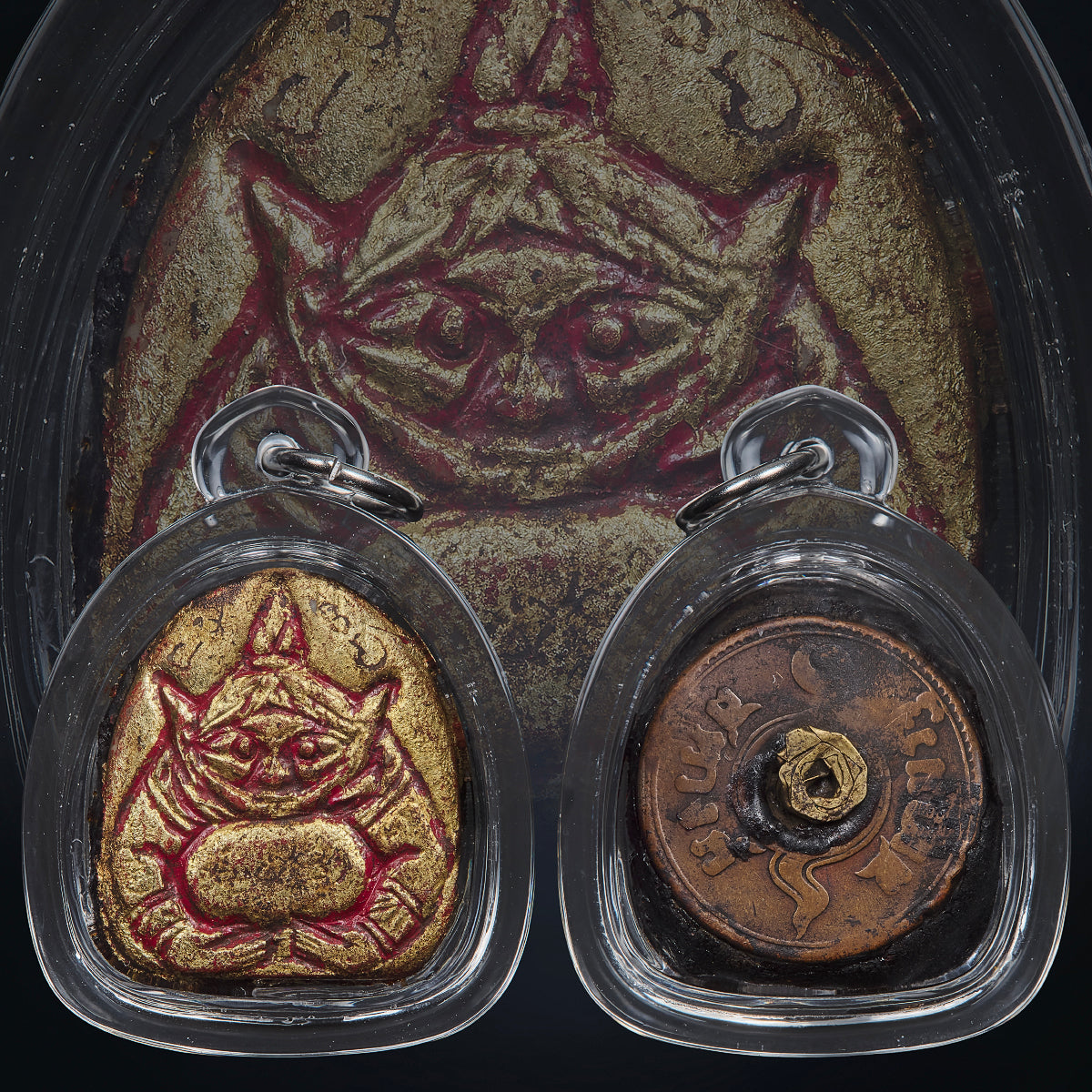
The front consists of a carved Paneang Phra Rahu, formed in the familiar powerful Rahu imagery with a broad face, prominent eyes and hands positioned around the central celestial form. The surface was coated with red lacquer mixed with Burmese wax and subsequently finished in gold, producing the characteristic contrast between aged gilding, deep red detailing and the darker underlying material.
Sacred characters appear around the upper portion of the carving, while the natural wear of the gold allows sections of the ritual colouring beneath to remain visible.
The reverse carries a circular Ngern Bpaag Phii as its principal visible component. Sacred markings remain visible across the aged coin surface, while the centre contains the attached takrut. Beneath and surrounding the coin is the darker prepared foundation containing Nam Man Prai mixed with graveyard soil collected from the abandoned mountain cemetery.
The two sides therefore express the complete ritual construction clearly: Rahu occupies the front as the force of consumption and transformation, while the reverse contains the cemetery-derived Prai materials and corpse coin associated with spirit-assisted fortune.
The completed artefact is housed within a fitted clear protective casing.
Recommended Pairing
Because this is already a strong Barang piece combining Rahu, Prai materials and Ngern Bpaag Phii, it does not require another heavy spirit-oriented artefact.
Phra Somdej provides a suitable Buddhist foundation of stability and Baramee. Phra Sivali can complement the Choke Lap aspect with steadier livelihood and abundance, while Tao Wessuwan may be paired where stronger guardianship and protection are desired.
Personal Notes
The most important part of this artefact may actually be what happened before it was created.
Por Sala Taan did not originally travel to the abandoned mountain village searching for powerful cemetery materials.
He went because the living were worried about their dead.
Floodwaters had destroyed homes and rice fields. Families moved elsewhere, but the graves remained behind, damaged by continued rain and erosion. Por Sala Taan was asked to perform the necessary rites and restore spiritual order to the burial ground.
Only after those ceremonies, and according to the account after communication with the associated spirits, were selected materials taken for sacred work.
From those materials Por Sala Taan created several different artefacts.
For this particular piece he chose Rahu.
The choice is fitting. A village had been overwhelmed by forces beyond human control; its inhabitants were displaced, graves disturbed and an established way of life brought to an end. Rahu likewise represents a period in which light is temporarily swallowed and ordinary conditions are overturned.
Yet an eclipse does not remain forever.
The moon eventually emerges.
That is perhaps the clearest way to understand this Phra Rahu Gaduk Prai: not as an artefact promising that darkness will never arrive, but as a traditional work for passing through difficult cycles, consuming adversity and allowing fortune to emerge again when the cycle begins to turn.
-
Free Shipping for Singapore| $15 Worldwide | $60 USA For Items Below $350