
OOBThaiAmulets
Phra Ajahn Anucha Wat Pho Ratchaburana
Phra Ajahn Anucha Wat Pho Ratchaburana
Couldn't load pickup availability
MS6
1st batch Rian Lang Liap
Phra Ajahn Anucha Anuchato, Wat Pho Ratchaburana, Ratchaburi
Summary
The First Batch Pim Lang Liap is one of the earliest and most sought-after releases by Phra Ajahn Anucha Anuchato of Wat Pho Ratchaburana, Ratchaburi Province. Early issues such as this are especially appreciated by collectors because they represent the beginning of the master's public amulet lineage, created before later productions became more widely known.
This example is struck in Nuea Chanuan (เนื้อชนวน), a traditional sacred melt alloy produced entirely from accumulated ritual metals. These include leftover sacred alloys from previous amulet castings, inscribed yantra metal sheets, temple ritual metals and other consecrated metallic remnants gathered over many years.
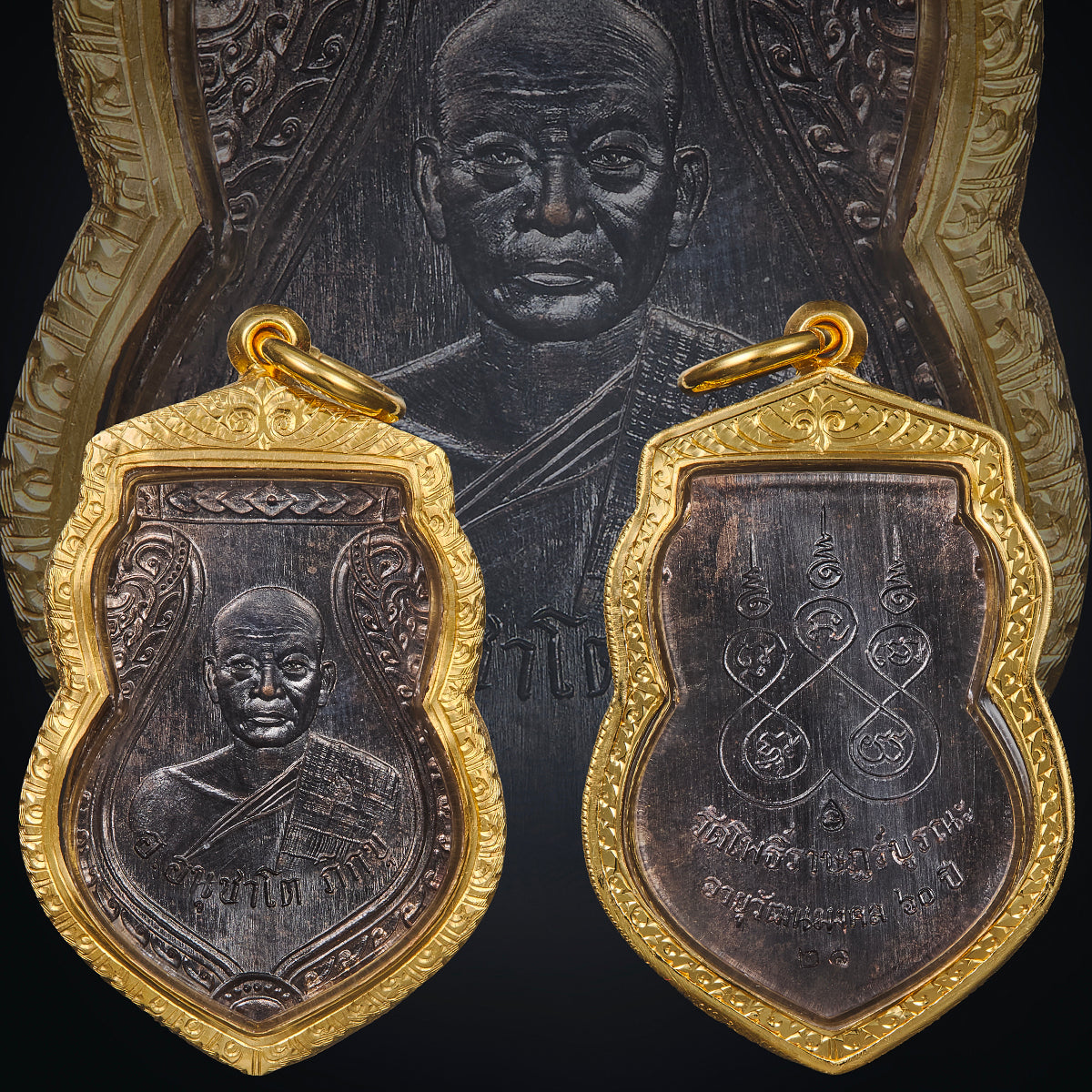
The front bears a finely executed portrait of Phra Ajahn Anucha, while the reverse features a traditional sacred yantra composition representing protection, authority and prosperity. Unlike the smooth-back version, this issue combines the master's image with an engraved yantra design already incorporated into the medal itself.
The medal has been newly encased in a custom gold casing, preserving both the sacred alloy and its finely detailed surfaces while making it suitable for everyday wear.
Collectors traditionally seek this first batch for its association with:
- Stable protection
- Business prosperity
- Personal authority
- Financial growth
- Long-term family well-being
Historical Background
Phra Ajahn Anucha Anuchato serves at Wat Pho Ratchaburana in Ratchaburi Province, a region long respected for preserving both orthodox Buddhist learning and traditional Thai wiccha.
Born on 23 August 1964 in Nakhon Pathom Province, he entered temple life at an early age and began studying Buddhist practice alongside traditional mystical sciences under Luang Pho Sanga.
His first ordination took place in 1984 at Wat Nong Pho, where he continued his religious studies while also fulfilling responsibilities outside the monkhood.
In 2009, he returned permanently to monastic life at Wat Pho Ratchaburana, devoting himself entirely to meditation, Buddhist education and the preservation of traditional sacred knowledge. Between 2013 and 2015, he completed the full sequence of Nak Tham examinations.
Alongside formal Buddhist education, he continued studying traditional wiccha under respected teachers including:
- Luang Pu Non of Wat Khao Phran Thup
- Luang Pho Boonkham of Wat Chaiyaphum
These teachings shaped the balanced approach that characterises his work today—combining disciplined Buddhist practice with carefully preserved ritual traditions.
Biography of the Master
Ratchaburi Province shares a close spiritual connection with neighbouring Phetchaburi, home to the legendary Luang Pho Deang of Wat Khao Bandai-It.
For generations, Luang Pho Deang's lineage has been closely associated with protection, prosperity and practical blessings for everyday life. As older disciples gradually passed away, many families naturally sought another teacher who combined sound Buddhist discipline with genuine ritual knowledge.
For many households, that role came to be fulfilled by Phra Ajahn Anucha.
Visitors to Wat Pho Ratchaburana frequently encounter long-time devotees who are established entrepreneurs, traders and business owners. Many describe themselves as second-generation disciples, continuing the relationship first established by their parents with Luang Pho Deang's lineage.
One businessman working within Thailand's beauty industry explained that his father regarded Ajahn Anucha as the natural continuation of their family's spiritual tradition. He attributed much of his business growth to maintaining both the master's guidance and blessings alongside diligent effort.
Similar experiences are often shared among his disciples, whose relationship with the master is based upon years of trust rather than occasional visits.
Origins of the Materials
One of the defining characteristics of this first batch is its use of Nuea Chanuan.
Within Thai amulet making, Chanuan is regarded as one of the most respected sacred alloys because it is not created from ordinary commercial metal.
Instead, it is formed by melting together ritual metals accumulated over many years, including:
- Leftover sacred alloy from previous amulet castings
- Yantra-inscribed metal sheets used during consecration
- Fragments of older temple ritual metals
- Sacred metallic remnants from earlier blessing ceremonies
Each addition contributes both physical material and symbolic continuity, linking the new amulet with earlier generations of consecrated sacred objects.
Because of its complex composition, Nuea Chanuan often displays an attractive range of natural tones across its surface. Variations in colour, texture and oxidation are characteristic of the alloy and are appreciated by experienced collectors.
Rather than striving for uniform appearance, the alloy reflects the accumulated history of countless earlier rituals brought together into a single sacred metal.
Ritual
The creation of this first batch formed part of Phra Ajahn Anucha's wider efforts to support the restoration and continued development of Wat Pho Ratchaburana.
Traditional preparation extended well beyond the striking of the medal.
The process generally included:
- Preparation of the sacred Chanuan alloy
- Casting and striking of the medal
- Temple chanting
- Consecration ceremonies
- Personal blessing by Phra Ajahn Anucha
The restoration project itself was supported through two principal consecration ceremonies held during July 2065, bringing together traditional chanting and blessing before the amulets were released to devotees.
Within Thai tradition, the importance of the ritual lies not only in the materials but in the repeated acts of dedication, chanting and merit-making accompanying the creation of the sacred object.
Blessings and Effects
Stable Protection
Protection remains one of the principal characteristics associated with Phra Ajahn Anucha's lineage.
Collectors traditionally carry his amulets to encourage:
- Personal safety
- Household harmony
- Peace of mind
- Long-term stability
- Protection during travel
The emphasis is upon calm resilience rather than confrontation.
Authority and Business Success
Many business owners are drawn to the master's amulets because of their longstanding reputation for supporting professional relationships.
Collectors traditionally seek blessings for:
- Building trust with clients
- Productive negotiations
- Stronger business relationships
- Professional recognition
- Greater confidence in leadership
Rather than replacing effort, the amulet is traditionally understood as encouraging favourable circumstances around honest work.
Prosperity and Growth
Long-time disciples frequently describe gradual improvements rather than sudden transformation.
Within the tradition, prosperity develops through opportunity, discipline and wise judgement.
Collectors commonly carry the amulet while:
- Expanding a business
- Starting a new venture
- Managing investments
- Seeking promotion
- Building long-term financial security
Modern Application
The balanced nature of this first batch makes it particularly suitable for daily wear.
It may accompany the owner through both professional and personal responsibilities without requiring specialised ritual practice.
Suitable situations include:
- Running a business
- Career development
- Client meetings
- Financial planning
- Family responsibilities
- Daily protection
Many collectors also appreciate its connection with one of Ratchaburi's respected contemporary monastic lineages, making it equally meaningful as a devotional object and a collector's piece.
Physical Details
This example is the First Batch Pim Lang Liap of Phra Ajahn Anucha Anuchato.
The medal is struck in Nuea Chanuan (Sacred Melt Alloy), displaying the naturally varied tones characteristic of this traditional ritual metal. The surface exhibits subtle colour variations created by the mixture of numerous sacred metallic components accumulated from earlier consecrated materials.
The obverse features a finely detailed portrait of Phra Ajahn Anucha framed within an ornate traditional border, with Thai inscriptions identifying the master beneath the portrait.
The reverse carries a beautifully executed sacred yantra design occupying the central field. Beneath the yantra are Thai inscriptions commemorating the issue, completing a balanced composition that reflects both ritual symbolism and traditional temple craftsmanship.
The medal has been newly encased in a custom gold casing, offering protection while enhancing its presentation. The casing preserves the original sacred alloy without altering the medal itself.
As with all Chanuan alloy pieces, slight tonal differences, natural oxidation and individual surface character should be regarded as desirable features rather than imperfections.
Recommended Pairing
Because this first batch already combines protection, prosperity and authority, it pairs naturally with several complementary sacred objects.
For Business
Pair with Nang Kwak.
Nang Kwak traditionally attracts customers, while Phra Ajahn Anucha's blessing supports sustainable commercial growth.
For Protection
Pair with Takrut Kasatorn.
The Takrut reinforces protective qualities, while the medal encourages long-term stability and favourable circumstances.
For Leadership
Pair with Maha Amnaj.
Together they strengthen confidence, authority and professional recognition.
For Prosperity
Pair with Hua Namo.
Hua Namo contributes broad auspiciousness and Metta, complementing Ajahn Anucha's emphasis on steady financial development and opportunity.
Personal Experiences
Collectors often describe the master's early issues as amulets that quietly accompany life's gradual progress.
Rather than dramatic changes, devotees frequently speak of improvements that become clear only after looking back over several years.
Examples commonly shared include:
- Businesses becoming more stable
- Better financial decisions
- Stronger professional relationships
- Increased customer confidence
- Career advancement
- Greater peace of mind during difficult periods
Such accounts remain personal experiences rather than guarantees, but they help explain why the earliest batches continue to enjoy a strong following among long-time collectors.
Personal Notes
The First Batch Pim Lang Liap in Nuea Chanuan reflects many of the qualities collectors seek in an early temple issue.
Its appeal lies not only in being among the master's earliest releases, but also in its use of traditional sacred melt alloy, preserving the accumulated spiritual heritage of earlier consecrated metals within a single medal.
Combined with its elegant portrait, sacred yantra reverse and new custom gold casing, it represents both traditional Thai temple craftsmanship and the continuing lineage of Phra Ajahn Anucha Anuchato.
Its traditional purpose may be summarised simply:
to encourage protection, prosperity, steady progress and the quiet confidence that comes from combining sincere effort with faith in a respected spiritual lineage.
-
Free Shipping for Singapore| $15 Worldwide | $60 USA For Items Below $350