
OOBThaiAmulets
LP Si Chantasiri - Wat Khao Tham Boonnak
LP Si Chantasiri - Wat Khao Tham Boonnak
Couldn't load pickup availability
MS06
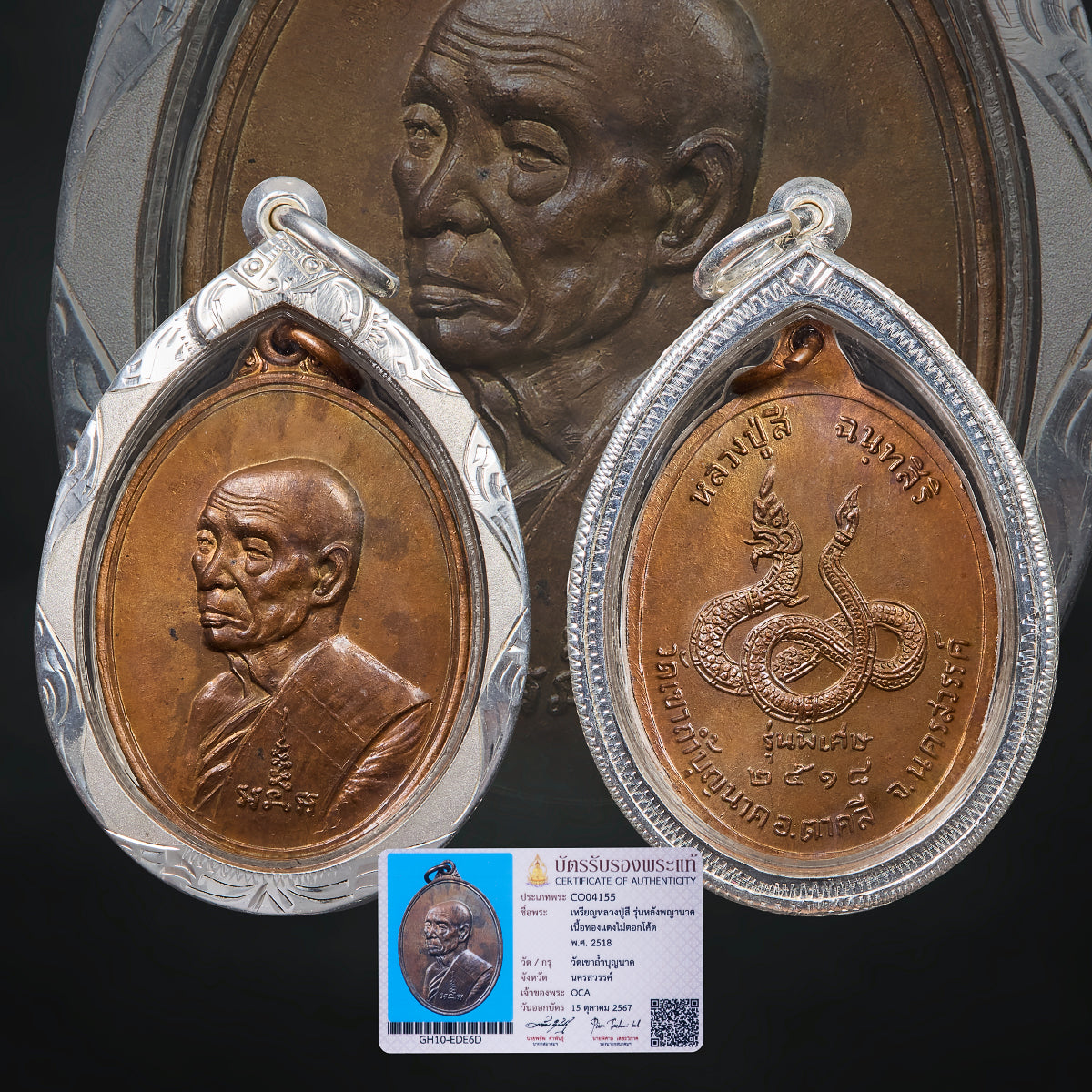
Rian LP Si Lang Payanak
LP Si Chantasiri · Wat Khao Tham Boon Nak · Nakhon Sawan
B.E. 2518 (1975)
1.5 Inches
Mainstream Artifact
Samakom Certification Card (GH10-EDE6D)
Individual Craftsmanship
The entire edition was made in copper, although surviving examples can show different finishes, particularly brown-patinated and phiu fai surfaces. Differences in striking, finishing and natural ageing give each artifact its own individual character.
Personal Experiences Shared by Luksits
The reputation of this particular medal became closely connected with the people who originally helped create it — workers from the Takhli cement factory.
One of the best-known accounts concerns a group of factory workers who accidentally entered an area where rock blasting was taking place. An explosion occurred, throwing rock and debris through the area.
According to the story preserved among LP Si's luksits, the workers emerged with torn clothing, dust-covered bodies and bruising, but without the severe injuries that might normally have been expected from such an accident.
What drew particular attention was that the workers involved were said to have been wearing the B.E. 2518 Naga medal received from LP Si.
The incident became one of the stories that established the medal's reputation for Klaew Klaad — escaping or passing safely through serious danger.
Further accounts later circulated concerning road accidents, motorcycle crashes, firearms and other dangerous situations. These remain traditional experiences passed among devotees rather than independently documented evidence, but they form an important part of the medal's collector history.
For many older luksits, the Lang Payanak therefore became known not merely as another LP Si portrait medal, but as a piece particularly associated with workers, travellers and people regularly exposed to physical risk.
Summary
The Rian LP Si Lang Payanak B.E. 2518 was created by a group of officials and employees associated with the Takhli cement factory, who sought LP Si's permission to produce the medal as an offering.
The project was also connected with merit-making for improvements around Wat Khao Tham Boon Nak, including road access and construction of a sala.
Approximately 10,000 copper medals are traditionally recorded for the issue.
Its imagery brings together two powerful elements: the revered image of LP Si Chantasiri on the front and the protective Payanak on the reverse.
Created only a short period before LP Si's passing in B.E. 2520, it belongs to the important final chapter of artifacts personally consecrated during his lifetime.
Historical Background
LP Si Chantasiri was one of the most respected elder monks associated with Wat Khao Tham Boon Nak.
Traditional biographies remember him for an exceptionally long monastic life, austere living, meditation and a quiet manner that attracted devotees from well beyond Nakhon Sawan. He settled at Wat Khao Tham Boon Nak during the later period of his life, living simply near the mountain and cave environment.
His practice became particularly associated with Metta, meditation and disciplined spiritual cultivation. Rather than becoming known through elaborate public displays, much of LP Si's reputation developed through the respect of those who visited him and the experiences later associated with his artifacts.
The B.E. 2518 Naga medal is especially interesting because its origin lies outside a normal commercial temple issue.
It was initiated by working people from the Takhli cement factory who wished to make merit, support the temple and receive an artifact blessed by LP Si.
That relationship between monk, temple and local working community remains central to the identity of the edition.
Origins of the Materials
Unlike powder amulets whose importance often lies in complicated sacred-material mixtures, the Lang Payanak was deliberately straightforward in its physical construction.
The principal material was copper.
Approximately 10,000 medals are traditionally recorded, with examples appearing in both brown-finished and fire-surface (phiu fai) forms.
A particularly interesting detail concerns the small five-pointed star code found near the Naga's mouth on some examples.
According to the accepted history of the batch, the medals had already been blessed when the temple began distributing them. For approximately the first two or three days, some pieces were released before the star code had been applied.
The organisers subsequently obtained the punch and began stamping the remaining medals.
Consequently, authentic examples are known in two forms: with the five-pointed star code and without it. The absence of the star is therefore part of the early distribution history rather than necessarily indicating a different consecration.
Around 4,000 medals were also traditionally said to have been retained and placed within the Ubosot of Wat Khao Tham Boon Nak rather than entering general circulation.
Ritual
The completed medals were presented to LP Si for Adithan Jit, his meditative blessing and determination of mind.
For devotees, this direct connection is important. The B.E. 2518 issue was created while LP Si was still alive and residing at Wat Khao Tham Boon Nak, rather than being a later commemorative medal produced after his passing.
The Naga imagery also gave the edition a particularly appropriate protective identity.
Within Buddhist tradition, Nagas appear repeatedly as guardians of sacred places and protectors of the Buddha and the Dhamma. In wider Southeast Asian tradition they are also connected with water, fertility, abundance and the hidden forces beneath the earth.
For an edition initiated by workers connected with heavy industry, quarrying and the landscape surrounding Takhli, the powerful Naga image became especially memorable.
Blessings and Effects
The strongest traditional reputation of the Lang Payanak is Klaew Klaad — protection through avoidance or survival of danger.
The famous factory-worker account reinforced this association, and the medal subsequently developed a following among people whose occupations involved machinery, construction, driving, physical labour or other potentially hazardous environments.
Protection is strengthened symbolically by the Naga itself. The Payanak is traditionally understood as a guardian — watchful, powerful and capable of defending sacred boundaries.
LP Si's own lineage adds Metta and Baramee. Metta concerns goodwill and favourable treatment from others, while Baramee concerns dignity, respect and the spiritual weight accumulated through disciplined conduct.
The Naga is additionally connected with abundance and prosperity, particularly through its traditional relationship with water and fertility. For this reason, some devotees also carry the medal for stability in livelihood and gradual improvement in fortune.
The overall character is therefore strongly balanced towards protection, safety, Baramee, Metta and stability of fortune.
Modern Application
The Lang Payanak remains particularly suitable for those whose daily lives involve frequent travelling, machinery, construction sites, industrial environments or physically demanding work.
For business owners and managers, its symbolism can be approached differently. The Naga represents guardianship of one's territory and resources, while LP Si's Baramee tradition supports calm authority and favourable relationships.
It is also appropriate for people experiencing uncertain periods in work or life. Rather than being understood simply as a luck artifact, its traditional character concerns remaining steady, protected and able to continue forward when circumstances become difficult.
Its clean medal format also makes it straightforward to wear every day.
Physical Details
A B.E. 2518 Rian LP Si Lang Payanak, struck in copper with a naturally aged warm brown surface. The obverse carries LP Si's distinctive side-profile portrait in monastic robes, while the reverse displays the intertwined Payanaktogether with the identifying inscriptions for LP Si and Wat Khao Tham Boon Nak. The issue was produced in copper and is known with both brown and phiu fai finishes, as well as coded and uncoded varieties. This example is preserved within a custom silver casing with clear acrylic protection and is accompanied by specialist certification.
Recommended Pairing
The Lang Payanak already has a particularly strong protective identity and therefore pairs naturally with an artifact emphasising a complementary quality.
A Phra Somdej provides a calmer Buddhist foundation of merit, stability and Metta. For business use, Nang Kwakcan add a stronger emphasis on customers and commercial movement.
Those wanting to emphasise authority may pair it with a Tao Wessuwan or another established Baramee artifact, while collectors concentrating specifically on LP Si can pair the medal with one of his powder Somdej pieces.
A particularly meaningful LP Si combination would be the B.E. 2518 Lang Payanak together with the B.E. 2519 Somdej Kaenan. The former carries the stronger protective and Naga identity, while the latter represents the classic Somdej qualities of Metta, stability, merit and Baramee.
Personal Notes
What I particularly like about this medal is that its history is tied directly to ordinary working people.
The Takhli cement-factory employees were not simply commissioning another commemorative medal. They were supporting improvements to the temple and creating an artifact that they themselves could carry while working in an environment involving heavy machinery, rock and physical danger.
The later blasting story consequently became closely connected with the identity of the piece.
I also find the reverse especially attractive. The intertwined Payanak gives the medal a completely different character from LP Si's Somdej and portrait amulets, while the side-profile portrait on the front is immediately recognisable.
This particular example has aged beautifully. The warm copper surface remains clear beneath the silver casing, allowing both LP Si's portrait and the detailed Naga to remain fully visible.
For someone building a collection of LP Si, I consider the B.E. 2518 Lang Payanak an important piece because it combines a clear origin story, a strong connection to his lifetime, distinctive iconography and one of the better-known protective traditions surrounding his later artifacts.
-
Free Shipping for Singapore| $15 Worldwide | $60 USA For Items Below $350