
OOBThaiAmulets
Luang Por Kuay · Wat Kositaram
Luang Por Kuay · Wat Kositaram
Couldn't load pickup availability
MS03
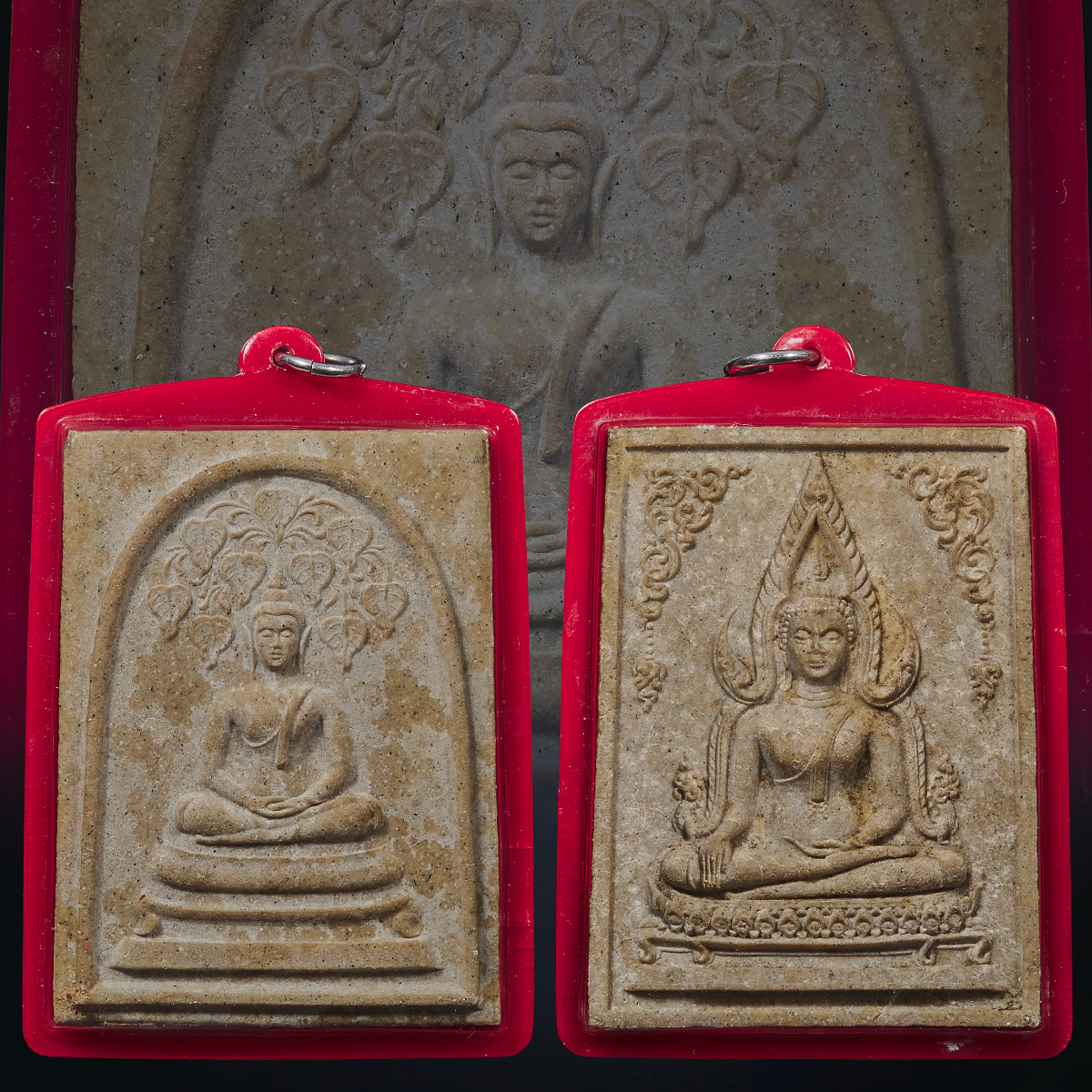
Phra Somdej Prok Pho Lang Phra Phuttha Chinnarat
Luang Por Kuay · Wat Kositaram
Wat Ratchanadda Ceremony · B.E. 2512 (1969)
4" height (Take note VERY BIG PIECE)
Sacred Craftsmanship
These amulets were individually pressed from traditional sacred material, with compositions associated with clay, sacred powders, Pong Nam Man and Pong Itthije. Natural differences in mixing, pressing, ageing and surface development mean that variations in colour, texture and definition are expected, giving each surviving piece its own individual character.
Personal Experiences Shared by Luksits
Among devotees of Luang Por Kuay, amulets blessed by him are traditionally carried for broad protection, Baramee, advancement and support through difficult periods of life.
Collectors of the Somdej Prok Pho forms particularly associate them with stability, protection and the gradual improvement of one's circumstances. The Bodhi tree above the Buddha represents shelter and awakening, while Phra Phuttha Chinnarat adds another highly revered Buddha image to the composition.
Luksits have long shared accounts of carrying Luang Por Kuay's amulets through periods of financial uncertainty, difficult work situations and important journeys. Some speak of timely assistance arriving when circumstances appeared difficult; others value the sense of confidence and steadiness associated with keeping his amulets close.
A well-known blessing attributed to Luang Por Kuay expresses the sentiment remembered by generations of his disciples:
“May my disciples never go hungry, never be without, never live in hardship or poverty, and never be beneath others in their circumstances.”
It is this concern for the everyday welfare of his disciples that remains central to the way many collectors understand his amulets.
Summary
This is the classic Phra Somdej Prok Pho Kao Bai, or Nine-Leaf Bodhi Somdej, with Phra Phuttha Chinnarat on the reverse, connected with Luang Por Kuay of Wat Kositaram.
The history of this particular type is especially interesting because it connects Luang Por Kuay with the important B.E. 2512 consecration at Wat Ratchanadda in Bangkok.
The original Wat Ratchanadda amulets were created under Phra Maha Komet Maneechot, with Luang Por Kuay invited as one of the monks participating in the Buddhaphisek ceremony. According to the collector history supplied with this piece, Luang Por Kuay subsequently took a number of the amulets back with him for distribution at Wat Ban Khae, the former name commonly associated with Wat Kositaram.
The design evidently left an impression upon him. The Prok Pho composition was subsequently reproduced in forms associated directly with his own temple, contributing to the development of the famous Somdej Prok Pho Kao Baitradition for which Luang Por Kuay is now widely collected.
This makes the Chinnarat-backed form an important piece for understanding the development of one of his most recognisable Somdej designs.
Historical Background
The B.E. 2512 ceremony at Wat Ratchanadda, Bangkok, brought together a notable group of respected monks.
The supplied historical record names participants including:
- Luang Pu Toh of Wat Pradoochimplee.
- Luang Por Kuay of Wat Kositaram.
- Luang Por Pring of Wat Bot Kong Thanu.
- Luang Por Nai of Wat Ban Chaeng.
- Luang Por Chuea of Wat Mai Bamphen Bun.
- Luang Pu Nak of Wat Nong Prong.
- Luang Por Suwan of Wat Khao Bom Kluai.
- Phra Ratcha Uthai Kawi, then ecclesiastical head of Uthai Thani.
The ceremony therefore places the amulet within a wider period of Thai sacred-object production in which important temple batches were frequently consecrated collectively by respected masters from different lineages.
For Luang Por Kuay collectors, however, the greater historical interest lies in what followed.
The Prok Pho design is traditionally understood to have influenced his subsequent production. Around B.E. 2513, only a short period after the Wat Ratchanadda ceremony, Luang Por Kuay produced his own celebrated Prok Pho forms at Wat Kositaram.
The Chinnarat-backed example can therefore be viewed as part of the historical bridge leading towards the better-known Wat Kositaram Prok Pho tradition.
Luang Por Kuay of Wat Kositaram
Luang Por Kuay Chutinธaro of Wat Kositaram in Chainat remains one of the most respected central Thai masters of the twentieth century.
His reputation developed not only through his sacred knowledge, but through the close relationship he maintained with ordinary devotees. His amulets were created for people living practical lives—farmers, merchants, workers, families and disciples who sought protection and stability.
Consequently, collectors traditionally associate his amulets with a particularly broad range of blessings:
Klaew Klaad — avoidance of danger and misfortune.
Kong Krapan — protection and resilience.
Metta Maha Niyom — goodwill and favourable treatment.
Chok Lap — fortunate opportunities.
Baramee — personal standing, support and advancement.
This broad character helps explain why many devotees of Luang Por Kuay are less concerned with owning only the most expensive or famous pim. For them, the connection to the master's blessing remains the central consideration.
The Nine-Leaf Bodhi Symbolism
The front presents the Buddha seated beneath a stylised nine-leaf Bodhi canopy.
The Bodhi tree carries profound importance within Buddhist tradition as the tree beneath which Siddhartha Gautama attained enlightenment.
Within amulet symbolism, the spreading Bodhi canopy consequently suggests several complementary ideas:
- Spiritual shelter and protection.
- Wisdom when facing difficult decisions.
- Stability during changing circumstances.
- Baramee and auspicious progress.
- Mindfulness and composure.
The Buddha remains calmly seated beneath the branches, creating an image of stillness beneath protection.
This visual character is one reason the Prok Pho design has remained especially recognisable among collectors of Luang Por Kuay.
Phra Phuttha Chinnarat
The reverse depicts Phra Phuttha Chinnarat, one of Thailand's most revered Buddha images.
Its distinctive form is immediately recognisable from the flame-like halo surrounding the seated Buddha. The original sacred image is enshrined at Wat Phra Si Rattana Mahathat in Phitsanulok and has been revered for generations.
Within this amulet, the pairing is particularly balanced.
The Prok Pho Buddha represents shelter beneath the Bodhi tree, while Phra Phuttha Chinnarat contributes the dignity and auspicious character of one of Thailand's most celebrated Buddha images.
Both sides therefore carry complete Buddhist imagery, making the piece visually and devotionally distinctive.
Sacred Material & Ritual
Collector information associated with this type records several material variations, including clay mixed with sacred powders, Pong Nam Man and Pong Itthije.
Pong Itthije belongs to an old tradition of inscribed sacred powders in which prescribed characters and formulas are repeatedly written, erased and collected as ritual powder. Such materials were incorporated into many traditional Thai powder amulets.
The Wat Ratchanadda pieces were then entered into the B.E. 2512 Buddhaphisek, during which Luang Por Kuay participated alongside the other invited masters.
According to the traditional account, some were later taken back by Luang Por Kuay and distributed among devotees at Wat Kositaram.
This direct ceremonial connection is what gives the type particular interest within his wider collecting tradition.
Traditional Blessings
Protection & Klaew Klaad
Luang Por Kuay's amulets are strongly associated with protection and avoiding harmful circumstances.
The peaceful Buddha imagery reinforces a form of protection based upon awareness, composure and fortunate avoidance.
Baramee & Advancement
The double Buddha composition is traditionally appropriate for those seeking greater stability and progress in life.
Collectors may carry it when hoping for:
- Career advancement.
- Support from senior figures.
- Greater stability in livelihood.
- Successful completion of important matters.
- Gradual improvement in personal circumstances.
Metta Maha Niyom
Metta concerns favourable relationships with those around the wearer.
For everyday life, this may be understood through smoother working relationships, helpful encounters and greater willingness from others to cooperate.
Chok Lap
Luang Por Kuay's devotees also associate his amulets with fortunate timing and unexpected assistance.
The traditional emphasis is broad: having sufficient opportunity and support so that hardship does not become overwhelming.
Physical Details
This example is a rectangular Somdej with the Nine-Leaf Bodhi Buddha on the front and Phra Phuttha Chinnarat on the reverse.
The front shows the seated Buddha beneath a clearly defined Bodhi canopy, with the leaves arranged around the upper portion of the image. The reverse presents Phra Phuttha Chinnarat seated within the characteristic flame-shaped aureole.
The material displays a naturally aged cream to light-brown tone with small darker inclusions visible throughout. Differences in powder composition, pressing and subsequent ageing are normal characteristics of this type.
The piece is currently protected in a red-framed casing, allowing both complete faces of the amulet to remain visible.
Recommended Pairings
For protection and travel, it pairs naturally with Luang Pu Thuat, combining two traditions strongly associated with Klaew Klaad and safe passage.
For career and authority, Tao Wessuwan or another Baramee-oriented amulet can complement the Somdej's more balanced protective character.
For commerce and customer relations, Nang Kwak or Salika adds a more specific emphasis upon trade, communication and Metta.
For many devotees, however, this Somdej requires little pairing. Its combination of Prok Pho symbolism, Phra Phuttha Chinnarat and the blessing lineage connected with Luang Por Kuay already gives it a particularly broad traditional purpose.
Who Is This For?
This piece is especially interesting to collectors who appreciate historical connections within a master's development, rather than concentrating solely upon the most famous or expensive pim.
Its importance lies in the relationship between the Wat Ratchanadda B.E. 2512 ceremony and the Prok Pho forms subsequently associated with Luang Por Kuay at Wat Kositaram.
It is equally suitable as an everyday Buddhist amulet for someone seeking a balanced combination of protection, Baramee, Metta and general auspiciousness.
For the Luang Por Kuay collector, its appeal can be summarised simply:
the blessing of the same master, the familiar shelter of the Bodhi tree, and an early chapter in the history of his celebrated Prok Pho tradition.
-
Free Shipping for Singapore| $15 Worldwide | $60 USA For Items Below $350