
OOBThaiAmulets
LP Weangai - Wat Um Pean
LP Weangai - Wat Um Pean
Couldn't load pickup availability
MS07
Mae Per
LP Weangai Phanthasaro · Wat Um Pean · Oddar Meanchey, Cambodia
1.5 Inches
Mainstream Artifact
Individual Craftsmanship
This Mae Per was cast in sacred alloy according to the old Cambodian tradition associated with LP Weangai Phanthasaro of Wat Um Pean, Cambodia.
Each figure was individually cast and finished, leaving natural differences in surface, patina and definition. These variations are part of the traditional character of the artifact rather than imperfections.
Personal Experiences Shared by Luksits
Among older Cambodian-style charm artifacts, Mae Per has always interested me because its imagery is so different from conventional Thai Buddhist amulets.
There is very little attempt to disguise its purpose. The imagery itself represents attraction, fertility and the power of the feminine principle.
This example is particularly interesting because it comes from LP Weangai, a Cambodian monk remembered for both protective wicha and traditional Khmer occult knowledge.
Rather than being simply a modern interpretation of Mae Per, it belongs to a Cambodian lineage in which this type of artifact continued to be made and consecrated according to older Khmer traditions.
Summary
Mae Per is an old form of Southeast Asian charm associated particularly with Metta Maha Niyom, Maha Saneh, attraction, trade and the drawing of people and opportunities.
This sacred-alloy example was created and blessed by LP Weangai Phanthasaro, a Cambodian monk of Wat Um Pean, Khok Mon District, Oddar Meanchey Province, Cambodia.
Thai accounts concerning LP Weangai describe him as one of a group of highly regarded Cambodian masters of his generation. He was known particularly for traditional Khmer wicha, protective inscriptions, Takrut, sacred cloths and other consecrated objects.
The Mae Per represents a different side of that knowledge: not battlefield protection alone, but the traditional disciplines of Metta and Saneh — attraction, social favour and persuasive presence.
Historical Background
LP Weangai was Cambodian by birth and, according to the traditional biography supplied with these artifacts, was raised in a family already familiar with Khmer occult practice.
His father was described as an Ajarn of traditional wicha, allowing the young Weangai to begin learning ritual knowledge well before entering the monkhood.
In B.E. 2495 (1952), he ordained at Wat Um Pean and remained there for Buddhist study and meditation before undertaking extended thudong practice.
The traditional account describes his journeys through Cambodia, Siam and Laos, where he encountered different monks and practitioners and continued exchanging and studying ritual disciplines.
The Kilen Mountain Tradition
One of the most important episodes in LP Weangai's traditional biography concerns his period at Kilen Mountain.
The mountain was remembered as an isolated environment associated with monks, hermits and practitioners of old Khmer disciplines. Accounts describe the region as difficult and dangerous, with wilderness, disease and other hazards making prolonged practice demanding.
It was during this period that LP Weangai was said to have encountered LP Suang, remembered popularly as the Thewada Dern Din — the "Angel Walking the Earth."
According to the lineage account, LP Weangai studied further wicha with him and remained in forest practice for many years.
He eventually returned to Wat Um Pean around B.E. 2509 (1966).
Origins of the Tradition
The period following LP Weangai's return coincided with years of severe instability and warfare in Cambodia.
Traditional accounts consequently place considerable emphasis on his Kong Kraphan and Klaew Klaad practices — invulnerability, protection and avoidance of danger.
Villagers and soldiers reportedly sought sacred inscriptions, Takrut, Pha Yant and other objects from him. Stories surrounding his lineage include protection from weapons and unexploded ordnance. Such accounts belong to the devotional history surrounding LP Weangai and should be understood as traditional testimony rather than independently verified events.
He was also associated with the study of old Khmer inscriptions, including sacred characters connected in oral tradition with Angkorian magical knowledge.
Mae Per belongs to another branch of this broader Khmer tradition.
Mae Per
Mae Per imagery represents the female generative principle — the mother as giver of life and the female body as a symbol of creation, attraction and continuity.
This explains the unusually explicit posture.
Within traditional interpretation, the image is not merely sexual. It combines several related ideas:
- Maha Saneh — attraction and personal magnetism
- Metta Maha Niyom — affection, goodwill and popularity
- Kha Khai — support for commerce and selling
- Choke Lap — opportunities and unexpected fortune
- attraction between men and women
- drawing customers and attention towards one's business
Ritual
LP Weangai's Mae Per was reportedly made according to an old Cambodian formula, rather than as a purely decorative representation of the figure.
The alloy body provided a permanent medium for consecration. In traditional Khmer and Thai wicha, metal objects could be empowered through mantra recitation, meditative determination and the invocation of the specific wicharepresented by the form.
The intention of Mae Per practice centres particularly upon Metta and Saneh: becoming noticeable, approachable and favourably received by others.
This differs from applying attraction oil or powder to the body. Once consecrated, the metal figure itself serves as the enduring carrier of the practice.
Blessings and Effects
Mae Per is traditionally regarded as one of the more direct forms of Saneh and Metta Maha Niyom artifact.
Its traditional purposes include attraction between people, increased social attention, persuasive communication, customer attraction, successful trade and greater ease when dealing with others.
For merchants, salespeople and those whose livelihood depends upon personal interaction, Mae Per has long been carried with the intention of drawing people towards the wearer and encouraging them to remain, listen, negotiate or purchase.
Old accounts also associate Mae Per with luck and prosperity. Some traditions extend its protective reputation to Klaew Klaad and Maha Ud, although attraction and commerce remain its most recognisable characteristics.
Modern Application
Mae Per remains particularly relevant to people whose work depends heavily upon personal interaction.
It may traditionally be carried by those involved in sales, retail, negotiation, entertainment, hospitality or other occupations where being remembered and favourably received is important.
Some practitioners carry Mae Per on the body, while merchants may keep one near the cash register or wherever money from the business is stored.
Its modern interpretation need not be limited to romantic attraction. Within the broader concept of Metta Maha Niyom, it represents the ability to draw attention, create goodwill and make interactions flow more naturally.
Physical Details
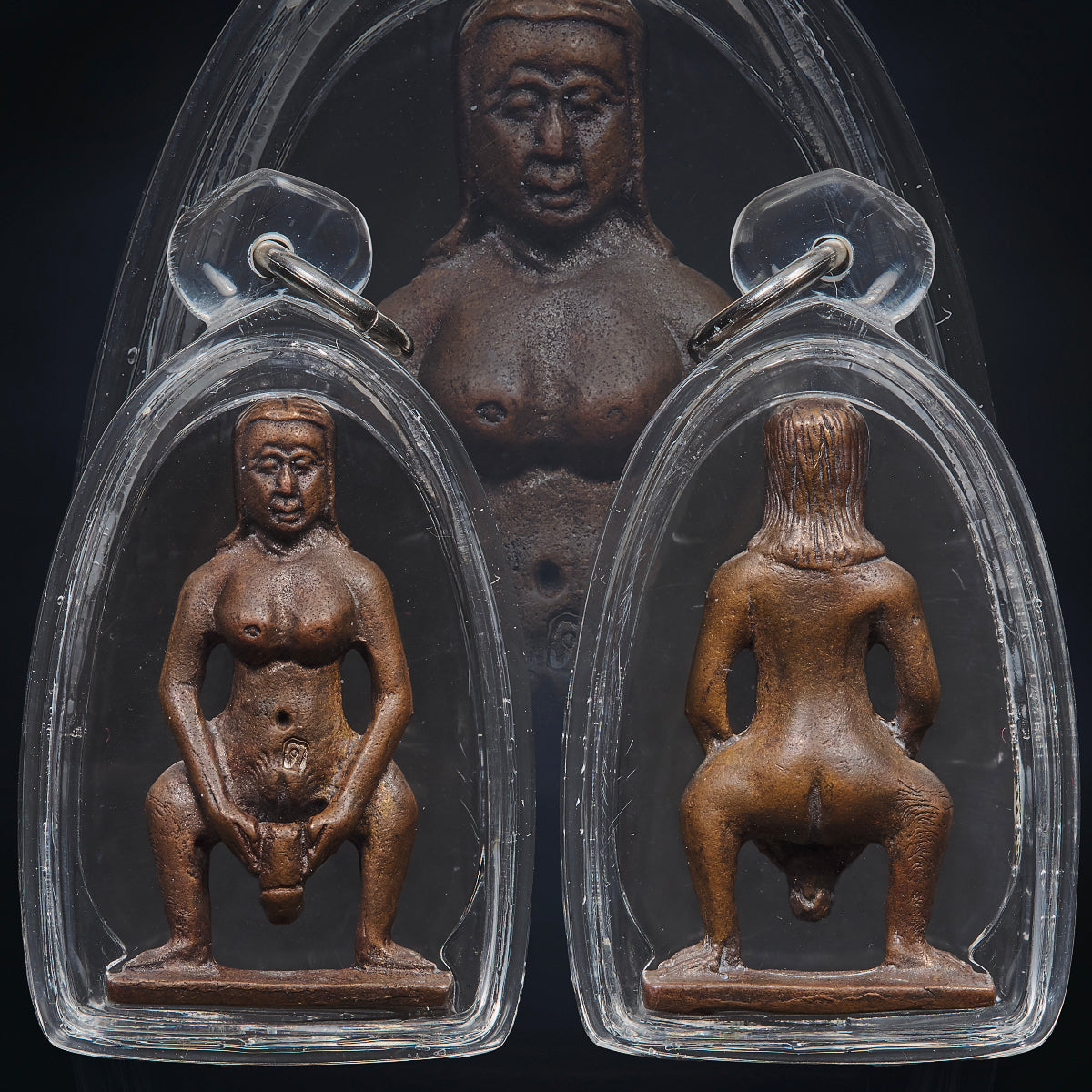
This example is a small three-dimensional Mae Per Roop Lor cast from sacred metal alloy. The front depicts the female figure seated with her legs apart and both hands positioned before the lower body, while the reverse retains the full sculptural treatment of the hair, back and seated posture.
The metal has developed a naturally aged brown and bronze-toned surface, with small casting variations visible across the body. The artifact is presently protected within a clear plastic casing suitable for wearing.
Recommended Pairing
Mae Per may be worn independently when the principal intention is Metta, Saneh, commerce and interpersonal attraction.
For business use, it can be paired with Nang Kwak or another Riak Sap artifact, combining Mae Per's people-drawing symbolism with the traditional wealth-drawing character of Nang Kwak.
For someone wishing to balance attraction with protection, it may instead be paired with a Buddha image or protective Takrut from a compatible Cambodian or Thai lineage.
Personal Notes
The appeal of this piece lies in its old Cambodian character.
The posture is uncompromising and immediately recognisable as Mae Per, while the simple alloy construction allows the figure itself — rather than elaborate decoration — to carry the meaning of the artifact.
More importantly, it represents an interesting surviving connection to LP Weangai and Wat Um Pean, preserving a form of Khmer wicha concerned not with warfare or protection alone, but with the equally old traditions of Metta, Saneh, human attraction and prosperity.
-
SG: Free | Worldwide except USA: $20 Registered | USA: $25 Registered / $100 Courier (SGD)