
OOBThaiAmulets
Lp Up Wat Tong Sai
Lp Up Wat Tong Sai
Couldn't load pickup availability
MS1
Summary
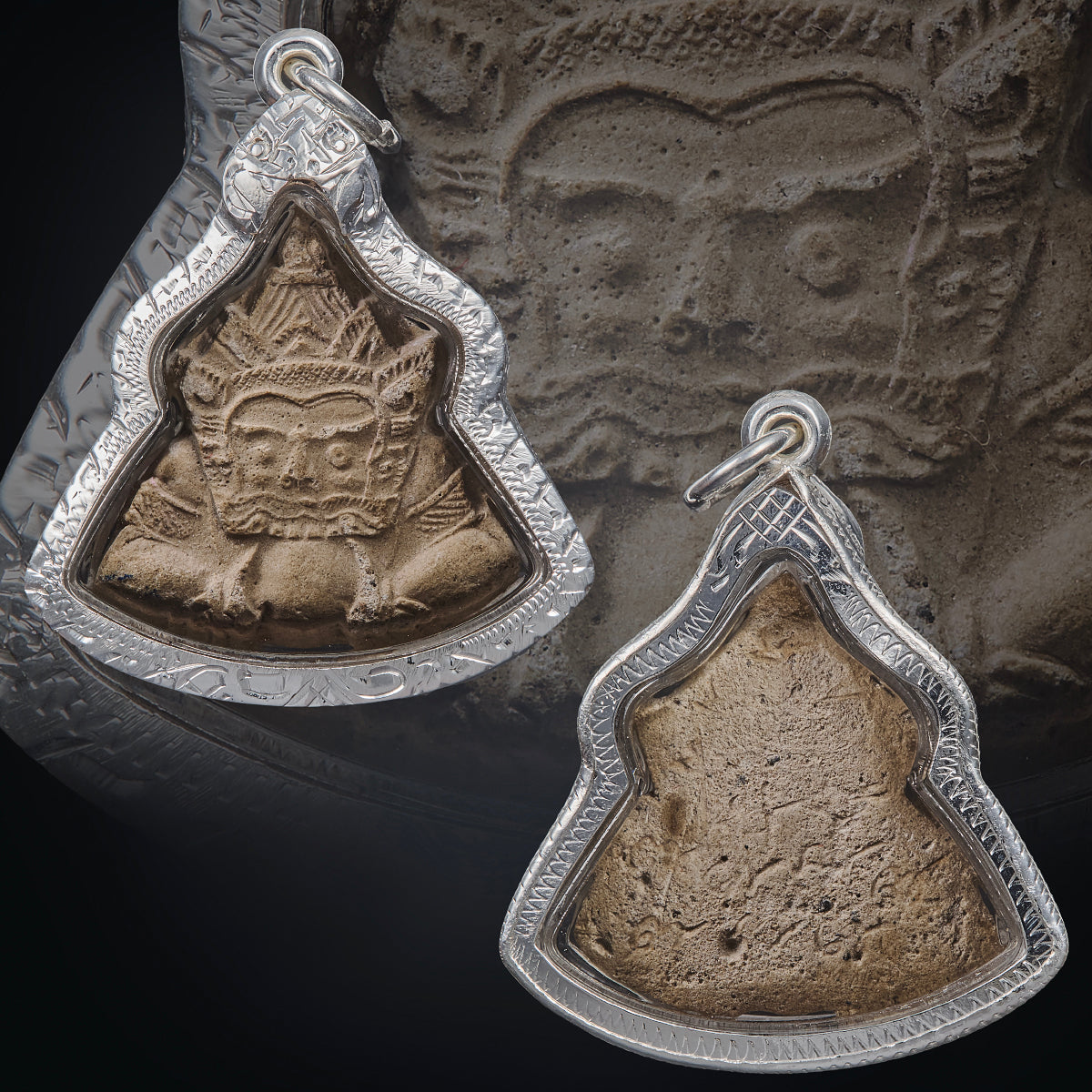
The Rahu amulet from Wat Tong Sai, consecrated in BE 2548 by Luang Phor Up, is a ritual-timed piece anchored in eclipse alignment. It carries the function Rahu is known for within Thai practice—absorbing periods of instability, reversing downward cycles, and establishing control in environments where outcomes are uncertain. The inclusion of hand-inscribed yantra during a lunar eclipse places this piece within a category of timing-based consecrations that are rarely executed with precision.
Historical Background
Luang Phor Up is regarded within the southern lineage as a practitioner who worked with timing, elemental balance, and planetary forces. His approach was methodical, often aligning consecrations with specific celestial events where ritual windows were open for only short durations.
Wat Tong Sai has long been associated with disciplined ritual practice rather than mass output. Items produced under this lineage tend to circulate among practitioners who understand timing-based consecration, especially those dealing with unpredictable environments such as trade, negotiations, and competitive industries.
The Rahu form itself holds a defined role in Thai cosmology. It represents the force that consumes light during eclipses, and within that symbolism lies its practical application—control over cycles, interruption of negative momentum, and the ability to operate within shadow phases where others lose direction.
Origins of the Material
The body of the amulet is formed from compounded sacred powders, prepared through a controlled mixing process. These powders typically include temple residues, prior consecration remains, and mineral-based elements that respond well to inscription and activation.
What defines this piece is not only the base material but the surface treatment. The reverse side carries yantra drawn directly by Luang Phor Up using blessed chalk during the eclipse window. This method allows the inscription to sit on the surface with active intent, instead of being embedded passively during molding.
Because the inscriptions were executed during a lunar eclipse, the material was exposed to a phase where lunar and shadow forces align. Within the tradition, this is when Rahu’s influence is most accessible and responsive.
Ritual
The consecration was conducted personally by Luang Phor Up during a lunar eclipse. This timing is central to the identity of the piece.
During an eclipse, the interaction between light and shadow is temporarily altered. Ritual specialists treat this as a moment where obstruction, reversal, and absorption can be invoked with greater clarity. The yantra inscriptions were written in that exact window, followed by focused incantation to seal the function into the amulet.
There is no extension or repetition of this timing. Once the eclipse window closes, the condition cannot be replicated, which places these pieces in a fixed ritual category tied to that specific celestial event.
Blessings and Effects
The functional scope of Rahu within this piece is direct and situational.
It absorbs periods of misfortune and stabilizes downward trends. This is particularly relevant during phases where deals stall, income fluctuates, or external pressure builds without clear cause.
It redirects obstacles into usable outcomes. In business contexts, this often shows up as delayed deals converting, unexpected openings appearing, or competitors losing momentum at critical moments.
It strengthens positional dominance. Individuals operating in competitive fields—sales, negotiations, leadership roles—use Rahu to maintain control when conditions are unclear or when opposition is active.
It also carries protective qualities against directed negativity, including intention-based harm and unseen interference.
Modern Application
This is a piece suited for individuals who operate in environments where outcomes are not linear. Business owners, traders, and deal-makers often move through cycles where timing determines results more than effort alone.
Wearing Rahu during these phases supports decision-making under pressure. It allows the wearer to stay composed when situations shift quickly, and to act when openings appear without hesitation.
In my own use of Rahu-based pieces, the effect is not loud. It shows up in timing. Situations that could have gone either way tend to resolve cleaner. Delays stop dragging, and interactions that feel blocked begin to move again. It is most noticeable during periods where things are unstable—when others start pulling back, that is when Rahu tends to do its work.
Physical Details
The amulet presents Rahu in its traditional consuming form, compact and balanced in proportion. The surface carries the density typical of powder-based compositions, with a matte finish that reflects age and handling.
The reverse side features hand-inscribed yantra markings applied by Luang Phor Up. The chalk-based inscription retains slight textural variation, indicating direct application rather than post-production stamping.
Size and weight make it suitable for daily wear without requiring adjustment.
Recommended Pairing
This Rahu piece integrates well with items focused on authority and forward movement. Pairing with salika or baramee-based amulets creates a balance between attraction and control, allowing opportunities to surface while maintaining command over outcomes.
For individuals dealing with high-pressure negotiations or unstable income cycles, combining Rahu with a protective lineage piece strengthens both positioning and resilience, ensuring that external factors remain contained while internal direction stays clear.
-
Free Shipping for Singapore| $15 Worldwide | $100 USA All products